

Our 2026 TBR is already looking busy, and Pakistani authors are a big reason why. From messy personal stories to crimes, conspiracies, and complicated cities, these three books cover very different ground — which is exactly what makes them interesting.
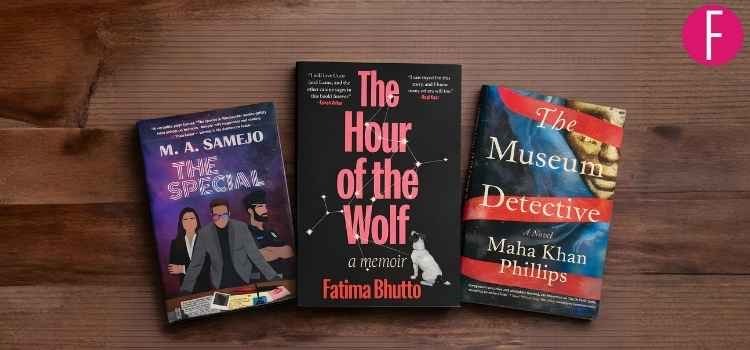
The Hour Of The Wolf – Fatima Bhutto
The Hour of the Wolf is Fatima Bhutto at her most vulnerable and quietly devastating. Moving away from the overtly political register of her earlier work, this memoir turns inward, chronicling a decade-long abusive relationship that began in New York and slowly eroded her sense of self through coercive control and psychological violence. Bhutto’s refusal to name her abuser calling him only “The Man”—keeps the focus firmly on the anatomy of abuse rather than the individual, interrogating why intelligent, self-aware women stay, and how intensity is so often mistaken for love. Interwoven with memories of her father Murtaza Bhutto’s assassination and a life shaped by exile, the book shows how unresolved grief can create a dangerous familiarity with loss, making manipulative dynamics feel almost inevitable.
What ultimately gives the memoir its strange tenderness is its turn toward nature as refuge and reckoning. Set largely during the COVID lockdowns in the English countryside, the “hour of the wolf” becomes a metaphor for the pre-dawn stillness in which Bhutto begins to hear herself again. Her bond with Coco, her Jack Russell terrier, offers a counterpoint to conditional, controlling love—an example of care without transaction. True to Bhutto’s intellectual voice, these personal moments are braided with reflections on wolves, astronomy, art, and literature, using the natural world to question human power, instinct, and survival. The result is a memoir that feels both intimate and expansive, making The Hour of the Wolf a quietly essential read for 2026 TBR lists.
The Museum Detective – Maha Khan Phillips
The Museum Detective by Maha Khan Phillips is a sharp, propulsive thriller that turns the theft of a single artifact into a larger interrogation of history, power, and ownership. Centered on Layla Khan, an expert in the illicit antiquities trade, the novel kicks off with the impossible disappearance of the “Dancing Girl” of Mohenjo-daro from Karachi’s National Museum. What begins as an art crime quickly expands into a multilayered mystery involving ancient Indus Valley secrets, global smuggling networks, and the murky alliances between collectors and corrupt officials. Layla’s investigation is as intellectual as it is physical, demanding fluency in archaeology, history, and human deceit, while forcing her to confront her own uneasy inheritance within Pakistan’s cultural world.
What sets the novel apart is how seamlessly Phillips blends genre with critique. Moving between Karachi, Mohenjo-daro, and London’s elite auction houses, the book exposes the violence embedded in “civilized” collecting and the West’s long-standing entitlement to South Asian history. Layla emerges as a compelling modern detective—part scholar, part skeptic—who deciphers puzzles not just to recover stolen art, but to reclaim meaning from a past repeatedly stripped and sold. By transforming the real-life Dancing Girl into both a narrative engine and a symbolic fault line, The Museum Detective delivers a high-stakes whodunit that is as politically charged as it is compulsively readable, making it a standout addition to 2026 TBR lists.
The Special – Muhammad Ali Samejo
The Special by Muhammad Ali Samejo plunges headfirst into the moral underbelly of Karachi, delivering a neo-noir thriller that is as psychologically abrasive as it is gripping. At its center is Dr. Zurain Shah, a once-celebrated criminology professor whose carefully curated life collapses after a scandal with a student leads to public disgrace and prison. From behind bars, Zurain is pulled back into the world that condemned him when Inspector Akbar Khan—the officer who arrested him—recruits him for a shadowy task force investigating “crimes of a special nature.” The resulting partnership has an unmistakable Sherlock-and-Moriarty tension: two men bound by intellect and mistrust, forced into uneasy collaboration by the very rot they are trying to contain.
What makes The Special unsettling—and effective—is its refusal to look away. Samejo takes readers into cases of sexual violence, domestic abuse, underground flesh rings, and cult-like criminal networks, exposing how easily brutality hides behind middle-class normalcy. The novel’s power lies in its moral ambiguity: Zurain’s cynical understanding of human depravity clashes constantly with Akbar’s rigid sense of right and wrong, raising uncomfortable questions about justice, complicity, and redemption. Grounded in procedural authenticity and steeped in Karachi’s chaos, The Special uses crime fiction as a mirror, forcing readers to confront the disturbing idea that the most frightening monsters are not outsiders—but products of the society itself.
Which one are you picking? Let us know!

