

Television dramas often spark conversations about relationships, family dynamics or social expectations. Every now and then, however, a storyline goes beyond entertainment and forces us to confront a reality that exists outside our living rooms. The latest episode of Aik Mohabbat Aur did exactly that.
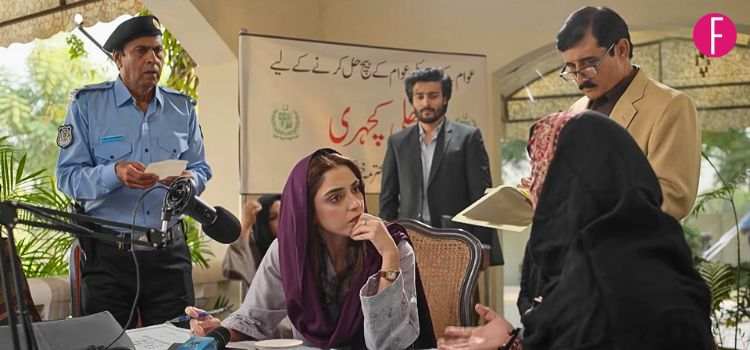
A nine-year-old girl is sent away to work in another city. Her mother cannot contact her. She has no way of knowing whether her daughter is safe, healthy, or even happy. Watching those scenes, it is easy to think of them as fiction. But for thousands of families across Pakistan, this is not a dramatic twist. It is everyday life.
The episode became even more impactful because of Khushbakht Naz’s observation that has since resonated with many viewers: “Agar beti paida hui tou kisi ke ghar kaam karne bhej denge, aur agar beta hua tou kisi workshop mein laga denge.” It is an uncomfortable statement because it reflects a reality we have quietly accepted. Girls are expected to become domestic workers, while boys are pushed into garages, factories, workshops and markets before they are even old enough to understand what childhood is supposed to feel like.
The conversation around child labour in Pakistan is not new. What is new is the scale of the problem that recent data has finally revealed.
The Numbers Are Far Worse Than We Imagined
For close to 30 years, Pakistan did not have any current statistics on child labor within the country. However, in 2026, the National Commission for Human Rights (NCHR), with the help of UNICEF and the Pakistan Bureau of Statistics, carried out the first Child Labour Survey after 30 years of no such statistics.
The results were shocking!
According to this survey, there are about 8.6 million children from the age of 5 to 17 years engaged in child labour across Pakistan. Of all these, 6.6 million children are engaged in hazardous employment that put them into danger due to exposure to dangerous machines, chemicals, heavy physical work, heat/cold weather conditions, and other factors which adversely affect their health and wellbeing. It is perhaps much more alarming that most of these children are supposed to be in schools, but instead work for 8 to 12 hours a day earning just a small portion of the family budget.
This study also emphasizes the disparity among provinces. As the population of Punjab is larger, the number of children working in child labor is also much bigger here, while agriculture industry employs the biggest number of child laborers in the whole country. The millions of children are engaged in agriculture, cattle breeding, cotton picking/harvesting starting from the early morning till late evening.
Moreover, the report states that Pakistan loses millions of children’s future and economy productivity, because child labour deprives children from education and therefore these children do not have a chance to get a decent job when they grow up.
The Invisible Workforce Nobody Counts
When one thinks of child labourers, one usually pictures child labourers selling flowers at traffic signals and cleaning windscreens. This is the category of child labourers that are visible to others. Experts are concerned about those who are invisible to other people.
Child labourers employed within the four walls of a house do not show up in public. They live in houses where the labour inspectors cannot enter and where the neighbors are reluctant to inquire about their wellbeing. Most of them are young girls aged between 8 to 14 years who cook, clean, wash clothes, iron, look after babies and work within the house from dawn to dusk.
Unlike those in the factory, there are no co-workers who can see how they are treated. Unlike students, there are no teachers who see any injuries inflicted on them. Unlike children in their families, there is nobody watching out for their welfare. International Labour Organization (ILO) research has repeatedly identified domestic work as one of the most hidden and vulnerable forms of child labour because children are isolated from society, making physical abuse, emotional abuse and exploitation much harder to detect.
This is exactly why the storyline in Aik Mohabbat Aur feels so real. If a child is taken away hundreds of miles to work in another someone else’s home, then he/she becomes invisible to all the support structures in place for most children.
We Only Remember Child Domestic Workers When They Become Headlines
Perhaps the cruelest irony of child domestic labour is that most of these children remain invisible until something horrific happens.
In 2018, 10-year-old Tayyaba, who was employed by a sitting judge in Islamabad, was in the headlines due to photographs showing severe burn marks and injuries caused allegedly because of minor mistakes made at home. This event shook Pakistan, and questions regarding employing children as domestic workers resurfaced once more.
Following that in 2020 was Zahra Shah, a 12-year-old girl who died allegedly after she had been abused and tortured by her employers for allegedly letting go of expensive pet parrots out of their cages. This resulted in calls for action against the mistreatment of child domestic workers.
Most recently in 2025, another child domestic worker named Iqra aged 13, employed as a domestic worker in Rawalpindi, died due to injuries allegedly sustained from physical abuse inflicted upon her by her employers. Again, Pakistan witnessed disturbing footage circulating on television and social media channels. Once again, there were promises of accountability. And once again, the conversation slowly disappeared.
These are only the cases that reached national headlines.
Pakistan Needs More Dramas Like Aik Mohabbat Aur
In Pakistan, TV dramas have never been just an entertainer but also the most significant cultural influence of the nation. People do not simply see the characters on screen; they connect emotionally with them. They appreciate their determination, copy their style, and learn their lingo. The influence is such that unknowingly, people accept and imbibe the ideology they stand for. It could be changing fashion trends, redefining family structures, or questioning social conventions that have existed since time immemorial. Whatever the case may be, Pakistani dramas have shown their potential for influencing public opinion more than once.
This is precisely the reason why there should be more dramas like Aik Mohabbat Aur in Pakistan. Rather than relegating the topic of child labour to mere backdrop and trivia, the drama puts the topic where it belongs – in the forefront of the narrative that people are interested in. Once audiences become emotionally invested in a character, they don’t just follow the plot; they begin to empathise with the character’s struggles and question the realities being portrayed. A good story has the ability to give life to facts, generate debate at dinner tables and challenge behavior that has been normalized by generations. Although a drama alone cannot solve the issue of child labour, it can do much more than that – it can get millions of people to stop viewing it as a normal activity.
Have you watched the latest episode of Aik Mohabbat Aur? Share your thoughts with us in the comments below!
The data and statistics used in this article have been sourced from: Pakistan Today, ILO, NCHR, and UNICEF.
Aik Mohabbat Aur is written by Faiza Iftikhar and directed by Farooq Rind. It is produced by Tehreem Chaudhary and presented by Multiverse Entertainment. It stars Ahad Raza Mir, Maya Ali, Samiya Mumtaz, YBQ, Noorul Hasan, Munazza Arif, Saqib Sameer, Omair Rana, Hajra Yamin, Sachal Afzal , Fajar Sheikh, Qudsia Ali, Shamyl Khan, Abbas Ashraf, Rehan sheikh, Dodi Khan and more.

