


Macklemore walked onto one of the biggest stages of his career and said two words he knew would make people uncomfortable: “Free Palestine.” Now, those same two words have cost him his place on Ed Sheeran’s US stadium tour. The rapper has been removed from the remaining dates of Sheeran’s Loop Tour after several venues reportedly said they would not allow concerts to go ahead with Macklemore on the lineup. The promoter has confirmed his removal, while Macklemore says pressure from New England Patriots owner Robert Kraft and other stadium owners played a major role in the decision.
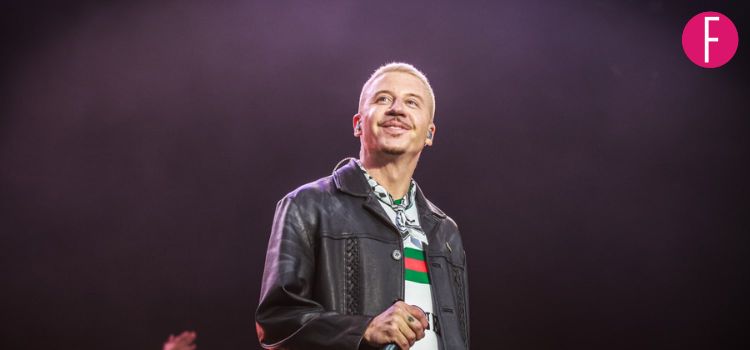
Image Credits: NBC
And honestly, the most interesting part of this story is not that a celebrity made a political statement. Celebrities have been doing that forever. The uncomfortable part is what happens when the political statement is about Palestine.
Macklemore has been outspoken about Palestinian rights since 2023. He was among the artists who signed the Artists4Ceasefire letter calling for a permanent ceasefire and humanitarian aid for civilians in Gaza, and his 2024 protest song “Hind’s Hall” became one of his most direct pieces of activism. So when he joined Sheeran’s tour this month, he apparently did not see the stadium stage as a place where he had to leave his politics at the door.
At MetLife Stadium in New Jersey on September 4, Macklemore performed “Hind’s Hall” while footage of destruction in Gaza played behind him. He told the crowd that part of the reason he wanted to be on the tour was to stand in stadiums and say “Free Palestine,” so that people in Gaza and the occupied West Bank would know they had not been forgotten. He returned the following night and made the distinction that criticism of Israel, apartheid or genocide was not criticism of Jewish people, saying his message was ultimately about peace, dignity and equality.
That was enough to trigger backlash.
Macklemore Lost The Stage. Palestine Did Not Become Less Real.
The Israeli American Council called for Macklemore to be removed from the tour, while StopAntisemitism accused him of turning a mainstream concert into a political platform. Singer Pink also amplified criticism of his performance before later explaining that she was not objecting to the words “Free Palestine,” but to what she described as frightening imagery and the way Jewish concerns were being addressed.
There is obviously room to debate how political a concert should be. But somewhere along the way, the conversation has become strangely selective.
Artists can speak about climate change. They can campaign against racism. They can comment on elections, immigration, gun violence and every other issue under the sun. But when an artist talks about Palestinian suffering, suddenly there is a conversation about whether they should have used the stage at all. Why?
Saying that Palestinians deserve freedom, safety and dignity should not require a celebrity to first pass a test proving that they are sufficiently neutral. And Macklemore clearly does not believe neutrality is an option here. In his statement following his removal, he said he was not the victim, nor was Ed Sheeran. He pointed instead to Palestinians living through what he described as unimaginable violence. He also said that he had been speaking about Palestine for years and that losing his place on the tour did not change his position.
That matters because, for once, the celebrity in the story is not asking us to feel sorry for him. He is saying: if speaking about Palestinians costs me a stage, then so be it.
Robert Kraft, Ed Sheeran And The Price Of “Staying Apolitical”
The exact chain of events behind Macklemore’s removal has been disputed in part, so this is where the distinction matters.
Messina Touring Group, the promoter for Sheeran’s US tour, said multiple venues had informed them they would not allow a concert to take place with Macklemore on the lineup. The promoter said keeping him could have resulted in cancellations affecting hundreds of thousands of fans, and after discussions with stakeholders, Macklemore was removed from the remaining support dates.
Macklemore, however, gave a more specific account. He claimed Sheeran told him that Robert Kraft, whose company owns Gillette Stadium, had objected to him performing there and had rallied other stadium owners to do the same. According to Macklemore, Sheeran was effectively faced with a choice: keep Macklemore or risk losing access to multiple venues. Kraft has confirmed that he opposed Macklemore’s recent rhetoric and imagery, saying he believed it had crossed a line, while also saying his goal was peace and an end to suffering and hate.
Whatever happened behind closed doors, the result is the same: Macklemore is gone from the tour because of a political position he refused to hide.
And that is where Ed Sheeran’s position becomes interesting too. Macklemore described Sheeran as a friend of 13 years and said the two had difficult conversations over the issue. According to Macklemore, Sheeran wanted to remain publicly apolitical and told him that the words “Free Palestine” and the Palestinian flag had been hurtful to people he had spoken to.
But there is something worth questioning about the idea of being “apolitical” in a situation like this. Sometimes neutrality sounds peaceful. Sometimes it is simply a refusal to take a position while one side is suffering. You do not have to be a politician to have a conscience.
Macklemore Is Not The Only One Choosing Palestine Over Silence
The reason Macklemore’s story matters is because he is part of a much larger group of celebrities who have decided that their platforms are too powerful to remain completely silent about Gaza.
Javier Bardem has repeatedly spoken publicly about Palestine and Gaza. At the 2026 Oscars, he used the stage to call for an end to war and a free Palestine. More recently, while promoting his new film at the Venice Film Festival, Bardem again defended the right of artists to speak about politics, acknowledging that people in his position have an amplified platform.
Mark Ruffalo has also been vocal. He was among the high-profile names involved with Artists4Ceasefire, a collective calling for a permanent ceasefire, humanitarian aid and the protection of civilians. The organisation’s signatories include dozens of major actors and musicians, showing that Macklemore is hardly some isolated celebrity suddenly deciding to get political.
And then there is Susan Sarandon, who recently spoke about how her outspoken political views and advocacy for Palestinians have affected her career. At the 2026 Venice Film Festival, she said she had lost film opportunities and attributed part of that professional fallout to her political positions.
That is the part people should be paying attention to. Because the question is no longer simply “Should celebrities talk about Palestine?” They already are. The question is why does speaking about Palestine so often come with a professional price?
Maybe The Problem Is Not That Macklemore Spoke — Maybe It’s That He Refused To Whisper
There is something almost ironic about what happened to Macklemore. He was invited onto a stadium tour where tens of thousands of people would hear him perform. He used that enormous platform to talk about people who have very little ability to control the world’s attention on their own. Then the platform disappeared. But the message did not.
Macklemore has lost eight remaining opening slots on Sheeran’s US tour. Sheeran’s tour will continue. The stadiums will continue filling up. Other opening acts will perform. The lights will come on and the music will go on. Meanwhile, Palestinians do not get to simply switch off the news. They are still living with the consequences and realities of an ongoing war that has killed tens of thousands of Palestinians, displaced families and created a humanitarian catastrophe in Gaza. The scale of that suffering is exactly why Macklemore and other artists have argued that silence is not an acceptable response. And perhaps that is why “Free Palestine” continues to make powerful institutions so uncomfortable.
Because it is not just a slogan.
It is a demand for freedom. For dignity. For an end to occupation and oppression. For Palestinians to be treated as human beings whose lives are worth the same attention, outrage and protection as anyone else’s.
Macklemore’s career will survive losing an opening slot. Javier Bardem will still have another film. Mark Ruffalo will still have another stage. Susan Sarandon will still have another role. But Palestinians do not have the luxury of waiting until the political conversation becomes convenient. So perhaps the bigger story here is not that Macklemore was removed from Ed Sheeran’s tour for saying “Free Palestine.”
It is that, in 2026, those words can still be enough to make a global concert stage suddenly feel like the wrong place for them. And maybe that is precisely why people need to keep saying them.
Sources: BBC, Tribune, The Guardian, NBC, Rolling Stone