Safia & Fajr In Aakhir Kab Tak – Why Communication Can Make Or Break Relationships … And Lives!
Safia is the mother of two main characters of the drama Aakhir kab Tak – Fajar and Noor. Her role is played by Javeria Abbasi. She has an abusive husband Ahitisham and equally abusive in-laws. Her character is central to how her daughters have led their lives so far. Yet, as a woman, she is given little or no authority over their upbringing.

Safia’s relationship in her household can be summarized in a word: belittlement
Belittle is a behavior that literally makes others feel small or unimportant. Not only Safia’s husband makes her feel this way but also her mother-in-law belittles her on every little thing. Everyone trivializes her around the house and Safia, in return, treats her daughters the same way.
Safia and Ahitisham’s relationship lacks communication
This is the major drawback of the relationship. Understanding your partner is necessary to communicate with them. Ahitisham always listens to his toxic mother and believes her. He never thinks of clarifying with Safia on those issues. He withholds everything till the point he explodes and starts taking out his frustration by hitting her.
Fajar and Saim’s relationship thankfully takes a different route than Safia and Ahitisham’s. Previously, Saim also used to listen to other people. However, now he stops doing so and starts to communicate with Fajr directly rather than believing blindly in a toxic mother.
Lesson learnt: Lack of communication between partners makes them feel incompatible with each other.
So far it can be seen that Safia’s and Ahitisham’s relationship gets better when Ahitisham is paralysed and Safia starts communicating her thoughts and feelings. She is now able to address the problem and expresses her feelings as well. This is why her relationship is getting better, just like Fajr’s after Saim starts communicating. Unfortunately, it is a bit too late for Safia, so if you feel you are following that route, do heed the alarm signals in the drama, they mirror harsh realities that we or someone close to us might be facing.

Fajr & Saim’s relationship needed neutral intervention and Inspector Nasir walked in just at the right moment to help them reconnect. Had Safia and Eihtisham had an Inspector Nasir in their lives, things might have been different.
It’s not just about your relationship – Safia’s and her husband’s relationship has a huge negative impact on their daughters’ lives
Fajar doesn’t feel comfortable speaking before anyone and likely suffers from social anxiety. She is portrayed as a weak, timid girl who has trouble speaking. Her stuttering is psychologically & emotionally triggered and lessens when she is given a platform to voice her thoughts. It is Safia who conditioned her in this way and taught her to stay quiet and never let out a word because no matter what happens it’s always her fault – a fallout from Safia’s own emotional baggage.

Much of children’s lives are shaped by their parents and their relationships. Parents’ relationships with each other not only have a huge impact on children’s well-being but also on their capability, academic success, and mental health. The drama portrays that not only Safia but also her daughters, Fajr particularly, do not have the mental stability to decide and live a successful social life. In addition to this, Fajr and Noor are shown to underperform in their academic life as well.
Aakhir Kab Tak depicts Safia as an oppressed and illiterate woman who has zero confidence and self-esteem
Safia is emotionally tortured by her mother-in-law. Her husband also emotionally and physically abuses her. She, however, never raises her voice against any of this ill-treatment. When her daughter tries to do something against the abuse, she stops her right away because of the fear of her in-laws and husband.
In a scene, Safia’s mother-in-law falsely accuses her that she goes out dressed up and neglects her household responsibilities. The mother-in-law tells Safia’s husband to take care of her waywardness. Later that evening, he gets mad at her and says to her, “tu chahti hai tujhey wase hi samjhaon jesay pehlay samjhata tha”. She gets scared and shakes her head. But he starts beating her.
Meanwhile, their daughter, Fajr who was standing outside their room is terrorized as she listens to the whole ordeal.
Safia never listens to her daughter’s complaints or problems because she wants to stay in denial, lacking the courage or self esteem to stand up for them
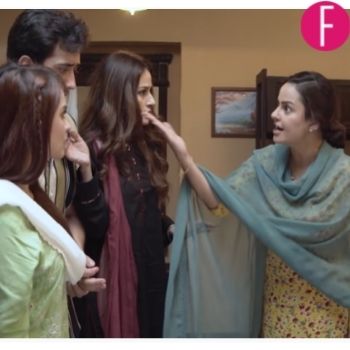
Her entire focus revolves around her in-laws. When Fajr tells her mother that her cousin Basaam harasses her, Safia, at first doesn’t believe her daughter and calls it a misunderstanding. But when Fajar insists on this, Safia tells her not to tell this to anyone. She says, “larkiyan aesi baatein nahi karti, buri baat hoti hai, ghar mein sab ko pata chal jayega toh kya izzat reh jayegi meri aur tumhari aur tumhare baap ko pata chal gaya toh kya hashar kare ga mera aur tumhara pata hai nah.” Instead of taking a stand for Fajr, she begins to think of marrying her off so that there’ll be no problem in Noor’s and Bassam’s life.
This reaction is quite common in our society. In fact, a majority of harassment happens within the household itself and by a close family member – Aakhir Kab Tak has portrayed the issue aptly.
Unfortunately, women like Safia exist in our society who stay quiet, don’t take a stand for their children, and ignore them. They live in abusive and toxic relationships just because they’re poor, uneducated, or didn’t give birth to a male child.
When we see women like Safia and Fajr who lack communication in their life and suppress their emotions, we should talk to them. Let them know they matter, their emotions matter and they should stand up for them and speak for their rights. Communicate with their husband or people around them because their relationship needs their input.
Imagine if Safia was a strong woman who knows about her rights, knows when and what to speak, knows how to take a stand for her daughters, and how to protect them. Neither she nor her daughters would have suffered any of this. Now, the storyline of the drama is moving forward where we can see a strong Safia who is making promises to herself that she will not tolerate any kind of physical and emotional abuse.
Tell us what you think of Safia’s journey in Aakhir Kab Tak and do you know of someone who needs your help?
*Please Note: The article has been written by Aisha Akhtar, a student of Psychology at Bahria University, as part of a collaborative effort between FUCHSIA Magazine & Project Yaqeen.