

While we stood helpless at the time, watching the story unfold on our television screens, the plight of millions of people not in our hands, but in the hands of the climate disaster that seemed to have unleashed its fury full throttle onto unaware, innocent souls, what we cannot say anymore is, that we are helpless.
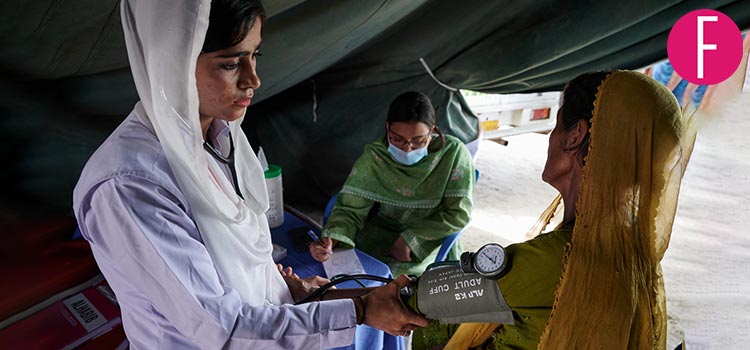
Image credits: UN Pakistan
Helpless is a word we could have used when the floods wreaked havoc on farmland, destroying crops that were ready to be harvested, homes that serves as shelters, security and comfort for millions and schools, clinics, hospitals that were brought down in a matter of minutes.
Helpless is not a word we can use now, at present, when millions need our help.
It is fair to say that although we lost many precious lives in the floods, the lives we lose now, in the aftermath of the floods, is not because of us being ‘helpless’. We can help, we can choose to remember and not forget, we can choose to shed light in any capacity we are able to, through funding, through visiting and carrying stories to the world, through donating to programs that have people on the ground, helping, through creating awareness and through making an effort to find out how our expertise can be best put to use.
It is easy for a medical expert, a doctor, a tent maker, a social worker, a media person to identify ways they can help. It is perhaps, not that easy for a teacher, an IT specialist or a restaurant owner to find ways. But they have found ways too. Now, more of them need to help.
It is critical that we do not forget. That we do not put the floods behind us and move on to the next big thing. The floods are very much here still. Acres and acres of flooded farmland will remain underwater for several months, breeding disease, and yes, death. These people who are impacted will not only have no mean to a livelihood, but also scramble for medical supplies, schooling, access to clean water, nutrition and … a chance at life.
In an effort to keep their stories alive and remind us that we have still a whole lot more to do, we feature 10 tweets from the UN mission in Pakistan to give you a bird’s eye view of the situation and how you can help.
Get the latest of flood relief efforts and the onsite situation in Pakistan
1. Large parts of Sindh & Balochistan will remain underwater for several months
Latest on #PakistanFloods More than 2 million damaged & destroyed houses 7.9 million people displaced 1.1 million livestock lost Large parts of Sindh and eastern Balochistan will likely remain underwater for several months to come. More updates https://bit.ly/3fmtdp2
2. An estimated 128,000 women impacted by #PakistanFloods will give birth in the next year
A midwife examines a pregnant woman @UNFPA supported mobile medical camp by @pnfwh_org in a campsite in Sujawal #Sindh. An estimated 128,000 women impacted by #PakistanFloods will give birth in the next year. They need health centers, trained midwives & supplies for a #safebirth If you’re a trained midwife, or medical/health professional, volunteer your services for the 128.000 women who need them.
3. First tier relief means providing safe drinking water, nutrition, learning & therapy
There are 4 ways UNICEF is reacting on a rapid response basis to the need of the hour:
- Safe drinking water supplies & hygiene
- Nutrition
- Access to Learning Facilities for children
- Providing Psychosocial support
However, the response falls short of the needs. So, if you’re able to provide funding, can help with therapy, teaching, or provide safe drinking water or medical supplies, maybe you can reach to provide necessary assistance.
4. Medicines are in short supply
How the WHO is helping. The needs are three times more than what we can provide, says one medical professional … Malaria, Typhoid, sickness and disease are spreading.
3 things @WHO is doing for the flood response in #Pakistan:
1. supporting health services for the sick & injured
2. delivering medicines & medical supplies
3. assessing health needs & risk of outbreaks
Psychosocial services are urgently required for those who have to deal with the aftermath of losing a loved one in the floods and also, caring for those left behind.
5. Dealing with Loss & also tending To Those Who are left behind requires mental & emotional strength
Baharah, from #Sindh lost one of her two sons when a wall fell on him during the #Pakistanfloods. Women & girls bear the brunt of the devastating impacts of climate change.
@UNFPA is committed to supporting the needs of girls & women as the country responds to this catastrophe
6. Surviving childbirth is just the first step
Sita’s story is one of the lucky ones where she survived and gave birth in incredibly challenging conditions. She now has to provide shelter for herself and her new-born, safe from disease and malnutrition
I had been hurting for days, but it became intolerable & I started to bleed so we tried to get the hospital,” says Sita. She delivered en route to a baby girl. Sita is one of 650,000 #pregnantwomen in the #floods who need access to #reproductivehealth services.
7. 9 months pregnant in flood-hit areas with no access to primary healthcare
Listen to Fehmida Bibi as she tells us what it’s like being 9 months pregnant in the flood.
Pregnant women affected by the #floods in #Pakistan need our support.
@UNFPA is urgently providing hospital tents, reproductive health kits and life-saving supplies to affected areas so that vital health services can continue.
If you have access to tents or those who supply them, tarpaulin, can donate essential medical supplies, this is the need of the hour.
8. Learning is challenging as schools are destroyed and those left over are being used as shelter homes
Many schools have been destroyed in the floods like this one. And the buildings that are in better condition are being used as shelters for the homeless. hence, providing learning facilities to children is a challenge that relief efforts face in Pakistan
This is what remains of a school in Sindh Province, #Pakistan. Floods have destroyed homes, devastated communities and disrupted learning for 3.5 million children. During crises, we must remember that #EducationCannotWait
9. Food in short supply as crop ready to be harvested destroyed by the floods
This family will need more food and sustenance in a month’s time,
With their house badly damaged by floods, Pathan & his family now live & sleep in the open in their village in Khairpur. WFP has provided them with one-month food supply but they – along with millions of people – need continued support in food, shelter, health & livelihoods.
10. Women & Girls need urgent protection from child marriages, trafficking and gender discrimination
Women and girls also face rising rates of gender-based violence. Displacement settings and distribution points are rife with the risk of sexual harassment, abuse and exploitation, especially for girls left alone while the adults go out in search of work. Makeshift living quarters are often cramped and badly lit, and men and women often have to share unsanitary bathrooms located far from their tents – increasing the potential exposure to violence. Gender discrimination places young women and girls in further danger of child marriage or trafficking. UNFPA is supporting safe spaces for women and girls to offer a measure of protection, but more efforts are needed.
Women & girls need urgent health & protection services amid the #Pakistanfloods2022: “I walked for about 35 km while in labor because the floods had damaged the road between my village & the hospital,” said Bakhtnama who gave birth to twins. Read more on
The devastation caused by floods in Pakistan is more widespread and overwhelming than relief agencies had anticipated. The floods themselves and subsequent loss of lives might be a result of climate change, but the lives that might be lost now, due to inadequate funding, rescue efforts or timely access to healthcare might be on us.
The collection of tweets above is but a means to creating awareness of the widescale impact that we must deal with. There are many other ways we can volunteer our time and effort to help. Some ideas to explore: if you’re an IT specialist, consider offering your services to organizations that are involved in Flood Relief. Reach out on social media platforms and find how where you can be the best fit and impact relief efforts. Try Code For Pakistan as one digital portal that might benefit from your work. If you’re a teacher, or health professional, contact the UN mission in Pakistan for providing your services. Similarly, medicine manufacturers, tent suppliers, textile, food, and therapists can also engage in recovery work where itis needed.
At the moment, Pakistan needs you in any capacity that you have to offer. So go ahead and raise awareness that relief efforts must continue for as long as flood impacted people need them.

