

Deemak attempts to blend supernatural horror with social commentary, delivering a technically polished film that leaves viewers both intrigued and conflicted.
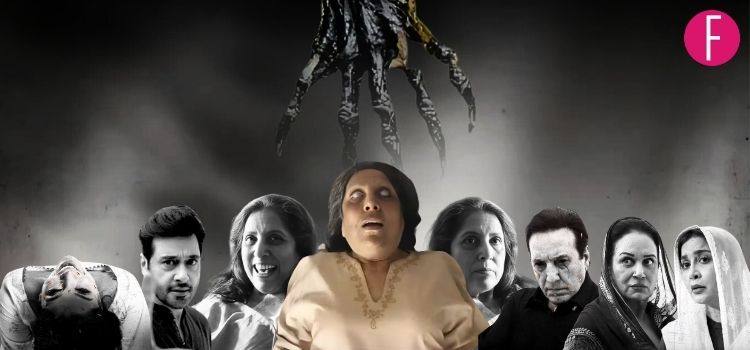
This story follows a family of jinns who, after an earthquake, move into a house occupied by Faraz played by Faysal Qureshi, and his family. The transformation of this family’s life into a state of perpetual turmoil is what sustains the viewer’s interest throughout the film.
It all begins with a spine-chilling and dreadful scene that will instantly capture your attention, make you curious about the upcoming scenes, and set the mood and expectations for an intriguing narrative.
Another win for Deemak is the execution of the script that keeps you engaged with the story, keeping you wondering what happens next and who or what is really behind all the strange happenings? Most importantly, you will find yourself fact-sorting mentally, almost as if you’re playing detective and trying to solve the mystery.
Deemak attempts not to keep the movie just horror-based by portraying the mental health issues, toxic relationships, and double standards within our society which plague many families. It addresses generational trauma and how one fights it; sometimes you fail completely, and sometimes you win — as they show in the case of Faraz who, after witnessing his mother’s tragic and abusive life at his father’s hands, fails to take a stand for his own wife. The sympathy for his mother overcomes his sense of justice towards his own wife.
What stands out in the entire film are the performances. It is a pleasure to watch Samina Peerzada (as Faraz’s mother, Kulsoom) on the big screen after so long, and we are reminded once more of her immense talent. There is a scene where the jinn possesses Sonya’s character, Hiba, and the entire cinema resounded with thunderous applause for her. That was the measure of her performance.
Faysal Qureshi is also great, and of course, we would not expect anything less from him. His portrayal of Faraz’s conflicts and traumas is subtle yet well-established — these inner battles prevent him from taking decisive action beyond a certain point. For example, he buys identically printeded outfits for both his mother and wife as a gift.
The film hits the spot in cinematography, scene execution, and lighting. The movie is technically impressive and well-executed. The scenes and their execution are such that you feel entirely immersed in the experience and do not feel the need to better it. However, the VFX could have been improved a notch. The jinns do not appear to be very scary, but in fact, seem quite artificial.
Appreciative shout out for the artists’ makeovers, especially Samina Peerzada’s character. It is brilliant.
However, what stands out about the movie also ends up being the reason many would feel frustrated or wonder about the purpose of the story. But the good news is that despite all the negatives, the movie is watchable given the genre, and you will not walk out wondering why you wasted the money.
As an individual, I am not particularly fond of narratives that lack resolution or context. I prefer stories that are thoughtfully developed with a clear objective and a well-rounded conclusion. Deemak falls into that category for me unfortunately.
A family of jinns, displaced by an earthquake, move into a house already occupied by Faraz and his family. Why they picked that specific house is vaguely explained and attributed to the negativity thriving in that house for decades. The jinns eventually end up winning and make the family leave that house.
That is why I genuinely believe and have repetitively pushed the need for script doctoring — for consulting someone outside of the production team to cover any weak points or loopholes. The first scene, despite being really gripping and scary, has no connection with the rest of the story.
The film is also subject to predictability and frequently ‘seen-before’ scenes. For instance, the scene where the son awakes in the middle of the night and looks under the bed, and subsequently, his bed starts moving – the minute the scene starts, you anticipate that the bed will move, and then of course, you are not disappointed at all. Similarly, as soon as you had mentally predicted it, a jinn appears and tries to scare the little boy. When Sonya’s character Hiba offers her prayers alone in the house, you know the jinn will appear. More brainstorming and creativity might have generated original and creative ideas.
The emphasis is also on forcibly establishing scenes as scary or typecasting the film into the horror genre, hence one feels the story fails to progress forward, but merely plays one scene after the other — till eventually the family finds out what is really happening. A water-tight storyline would have saved the film from this predictable circle.
Mixing two themes together is tricky to sustain throughout the storyline. The movie struggles to balance generational trauma with its horror theme. Throughout the screenplay, the narrative suggests that past events may be causing the family’s current suffering, repeatedly drawing viewers back to the opening scene. You also wonder: what if the girl’s mother or the mother-in-law herself is performing black magic and something went wrong? You might consider multiple possibilities, ultimately determining that jinns are drawn to the house for certain reasons, and that the negative energy either attracts or sustains them. At that moment, you literally feel like the story caved into the oft-used idiomatic expression “making a mountain out of a molehill” in its script delivery. The film never established any connection between the generational trauma and the jinns, other than the negativity of the house and the characters.
Faraz ignores his children and wife, possibly due to the jinns influencing him; however, this should have been clarified in the film. Because it seems strange that a husband pays absolutely no attention to what his wife is saying, given she has no record of being delusional.
While the initial scene is gripping, it is confusing. Why did the jinns also leave that place? Was that because of the people reading Quranic surats? But then why were the people leaving also punished through an earthquake? And then you keep waiting — what is the connection or relevance of this scene to the story? Is Kulsoom related to the person who killed the young girl possessed by jinns, or involved in any way? It was very confusing to try and figure out the motivations that drove the characters, only because the script often provided none. Up until the concluding moments, there was an anticipation for the connection or backstory to be clarified. You are simply narrated a situation where some jinns were displaced and sought a new home.
More research would have also established the religious perspective or information about the presence of jinns, which would have helped develop a more substantial storyline.
I was disappointed to see the jinns winning and the family leaving the house ultimately. At the end of such an intense watch, you expect a better or a happy conclusion. Or alternately, even if the entire family would have been killed by jinns, this would also have delivered a different story, but the family leaving the house is just a luke-warm, unsatisfactory ending.
Although the film has made significant advancements and improvements in its creative journey, there are aspects that could have been enhanced or avoided altogether. If we genuinely want the film industry to grow and thrive, we must not get comfortable with lazy writing and stay rooted in present production standards. One has to push the envelope for more and better things to come.
The verdict? Deemak marks a step ahead in movie-making in Pakistan. If you’re a fan of horror or thriller stories, then you might enjoy this film. It’ll pass as a one-time watch!
Credits
Deemak is directed by Rafay Rashdi, with script by Ayesha Muzaffar. The film is distributed by Mandviwalla Entertainment, with Geo Films as the media partner. The cast includes Sonya Hussyn, Samina Peerzada, Faysal Qureshi, Bushra Ansari, Saman Ansari, and Javed Sheikh.

