

In an era increasingly defined by advanced military technology and strategic deterrence, Iran’s unveiling and operational use of the Fattah-1 hypersonic missile has marked a significant turning point in modern warfare. Iran’s successful deployment of this missile has not only elevated its military stature but also challenged the conventional defense paradigms of adversaries—most notably Israel.
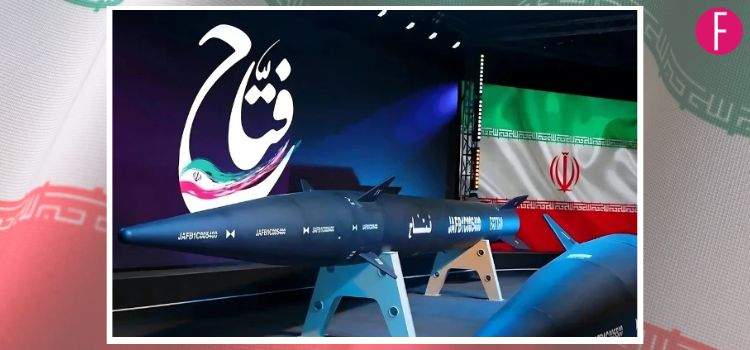
Fattah-1 missile
The Fattah-1 missile, meaning “the opener” or “the conqueror” in Persian and Arabic, was publicly unveiled in June 2023 by Iran’s Islamic Revolutionary Guard Corps (IRGC), under the direct endorsement of Supreme Leader Ayatollah Ali Khamenei. The missile is the result of years of domestic research, intended to circumvent and outperform Western missile defense systems. Its two-stage solid-fuel design, maneuverable re-entry vehicle, and ability to glide at hypersonic speeds make it an exceptional feat of Iranian engineering. According to official sources, the missile can reach speeds of Mach 13 to 15—approximately 17,000 to 19,000 kilometers per hour—while maintaining precision and evasiveness against traditional interception systems.
The Fattah-1 stands as a medium-range missile with a range of around 1,400 kilometers and a warhead capacity of approximately 200 to 450 kilograms. What sets it apart is not just its speed, but its ability to alter course mid-flight via a movable nozzle system, effectively allowing it to bypass advanced missile defense shields like Israel’s Iron Dome and Arrow systems. Moreover, HGV-equipped warheads, such as those used on Iran’s Fattah‑1, can fly at extreme speeds and execute zig-zag or erratic maneuvers, making their path unpredictable to missile defense radars. The missile’s trajectory involves high-altitude suborbital flight followed by a glide phase with precision targeting, rendering it almost impossible to detect and destroy during its final approach.
Deployment Against Israel
The missile came into international headlines again in June 2025, when Iran reportedly deployed multiple Fattah-1 missiles during Operation True Promise III, in retaliation to Israeli aggression on the Iranian soil. On June 18, at least one Fattah-1 missile struck near Beersheba in southern Israel, causing widespread fires, structural damage, and the temporary evacuation of hospitals and civilian facilities. Although Israeli defense sources claim that over 95% of incoming threats were intercepted, the breach by Fattah-1 marked a significant psychological and tactical blow. For the first time, Israel’s air defense faced a projectile it struggled to fully neutralize.
From Tehran’s perspective, the missile is not merely a weapon but a tool of strategic deterrence. Iranian officials and media outlets have repeatedly emphasized that Fattah-1 is designed to protect the Islamic Republic from foreign aggression and to counterbalance the military superiority of nations like Israel and the United States. It also reinforces Iran’s ideological position as the defender of oppressed Muslims in the region, particularly in the context of the Israel’s genocide in Gaza.
Global Hypersonic Landscape
Currently, only a few nations possess operational hypersonic missile technology. Russia has fielded the Avangard and Kinzhal systems; China has developed the DF-ZF glide vehicle; and the United States is conducting trials of various boost-glide systems. India, in joint collaboration with Russia, is developing and testing the BrahMos-II—a next-generation hypersonic cruise missile. Iran joining this elite list highlights its drive to compete on the global military stage.
Unlike traditional ballistic missiles, hypersonic weapons combine velocity with unpredictability. They fly at low altitudes, are capable of sharp maneuvers, and can strike with very little warning. These characteristics diminish the effectiveness of existing missile defense networks and force adversaries to invest in newer, more expensive interception technologies.
The Fattah-1 missile is a breakthrough in military technology and geopolitical messaging. While its operational effectiveness remains partially obscured by the fog of war and conflicting reports, there is no doubt that it has changed the strategic equation in the Middle East. Iran’s ability to produce and launch such a weapon underlines its growing technological capabilities and its determination to maintain regional influence. In a world increasingly defined by the race for next-generation weaponry, Iran has emerged not only as a contender—but, in the eyes of its supporters, a hero of the resistance.
Sources: Express Tribune, Wikipedia, and Al Jazeera.

