

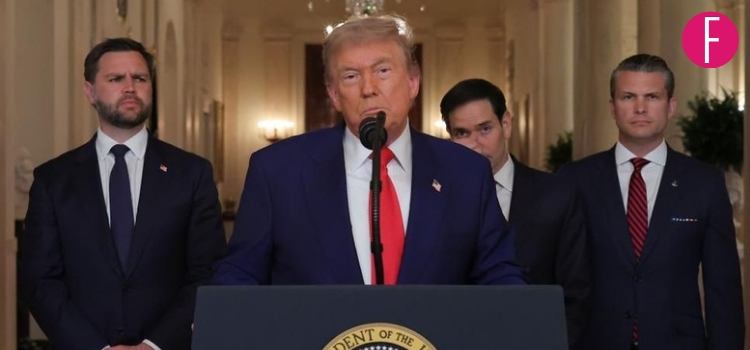
In a chilling and defiant tweet, Donald Trump announced that the U.S. had carried out successful strikes on Iran’s key nuclear facilities — Fordow, Natanz, and Esfahan. He proudly declared that a “full payload of bombs” had been dropped, that all American planes had returned safely, and that no military in the world could have pulled this off. It wasn’t just a show of might. It was a global message.
But the message wasn’t peace.
For months, tensions between Israel and Iran had been building.
The recent Israeli strikes targeting Iran’s nuclear and military infrastructure were already being called acts of war. Now, with the U.S. directly intervening and hitting Iran’s most protected nuclear sites with bunker-busting bombs, the crisis has gone far beyond a proxy battle. This is open warfare.
Iran’s response was immediate. Dozens of missiles rained down on Israel just hours later, some breaching defense systems and hitting civilian areas. Iran’s foreign minister called the U.S. strikes a violation of the UN Charter and international law. He warned of “everlasting consequences” and made it clear that Iran reserves the right to defend itself — not just politically, but militarily.
Tehran has acknowledged the damage at Fordow, Natanz, and Esfahan. But in the same breath, it said the attacks would not halt its nuclear progress. It’s the same defiant tone we’ve seen before, but this time, it lands differently. These weren’t symbolic strikes. The U.S. chose specific, high-value nuclear targets; facilities buried deep underground, previously seen as untouchable. And that changes the game.
this also reignites the conversation around regime change. Whether or not the U.S. admits it, this strike aligns perfectly with long-standing Israeli calls to not just halt Iran’s nuclear ambitions but to dismantle its political structure. Israel doesn’t just want a weaker Iran, it wants a different Iran. And with Trump at the helm, the idea of “toppling the regime” no longer feels like a conspiracy. It feels like a goal.
From the streets of Tel Aviv to Tehran, the uncertainty is thick. In Israel, shelters are filling up. In Iran, people are bracing for more — more airstrikes, more sanctions, more isolation. But also, potentially, more unity against what’s now being framed as a full-scale invasion of sovereignty. The fear isn’t just about missiles anymore, it’s about escalation without end.
International reaction has been cautious but not forceful. European leaders are urging Iran to return to talks. The UN nuclear agency is convening an emergency meeting, and countries like Germany, the UK, and Australia are walking a tightrope , supporting action against Iran’s nuclear program but nervous about how far this might go. Meanwhile, countries like Iraq, Cuba, and Venezuela have outright condemned the U.S., calling it a dangerous act of aggression that puts the entire region at risk.
And then there’s the bigger picture — the regional fire this could unleash. Iran isn’t just under attack. It’s retaliating. Israel has launched new strikes on western Iran. The U.S. is evacuating staff from Iraq. Allies are watching, enemies are preparing, and diplomacy is hanging by a thread.
Here’s How the World is Responding.
Fatima Bhutto, Pakistani author, poet and journalist, posts on X, questioning if Pakistan will withdraw its nomination for Nobel Peace Prize
Now that Trump has acted against his Congress and constitution by bombing Iran on behest of genocidal Israel, will Pakistan withdraw its nomination for Trump to receive the Nobel Peace Prize?
Zohran K Mandani, NYC First Muslim Mayoral Candidate with a sizeable public following terms Trump administration’s military actions against Iran as “illegal.”
My statement on the Trump administration’s illegal military actions and the wars that must end.
Bernie Sanders, United States Senator for Vermont states that this is an “illegal war with Iran” … “could cost the US countless lives and waste trillions more dollars.”
Tonight, I introduced legislation to stop Trump from leading us into an illegal war with Iran. Another war in the Middle East could cost countless lives, waste trillions more dollars, and lead to even more deaths, more conflict, and more displacement.
Ishaq Dar, Foreign Minister Government of Pakistan “condemns the US attacks on Iranian nuclear facilities.”
Narendra Modi, Prime Minister of India “expressed deep concern at the recent escalation.”
Spoke with President of Iran @drpezeshkian. We discussed in detail about the current situation. Expressed deep concern at the recent escalations. Reiterated our call for immediate de-escalation, dialogue and diplomacy as the way forward and for early restoration of regional peace, security and stability.
It’s clear that the recent acceleration in hostilities from President Donald Trump is not a warning shot anymore. It’s war — in the air, on the ground, and across the political map. The U.S. didn’t just target nuclear sites. It targeted the narrative of Iranian power. And in doing so, it may have lit the match for something far bigger than a single operation. For Iran, Israel, and everyone caught in between, the next chapter has already begun and it’s written in fire.
Sources: Al Jazeera, BBC, Reuters

