

Aik Aur Pakeezah is giving us plenty to talk about, but let’s be honest—right now, it’s Hina Bayat as “Mummy” who is completely stealing the show.
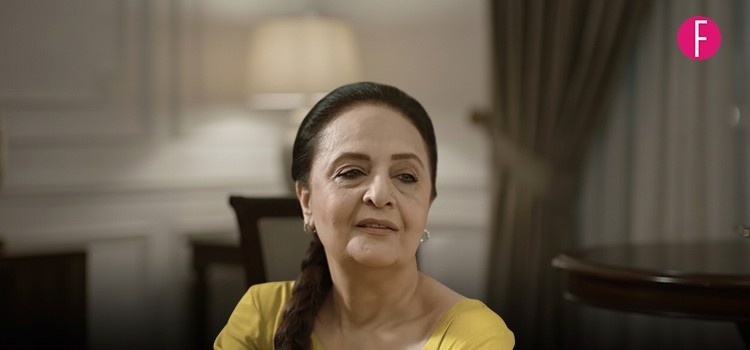
Mummy is that rare mix of compassionate, wise, and just the right amount of tough love—the kind of mother figure you don’t just respect, but lowkey wish you had. Hina Bayat brings her to life with such ease—her expressions, her tone, that effortless authority—it all just works. You believe her instantly.
One of the most compelling aspects of her character is her relationship with Saman, which might just be one of the most refreshing dynamics on screen right now. The fact that Saman is her stepdaughter barely registers; their bond feels real—slightly chaotic, a little dysfunctional, but deeply rooted in care. Mummy keeps it honest with her, sometimes brutally so, but there’s always warmth underneath. It’s that perfect balance of “I’ll call you out” and “I’ve got your back.”
And speaking of calling things out—Mummy does not believe in sugarcoating. She says it like it is, even when it stings. Her sharp, slightly sarcastic one-liners bring a touch of unexpected humour to an otherwise heavy narrative. She comes across as someone shaped by life’s harsher lessons—someone who has no patience for nonsense, yet carries a deeply compassionate core. Her support for Pakeezah and Noor Bhari is a testament to that softer side.
When it comes to protecting those she cares about, Mummy truly steps into her “mother hen” energy—fiercely protective and unwavering. A striking moment is when Faraz is shot, and she firmly tells Saman that they should not go to court until law enforcement can guarantee safety for those seeking justice. Her anger in that moment isn’t just frustration—it’s fear, concern, and a desperate need to shield Pakeezah from harm.
What makes her even more admirable is how effortlessly she embraces Pakeezah and Noor Bhari as her own. She supports, protects, and nurtures them in a way that redefines family—not just as something bound by blood, but by choice. Through her actions, the drama subtly highlights the strength of women standing by one another, showing how solidarity can create safe spaces even in the most difficult circumstances. Her unconditional support sends a powerful message: relationships built on shared struggles and empathy can be just as strong—if not stronger—than those defined by lineage.
Her understated yet impactful commentary on men and societal norms adds yet another layer to her character. Through passing remarks and sharp observations, she voices thoughts many people quietly hold but rarely express so candidly. It’s this blend of realism, wit, and emotional depth that makes Mummy not just a character—but a presence you feel every time she’s on screen.
Did we miss anything? Let us know!
Written by Bee Gul and directed by Kashif Nisar, the drama stars Sehar Khan in the titular role alongside Nameer Khan, Amna Ilyas, Gohar Rasheed, Hina Bayat, Nadia Afgan, Namra Shahid, Umer Darr, Davar Mahfooz, Ali Jan, Yusra Jan, and Noor Ul Hassan. The drama is presented by GEO Entertainment in collaboration with Kashf Foundation, with production backed by Kashf Foundation.

