

Every four years, the FIFA World Cup produces moments that become part of sporting history. A last-minute winner, a dramatic penalty shootout, a goal that leaves millions speechless. What most people never think about is the object at the centre of those moments: the football itself. There is a very high chance that ball was made in Sialkot, Pakistan.
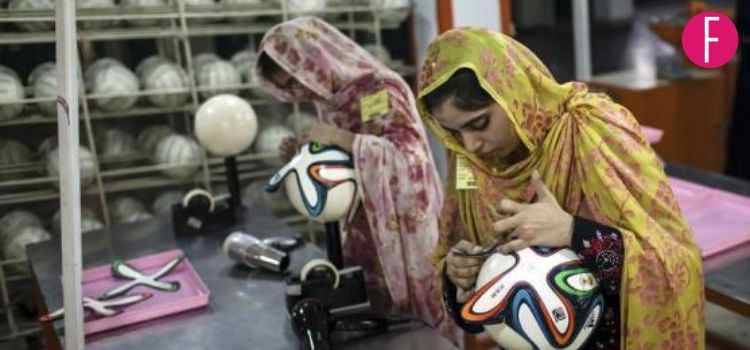
For decades, Sialkot has quietly been the beating heart of the global football manufacturing industry. The city produces the majority of the world’s hand-stitched professional footballs, including those used in major international tournaments. While factory owners and export figures often dominate the conversation, another story has been unfolding behind the scenes — the growing role of women whose skilled hands help create the footballs used on the sport’s biggest stages.
Their work rarely makes headlines, yet it has transformed not only an industry but also thousands of households across the city.
Why More Factories Are Turning to Women Workers
The football manufacturing industry in Sialkot was once heavily male-dominated, and in its earlier years also faced serious concerns around labour practices, but over the past two decades it has undergone a significant shift. Today, women form a substantial part of the workforce in many football manufacturing facilities, taking on roles ranging from stitching and quality inspection to finishing and packaging.
Factories such as Forward Sports and often point to consistency and attention to detail as reasons why women have become increasingly valued in the sector. Producing a professional football is not a simple assembly-line task. Every panel must be stitched with precision, measurements must remain exact, and even minor imperfections can affect the final product. The work demands patience, concentration and technical skill.
To attract and retain female workers, many companies have had to rethink workplace structures. Separate facilities for women, dedicated prayer spaces, transport arrangements and, in some cases, childcare support have become increasingly common. These changes are not merely about recruitment; they reflect a growing recognition that women are now central to the industry’s success.
The rise in female employment has also challenged traditional assumptions about who belongs in manufacturing spaces. In a country where women often face barriers to workforce participation, football factories have opened doors that were previously unavailable to many.
More Than Footballs: How the Industry Is Changing Women’s Lives
For many women in Sialkot, football stitching is not simply a job. It is an opportunity for financial independence in households struggling with rising living costs and economic uncertainty.
In numerous families, a single income is no longer enough to cover essentials. Women’s earnings have become a crucial supplement, helping households manage school fees, healthcare expenses and everyday necessities. What might appear to be a modest salary can significantly alter a family’s quality of life when combined with other household income.
The impact extends beyond immediate financial relief. Greater earning power often translates into greater decision-making influence within families. Women who contribute economically frequently gain more say in household matters, children’s education and long-term planning. In many cases, their income has helped ensure that the next generation remains in school rather than entering the workforce early.
The broader effects are visible across Sialkot itself. As the football industry has expanded, so too have educational opportunities and local development. Increased household incomes have contributed to a stronger local economy, while growing demand for skilled workers has encouraged greater investment in training and education.
There is a certain irony in the fact that Pakistan has never qualified for a FIFA World Cup, yet the country continues to play a defining role in every tournament. While football fans celebrate goals scored in New York, Toronto or Mexico City during the 2026 World Cup, many of those moments will begin thousands of miles away in Sialkot. And behind countless match balls will be women whose work remains largely invisible to the world, despite helping shape the game’s biggest stage.
Their contribution goes far beyond stitching panels together. In many ways, they are stitching together opportunities, financial stability and a different future for themselves and their families — one football at a time.
Sources: Gulf News, SRF, Diva Magazine
For more, head over to our Instagram:

