

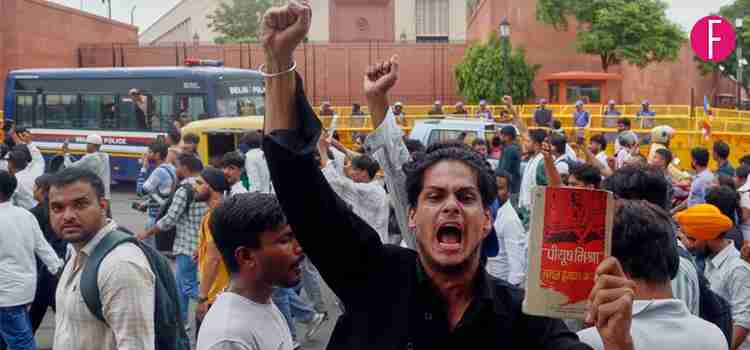
Thousands of Indian students continue to gather at Delhi’s Jantar Mantar and on the streets surrounding Parliament, demanding accountability for what they describe as the systematic collapse of India’s examination system. Sparked by allegations of paper leaks, evaluation irregularities, and repeated administrative failures, the protests have grown into one of the country’s largest youth-led movements in recent years. What began as outrage over the credibility of high-stakes examinations has evolved into a broader challenge to institutional accountability, with students arguing that the system entrusted with shaping their futures has failed them.
How a “Cockroach” Became a Symbol of Resistance
The Cockroach Janta Party was born out of controversy in May 2026 after remarks made during a Supreme Court hearing allegedly compared unemployed youth who questioned the system to “cockroaches” and “parasites.” Although Chief Justice Surya Kant later clarified that his comments referred to individuals with fake degrees rather than India’s youth as a whole, the phrase had already sparked widespread outrage.
Seizing the moment, Abhijeet Dipke, a 30-year-old public relations graduate from Boston University, reclaimed the insult by launching the Cockroach Janta Party (CJP)—a satirical movement with the tagline, “A political party for the people the system forgot to count.” What began as an online parody quickly resonated with millions of young Indians frustrated by unemployment, examination controversies, and a perceived lack of accountability. Within weeks, the movement’s social media following exploded, transforming the cockroach from an insult into a symbol of resilience and resistance.
Why Did Students Take to the Streets?
For millions of Indian students, success depends on a handful of high-stakes examinations. Admission to prestigious medical colleges, engineering institutions, universities, and government jobs is determined by competitive national tests that often require years of preparation and significant financial investment. When those examinations lose credibility, students argue that it is not merely an administrative failure—it is a threat to their future.
That crisis unfolded in 2026.
The immediate trigger was the NEET-UG examination scandal, India’s national medical entrance examination taken by more than 2.2 million students. Days after candidates sat the paper, allegations emerged that the question paper had been leaked before the examination. Authorities cancelled the results and ordered a re-examination under heightened security.
For many aspirants, the decision was devastating. Students who had spent years preparing suddenly had to repeat one of the most competitive examinations in the country. Families incurred additional financial costs, while thousands of candidates reported severe mental distress. Activists and families also alleged that around 20 students died by suicide in the aftermath of the controversy, making the scandal a national issue rather than simply an academic one.
The anger deepened when students also began reporting irregularities in the Central Board of Secondary Education’s On-Screen Marking evaluation process. Many complained of inconsistent marking, unexplained score discrepancies, and delays in re-evaluation, leaving university admissions hanging in the balance.
The Modi government has faced mounting criticism for its handling of the examination controversies, with students and opposition voices accusing it of failing to accept responsibility for repeated lapses in the country’s testing system. The Cockroach Janta Party has placed these issues at the centre of its campaign, demanding greater accountability for examination paper leaks and calling for the resignation of Union Education Minister Dharmendra Pradhan.
Beyond the examination scandals, the movement has become a platform for a generation grappling with broader economic uncertainty. For many Gen Z and millennial Indians, the protests reflect growing disillusionment with an education system they believe no longer guarantees opportunity and a labour market struggling to absorb young graduates. This frustration is underscored by recent estimates showing that nearly 40% of Indian graduates under the age of 25 are unemployed.
From Viral Campaign to Nationwide Protest
What began as an online movement quickly spilled onto the streets. On 6 June 2026, CJP founder Abhijeet Dipke returned to India to lead the movement’s first major demonstration at Jantar Mantar in New Delhi, where thousands of students gathered with national flags and textbooks to demand accountability for examination scandals, sweeping education reforms, and the resignation of Union Education Minister Dharmendra Pradhan. As the protests gained momentum, solidarity demonstrations spread to several cities across India.
The movement reached a turning point on 28 June, when renowned Ladakhi engineer and education reformer Sonam Wangchuk joined the sit-in and began an indefinite hunger strike in solidarity with students. His participation elevated the campaign from a youth-led online movement to a nationally recognised protest, drawing wider public attention to demands for transparency, institutional accountability, and reforms to India’s examination system.
The Police Crackdown and the March to Parliament
Tensions escalated in mid-July when Delhi Police, citing Wangchuk’s deteriorating health and court directions, removed him from the protest site and admitted him to Safdarjung Hospital. His detention triggered widespread outrage, prompting Dipke to begin his own indefinite hunger strike at Jantar Mantar.
Ahead of the planned “Sansad Chalo” (March to Parliament) on 20 July, Wangchuk urged Dipke—through his wife, Gitanjali Angmo—to end his fast and lead the demonstration. Dipke agreed, and thousands of protesters assembled in central Delhi, setting the stage for the movement’s largest and most consequential confrontation with authorities.
The movement reached its defining moment on 20 July, the opening day of Parliament’s Monsoon Session, when an estimated 10,000 to 50,000 students and supporters gathered in central Delhi for the CJP’s “Sansad Chalo”. Anticipating the demonstration, authorities deployed heavy police and paramilitary forces, erected multi-layered steel barricades, stationed water cannons, and closed several Delhi Metro stations around the Parliament complex.
Violence erupted when protesters attempted to push past barricades near Parliament Street and Shastri Bhawan. Delhi Police responded with tear gas and lathi charges, while organisers accused officers of using excessive force against largely peaceful demonstrators. Police, however, said force became necessary after protesters breached security cordons and attacked personnel.
The clashes left more than 60 protesters and over 100 police personnel injured, dozens of protesters detained, and several government vehicles damaged. Far from ending the movement, the crackdown intensified national attention, prompting solidarity protests and candlelight vigils in cities including Mumbai, Bengaluru, Goa, and on university campuses across India.
What Lies Ahead?
Whether or not the Cockroach Janta Party achieves its immediate demands is almost beside the point. Its greatest achievement has already been to transform the frustrations of an online generation into a movement that cannot be ignored. Too often, Gen Z is dismissed as politically apathetic, distracted by social media, or content to express dissent through memes. Yet across South Asia, that stereotype has repeatedly been challenged. From the student-led uprisings that reshaped politics in Bangladesh, to youth-driven protests in Nepal and Sri Lanka demanding accountability from those in power, young people have demonstrated that when institutions fail them, they are willing to organise, mobilise, and force uncomfortable national conversations.
India may not be on the brink of political upheaval, but the message emerging from Jantar Mantar is unmistakable. The students marching through Delhi are not simply protesting an examination scandal; they are questioning whether the promise of merit, opportunity, and social mobility still holds true. A generation that believes the system no longer rewards hard work is unlikely to remain silent for long.
For Prime Minister Narendra Modi’s government, the challenge extends far beyond replacing an education minister or reforming one examination. It is about restoring public confidence in institutions that millions of young Indians depend upon. History suggests that governments rarely falter because of a single protest. They falter when they underestimate the depth of public frustration behind it. If the voices gathering at Jantar Mantar continue to grow, the Cockroach Janta Party may be remembered not for its unusual name, but for marking the moment India’s youth discovered the political weight of their collective voice.
Sources: BBC, The Guardian, New York Times, Al Jazeera

