

Yemen’s Houthi movement has opened another flashpoint.
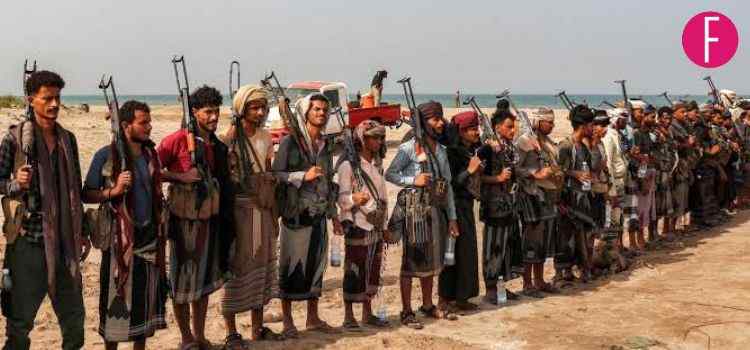
Image Credits: Foreign Policy
The Iran-backed group has announced a maritime blockade against Saudi Arabia, threatening one of the world’s most important shipping routes at a time when regional tensions are already running high because of the ongoing US-Iran conflict. While the blockade has not yet been fully enforced, its announcement alone has raised concerns over oil exports, global trade and the possibility of another escalation in an already fragile region.
On Monday, the Houthis declared what they called a “maritime embargo” against Saudi Arabia, saying the decision would come into effect immediately. The group has not released operational details explaining how the blockade will be carried out. However, senior Houthi officials later indicated that Saudi-linked shipping passing through the Bab al-Mandeb Strait would be their primary target.
Saudi Arabia has strongly rejected the move, saying it will continue protecting navigation through the Red Sea and respond to any threats against commercial vessels in line with international law.
Why are the Houthis imposing the blockade?
According to the Houthis, the blockade is retaliation for what they describe as more than a decade of Saudi restrictions on Yemen’s ports, airports and borders. The announcement also follows a sharp rise in military tensions between both sides.
Last week, explosions struck Sanaa International Airport after Yemen’s internationally recognised government said it had targeted the facility to stop an Iranian aircraft from landing without approval. The Houthis blamed Saudi Arabia for the attack, despite the Yemeni government’s claim of responsibility.
The incident quickly escalated. The Houthis responded by launching missiles and drones towards Saudi Arabia’s Abha International Airport, marking one of the biggest confrontations between the two sides since their 2022 truce.The maritime blockade is now being presented by the Houthis as another response in that growing standoff.
Why is Bab al-Mandeb so significant?
The Bab al-Mandeb Strait may not receive as much attention as the Strait of Hormuz, but it is equally vital to international trade. The narrow waterway links the Gulf of Aden with the Red Sea, providing direct access to the Suez Canal. Around 12 percent of global trade passes through this route, including millions of barrels of oil and petroleum products every day.
Any disruption means ships must sail around the southern tip of Africa instead, adding thousands of kilometres to journeys, increasing transport costs and delaying deliveries.That is why even the threat of instability in the area often has immediate consequences for shipping companies and energy markets.
Why is this announcement particularly important now?
The blockade comes at a time when Saudi Arabia has become increasingly dependent on the Red Sea route.
With shipping through the Strait of Hormuz heavily affected by the war in Iran, Saudi Arabia has been exporting much of its crude through the East-West Pipeline to the Red Sea port of Yanbu before sending it onwards through Bab al-Mandeb.
That alternative route has helped the kingdom maintain oil exports despite disruptions in the Gulf. If Bab al-Mandeb also becomes unsafe, Saudi Arabia could face fresh challenges moving its oil to international buyers, while countries that rely heavily on Saudi crude could also feel the impact.
What could this mean for the global economy?
Saudi Arabia remains one of the world’s largest oil exporters, supplying major economies including China, India, Japan and South Korea.Any prolonged disruption to its exports could tighten global energy supplies, push up shipping costs and place renewed pressure on international oil prices.
The effects would likely stretch beyond fuel markets. Higher freight costs often feed into the prices of everyday goods, increasing inflation and affecting supply chains already under pressure from ongoing regional conflicts.
What happens next?
At this stage, there is still uncertainty over how the Houthis intend to enforce the blockade and whether commercial vessels will become direct targets.
For now, the announcement serves as another reminder that the conflict in the Middle East is no longer confined to a single battlefield. With tensions involving Iran, the United States, Israel, Saudi Arabia and the Houthis increasingly interconnected, even one declaration affecting a strategic waterway has the potential to ripple across global trade, oil markets and international shipping.
Sources: Al-Jazeera, BBC, Geo News, Dawn, AP News

