


A catastrophic disaster in the Himalayas has left at least 584 people dead and more than 1,500 others missing across Nepal and the bordering Tibetan region.
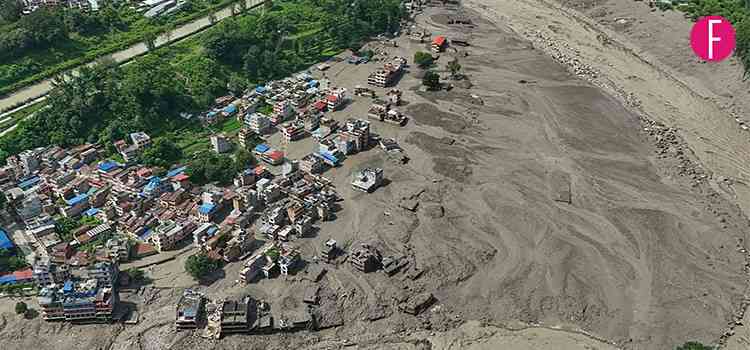
The devastating flash flood struck on August 26, 2026, after what authorities and geological experts have identified as a massive high-altitude glacial collapse and rock avalanche near the Nepal-Tibet border. The disaster sent an enormous surge of ice, water, rock and debris racing through river valleys, destroying settlements, roads, hydropower infrastructure and a major border crossing.
Here is everything we know so far.
What Caused the Disaster?
The catastrophe began at around 8:37 AM local time, when a massive section of glacier ice and bedrock reportedly broke away at an altitude of approximately 5,200 metres in the Langtang/Nepal-Tibet border region.
The collapsing mass plunged roughly 1,200 metres into the valley below, creating an impact powerful enough to register as a magnitude 5.2 seismic event, initially believed to be an earthquake.
The collapse unleashed a deadly debris flow made up of pulverised ice, glacial water, mud and rock. The rapidly moving surge travelled through the Lhende Khola, Bhotekoshi and Trishuli river systems, with water levels in some areas reportedly rising by as much as nine metres within just 30 minutes.
The Death Toll Continues to Rise
According to Nepal’s National Disaster Risk Reduction and Management Authority, the death toll in Nepal has climbed to 579.
Combined with five confirmed deaths in Tibet, the total death toll across the border region now stands at at least 584 people.
However, the number is expected to remain fluid as search and rescue operations continue in some of the most dangerous and inaccessible parts of the Himalayas.
More Than 1,500 People Remain Missing
The scale of the missing persons crisis is staggering.
In Nepal, authorities have reported at least 977 people unaccounted for, including local residents, domestic tourists, security personnel and foreign nationals.
Among them are reportedly at least 517 foreign nationals.
Across the border in Tibet, Chinese state media has reported 558 people missing in Gyirong County, including approximately 260 foreign nationals. Officials are still attempting to resolve possible overlaps in cross-border missing persons lists.
The missing include trekkers travelling through the Langtang region, pilgrims heading towards Mount Kailash, infrastructure workers and residents of isolated mountain communities.
Foreign Nationals Are Among Those Still Unaccounted For
The disaster has triggered a major international response, with families and diplomatic missions desperately seeking information about missing citizens.
Reported missing groups include nationals from India, the United States, Ukraine, Malaysia, Australia, the United Kingdom, Canada, South Korea, Singapore, Germany, Russia, South Africa and several European countries.
India is believed to have one of the largest groups of nationals affected, including infrastructure workers and pilgrims.
Meanwhile, the United Kingdom has confirmed 33 British nationals remain unaccounted for, with families making increasingly urgent public appeals for expanded ground searches. Among them is the brother of a missing British woman believed to have been travelling in the Langtang region.
More Than 100 Foreign Nationals Have Been Rescued
Despite the devastating conditions, rescue teams have managed to save thousands of people.
More than 100 foreign nationals have reportedly been rescued so far, while military and emergency teams continue to prioritise helicopter evacuations and tunnel extraction operations.
The Nepali Army and Armed Police Force have also reportedly airlifted more than 3,200 survivors, including critically injured victims, from isolated valleys to hospitals in Kathmandu and Nuwakot.
But reaching those still trapped remains an enormous challenge.
A Major Rescue Operation Is Underway at the Trishuli-1 Hydropower Tunnel
One of the most difficult rescue efforts is currently centred around the Upper Trishuli-1 Hydropower Project in Rasuwa.
Hundreds of workers were reportedly caught when thick mud and debris inundated access tunnels.
While more than 350 people have been rescued alive, emergency teams are continuing to dig through metres of sludge in the hope of reaching others who may still be trapped underground.
The operation remains extremely dangerous due to unstable terrain, flooding risks and the possibility of further collapses.
A New Threat: A Landslide-Dammed Lake
Rescue operations have also been complicated by fears of a secondary disaster.
A landslide-dammed lake near the Nepal-China border reportedly began overflowing, raising concerns about another potential flood surge downstream.
Although Chinese authorities indicated that the immediate situation had begun to stabilise, alerts remain active for emergency responders and communities living along downstream rivers.
Rescue teams have reportedly been forced to pause operations repeatedly because of flash-flood warnings and concerns over unstable landslide dams and glacial lakes.
Entire Roads, Bridges and the Nepal-China Border Crossing Have Been Destroyed
The destruction to infrastructure has been immense.
The flood reportedly demolished the Rasuwagadhi/Gyirong Port border crossing, including customs facilities, transport vehicles and the main road corridor connecting Nepal and Tibet.
Entire riverbank settlements have been swept away, while bridges, highways, footpaths and hydropower infrastructure have either collapsed or been buried under thick layers of mud and silt.
In many areas, rescue teams cannot transport heavy equipment because roads leading into the affected valleys no longer exist.
Why Rescue Operations Are So Difficult
The Himalayan terrain is making an already catastrophic emergency even harder to manage.
Several villages remain completely cut off after bridges and roads were destroyed. Thick mud, landslides and unstable mountain slopes have limited ground access, while poor weather and narrow valleys have complicated helicopter operations.
Communication blackouts have created another major problem. Damaged mobile towers and power infrastructure mean that some people listed as missing may simply be stranded without access to communication.
Search teams are now using helicopters, drones, sniffer dogs and heavy machinery to search tunnels, riverbanks and debris fields.
River sweeps are also continuing along the Bhotekoshi and Trishuli rivers, extending towards the plains of Chitwan, as rescuers search for vehicles, buses and people believed to have been swept downstream.
The Disaster Raises Fresh Concerns About the Climate Crisis in the Himalayas
Scientists have long warned that the Hindu Kush Himalayan region is becoming increasingly vulnerable to climate-related disasters.
The region is warming at approximately twice the global average, contributing to glacial retreat and the degradation of mountain permafrost — often described as the frozen material that helps hold steep rockfaces together.
As temperatures rise, glaciers, rock formations and high-altitude slopes can become increasingly unstable.
Experts say disasters involving glacial collapses, landslides and sudden flooding could become more frequent as warming continues to alter the fragile Himalayan landscape.
What Happens Next?
For now, the focus remains on finding survivors.
With more than 1,500 people still officially missing across Nepal and Tibet, emergency workers are racing against time while navigating unstable terrain and the ongoing threat of further flooding.
The full scale of the tragedy may not be known for days — or even weeks.
As families around the world wait for answers, the disaster has become one of the most devastating humanitarian emergencies to strike the Himalayan region in recent years.