

There is something deeply compelling about stories of ordinary people doing extraordinary things in moments of crisis. In the aftermath of tragedy, we look for the person who ran back into the fire, refused to abandon those in danger or risked their own life to save someone else. Their courage offers us something to hold on to when everything else feels like failure.
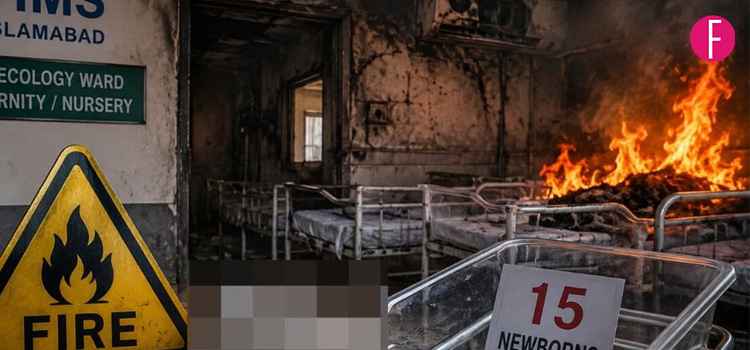
That is perhaps why the stories emerging from the devastating fire at the Mother and Child Healthcare Centre at PIMS have resonated so deeply. Amid the horror of fourteen babies losing their lives, the courage of medical staff who attempted to rescue those trapped inside has also come to the forefront. Their actions deserve recognition. There is no question about that.
But there is another conversation we must have, and it is arguably the more important one. Why did ordinary people have to become heroes in the first place?
The answer cannot simply be that disasters happen. Fires do happen. Electrical faults occur. Accidents are sometimes unavoidable. But a tragedy of this scale demands that we look beyond the spark that started the fire and examine everything that allowed it to become catastrophic.
According to PIMS, the fire began with a spark inside the nursery at approximately 6:38am. The hospital said that within seconds, the fire intensified because of oxygen points installed at each incubator. Doctors and nurses on duty responded immediately. Yet the incident has been followed by troubling accounts and serious questions about emergency preparedness at the hospital.
Witnesses claimed they waited for emergency services and were forced to smash windows to access the affected area. Some alleged that doors were locked. The hospital and government later disputed claims of delays and locked emergency exits. These conflicting narratives make an independent and transparent investigation even more important. When those who witnessed a tragedy describe something fundamentally different from the institution responsible for explaining it, the public cannot simply be expected to accept one version without scrutiny.
The findings that have emerged from the inquiry are equally alarming. The ward where the babies were housed reportedly had no water sprinkler system or fire alarm system. PIMS had several protocols and SOPs in place, but no dedicated SOP dealing specifically with fire safety and emergency response. References to fire safety existed only in limited sections of other protocols.
Perhaps even more concerning is the fact that this was not the first fire-related incident at the institution. A fire reportedly broke out at the PIMS nursing hostel in June 2026, but no meaningful institutional response followed. According to the inquiry findings, not even a meeting was held to determine whether additional safety measures, protocols or emergency procedures were required.
That raises a difficult question about how institutions learn from warning signs. A small incident should be an opportunity to prevent a larger one. A fire in one part of a major hospital should prompt an immediate review of fire safety across the entire institution, particularly in areas as vulnerable as neonatal and intensive care wards. If an earlier incident did not lead to a reassessment of emergency preparedness, then the problem is not merely a lack of resources. It is also a failure to recognise risk before it becomes a catastrophe.
The inquiry further found that there was reportedly no supervisor present in the ward at the time of the fire. There was one house officer and two nurses on duty. PIMS also reportedly lacked a dedicated official responsible for handling emergencies of this nature and had no comprehensive SOP specifically dealing with fire emergencies. The neonatal ward was found to be in violation of WHO guidelines and requirements for such a facility.
Taken together, these findings paint a disturbing picture. This was not simply a case of a fire breaking out in an otherwise fully prepared hospital. The alleged absence of basic fire safety systems, the lack of dedicated emergency protocols and the failure to respond meaningfully to an earlier fire all point towards a wider institutional failure that deserves serious examination.
And yet, in the middle of this failure, we have once again turned our attention towards the heroes.
This is not an argument against celebrating them. The nurse who risked her life deserves to be recognised. The doctors and others who attempted to rescue babies from the fire deserve acknowledgement for their courage. But there is a danger in allowing individual acts of bravery to become the dominant story after an institutional disaster. Heroism can sometimes make us forget what should have happened before the hero was needed.
We should not live in a country where a nurse has to risk her life because a hospital ward does not have adequate fire safety measures. Families should not have to depend on the personal bravery of whoever happens to be on duty that day to ensure their loved ones survive an emergency.
A functioning system is supposed to reduce the need for heroism. Emergency alarms are meant to warn people before they are trapped. Sprinkler systems are meant to contain fires before they spread. Clearly marked exits are meant to ensure people can leave dangerous spaces quickly. Protocols are meant to guide staff during moments of panic when every second matters.
These systems may not be glamorous, and they do not make for viral social media stories, but they save lives precisely because survival does not depend on someone doing something extraordinary.
This is where the conversation must move beyond PIMS. Pakistan has developed a troubling relationship with preventable tragedy. A building collapses, a fire breaks out, a road becomes dangerous, a hospital fails and, for a few days, there is outrage. Videos circulate. Social media demands justice. Officials promise an inquiry. Then the public moves on, and institutions often survive with little more than reputational damage.
The people who suffer most from these failures are also often those with the least power to demand accountability. Many tragedies involving ordinary Pakistanis receive attention only as long as they remain shocking. Once the outrage fades, so does the pressure to find answers.
Fourteen babies died in this fire. Their families cannot be expected to carry the burden of ensuring that this incident is not forgotten. That responsibility belongs to the state and to the institutions entrusted with protecting citizens, particularly in public hospitals where people often have no choice but to depend entirely on the system.
This is why the fallout from the PIMS fire cannot end with an inquiry report. There must be clarity about who was responsible for fire safety. There must be an independent examination of the conflicting accounts surrounding the emergency response. The findings of any investigation must be made public, and those responsible for negligence must face consequences.
Accountability cannot mean another committee, another report and another set of recommendations that disappear into government files. Someone must answer for why basic safety measures were allegedly absent. Someone must explain why an earlier fire did not result in improved protocols. Someone must be responsible for ensuring that a neonatal ward is equipped to protect its most vulnerable patients during an emergency.
Resignations, disciplinary action and institutional reform are not acts of revenge. They are how public institutions learn that negligence has consequences. Without accountability, there is little incentive to change.
But perhaps the most important lesson from PIMS is one we need to learn as a society. We need to stop being satisfied with heroes when what we actually need is accountability.
Celebrate the nurse. Honour the people who ran towards danger. Recognise every person who tried to save a life. But do not let their courage become a convenient ending to the story.
The real question is not whether ordinary Pakistanis are capable of extraordinary bravery. They have proven that repeatedly. The real question is why the country continues to put them in situations where bravery becomes a substitute for systems that were supposed to protect them.
A nurse should be able to care for patients without becoming a firefighter. Parents should not have to hope that, in the event of disaster, there will be someone brave enough nearby to save their children.
We keep celebrating heroes because they give us hope after systems fail. But hope is not a fire alarm. Courage is not a sprinkler system. And bravery, however extraordinary, cannot replace accountability.
Perhaps the greatest tribute we can pay to those who acted heroically at PIMS is to ensure that the next nurse is never forced to make the same choice between her own life and someone else’s because an institution failed to do its job.
Pakistan does not need fewer heroes. It needs fewer reasons for ordinary people to wear Superman capes.

