

Ukraine awoke on 2 June 2026 to one of the largest and most intense Russian aerial assaults of the year, as Russian forces launched a massive overnight barrage of missiles and drones against multiple Ukrainian cities.
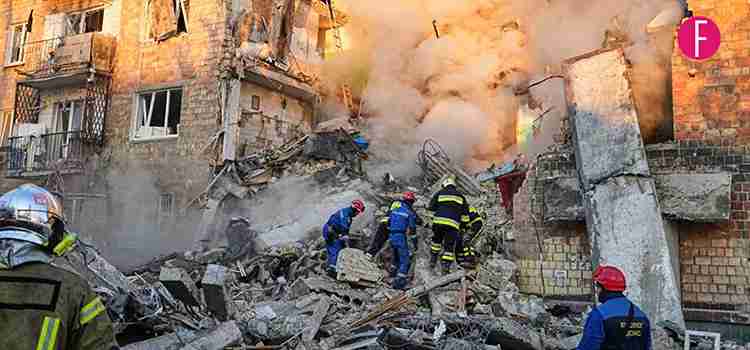
Reports of missiles and drones hitting major cities in Ukraine overnight include Kyiv, Dnipro, and Kharkiv, resulting in large numbers of civilian casualties, many residential structures being destroyed, and large amounts of property being severely damaged due to the fires ignited by the bombs falling on the cities. Critical services in the affected cities were also disrupted. Ukrainian officials characterized the missile attack as coordinated and nationwide, while the Russian government claimed it was retaliatory in nature due to recent acts of terrorism committed by Ukrainians against Russians.
The assault began last night (Monday) and is still ongoing through the early hours of Tuesday morning, according to Ukrainian government reports and various other international sources. Throughout much of the nation, air-raid sirens were activated as multiple drones and missiles were launched from multiple locations. In Kyiv, numerous citizens were forced to seek shelter in subway tunnels and other underground facilities to avoid incoming debris falling from the sky. Along with material destruction and civilian casualties, large fires were reported to have broken out in many areas throughout the capital; images from the event have reached beyond the borders of Ukraine, showing thick smoke rising from numerous areas across Kyiv. Emergency responders worked to assist those injured and displaced by the missile attacks and drone swarms.
The casualty rate is still being calculated, currently it is estimated that over 10 to 11 people have died and many civilians injured. Reports show casualties in multiple locations including Kyiv, Dnipro and Kharkiv. Civilians have been treated in hospitals throughout Ukraine while rescuers are working at several of the affected sites checking for survivors. Many of the victims are trapped under the debris of their collapsed homes due to the impacts from missiles on civilian residential buildings. Officials say the current numbers may increase as there are still search and rescue operations taking place throughout the affected areas.
Dnipro has been cited as one of the hardest hit cities; with numerous buildings suffering extensive to total damage. Firefighting crews have been on the scene trying to extinguish fires and begin securing any of the buildings; however, this will be a long and drawn out process.
According to Ukrainian military leaders, Russia attacked Ukraine using an unusual number of aerial munitions, including reports of hundreds of drones and missiles being used in the attack, which accounts for the potential of over 650 drones and 70 missiles being employed against Ukraine and represents one of the largest combined attacks utilizing drone and missile weaponry since the beginning of the full-scale invasion. Ukrainian military sources indicate that air defense systems were activated throughout Ukraine, and reports indicate that air defense units are intercepting a large percentage of incoming threats; however, there were still a large number of munitions that penetrated the air defense systems resulting in extensive damage.
This strike comes at a very precarious time in the ongoing conflict. Ukrainian President Zelenskyy has warned that recent assessments indicate that Russia is preparing a significant strike. Russia has continued to conduct long-range strikes in increasing quantities against Ukraine while at the same time Ukraine has conducted several long-range strikes into Russia against military, logistical, and energy site infrastructures using indigenous sources of drones and long-range missiles. Ukraine’s expanded strike campaign is having an increasing effect on Russian military infrastructure and logistics.
Once again, Moscow has clearly stated that the latest wave of attacks is being called a ‘retaliation’. According to the Russian Ministry of Defense, the recent attack is retribution for what the Russians state were Ukrainian military operations targeting civilian areas and Russian military installations. On the other hand, Kyiv has labeled the majority of the Russian attacks as attacking civilian locations where people live. As has been highlighted during all the phases of the war, both sides have been unable to agree on the real purpose for which they are conducting military operations or the legitimacy of the operations themselves.
From a strategic perspective, this attack illustrates a larger trend that has developed during the course of 2026: A dramatic escalation in the use of air power has occurred. Both Russia and Ukraine have dramatically increased their utilization of drones, long-range missiles, and precision-guided munitions. Analysis of the last several months has indicated that Russia still enjoys a quantitative advantage in aerial attacks over Ukraine, even as Ukraine has increased its capability to conduct strikes well into Russian-controlled territory. Therefore, the conflict has morphed into a long-term competition; one in which both nations continue developing their long-range strike capabilities, air defense systems, industrial production, and logistics systems.
Ukraine continues to face significant challenges due to the ongoing missile and drone attacks by Russian forces, particularly in relation to the vulnerability of Ukraine’s urban centres as evidenced by the most recent series of attacks on Ukraine.
Ukraine’s urban centres have been targeted repeatedly since the beginning of a full-scale invasion in February 2022 and this trend continues. The Russian military have employed missile and drone strikes against energy infrastructure, transport networks, industrial properties and residential areas throughout Ukraine since the full-scale invasion of Ukraine began on 24 February 2022.
Although the air-defence systems in Ukraine have improved tremendously through the assistance of Western governments, the size and scale of the offensive operations by the Russian military since 24 February 2022 have proven challenging to defend against and have complicated ongoing attempts to provide complete protection for the civilian population within Ukraine.
Currently, the Russian military’s use of missile and drone attacks against Ukraine will likely represent a new stage of heightened long-range warfare by the Russian military against Ukraine, thereby negatively impacting Ukraine’s allies by causing renewed worries regarding whether or not a political resolution will ever be achieved and ultimately resulting in an extension of the current armed conflict by way of continued assaults against Ukraine’s urban centres.
This is a developing story.
Sources: Reuters, BBC, and DAWN News.

