

Humanitarians are running out of language strong enough to capture the scale of suffering in Gaza. Once home to bustling neighborhoods and functioning institutions, the small, besieged strip has been reduced to devastation. Hospitals, schools, and all infrastructure essential to life have either been obliterated or rendered non-functional. Now, a new alert from the UN-backed Integrated Food Security Phase Classification (IPC) warns: “the worst-case scenario of famine is now unfolding in the Gaza Strip.”
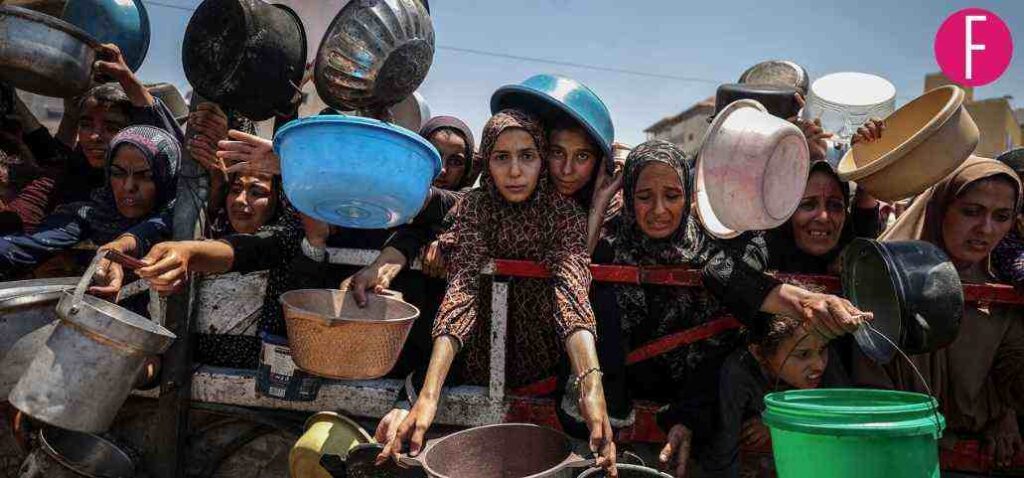
Thousands of children are malnourished, and hunger-related deaths are rising—particularly among the youngest.
- Since mid-July, at least 16 children under five have died from hunger-related causes.
- Over 20,000 children have been treated for acute malnutrition since April.
- According to the IPC, one in three people in Gaza now goes without food for days at a time.
This is not yet a formal famine designation—but that label is both rare and difficult to attain. Only a handful of famines have been officially declared in the 21st century: Somalia in 2011, South Sudan in 2017 and 2020, and Sudan in 2024. In Gaza, two out of three famine thresholds have already been crossed—plummeting food consumption and acute malnutrition. The third threshold—hunger-related deaths—has not been formally met due to the inability to collect reliable data amid the collapse of Gaza’s health system. Still, there is growing evidence that “widespread starvation, malnutrition, and disease” are causing hunger-related deaths to surge.
As of the latest May 2025 IPC analysis, at least 500,000 people—one in five Palestinians in Gaza—are expected to fall into IPC Phase 5 (Catastrophe) by September, a stage defined by starvation, destitution, and death. The rest of the population is already experiencing emergency levels of acute food insecurity.
The tragedy, experts stress, is not just a natural disaster—it’s a human-made catastrophe. Despite the crisis, food and medicine sit blocked at Gaza’s borders, unable to reach those in need. A recent report by Doctors of the World (Médecins du Monde) finds that in just 18 months, Gaza’s levels of acute malnutrition have reached those usually seen in nations with decades-long humanitarian crises. Already, 154 people, including 89 children, have died from hunger during Israel’s ongoing war on Gaza. And rising as we speak.
“This is not a warning. This is a call to action,” said Ross Smith, Director of Emergencies at the UN World Food Programme. “This is unlike anything we have seen in this century.”
Malnutrition So Severe, It’s Killing the Injured
Dr. Nick Maynard, a British surgeon who has visited Gaza multiple times since October 2023, describes the situation as “much, much worse” than he imagined. On his latest trip, he witnessed patients—especially children—dying not just from injuries, but because their malnourished bodies were too weak to heal.
“Malnutrition was really unimaginably bad… Patients of mine died because their bodies couldn’t recover from surgery,” said Dr. Nick.
Healthcare Workers Are Starving Too
Dr. Tania Haj Hassan, a pediatric intensive care specialist, shared a chilling update: even doctors and nurses—usually better off than the average population—are now starving.
“A colleague just told me he hasn’t eaten bread in six days. He joked about it but was serious—he now weighs less than I do,” she said.
Doctors report treating two children per day with complications they can no longer manage due to the lack of medical supplies. From diarrheal diseases to severe neurological disorders like Guillain-Barré syndrome, the collapse of basic hygiene and nutrition is fueling an unprecedented health emergency.
Children Dying from Lack of Formula
There is no baby formula left in Gaza. Hospitalized newborns are being fed sugar water (10% dextrose), which has no nutritional value. Doctors who tried to bring in formula in their luggage had it confiscated by Israeli border officials.
“Four premature babies died while I was there, directly from malnutrition,” Dr. Nick said.
One heartbreaking case involved a girl named Huda, who died because she needed IV nutrition after surgery and none was available.
Refeeding Isn’t a Quick Fix: The Dangers of Starvation Recovery
Even if aid were allowed in immediately, recovery is not as simple as providing food. Both Dr. Nick and Dr. Tania explain the risks of refeeding syndrome—a dangerous shift in electrolytes when starved patients begin eating again. It can cause fatal heart rhythms, especially in severely weakened bodies.
Malnutrition affects every organ system:
- Intestinal lining dies, leading to diarrhea and poor absorption
- The heart weakens, leading to failure or fatal arrhythmias
- Immune systems collapse, making infections like sepsis deadly
- Children suffer irreversible brain damage, bone growth issues, and long-term developmental delays
Psychological Trauma: A Generation Lost
Beyond the physical toll, the psychological damage is immense. Children are no longer behaving like children.
“They stare at the walls. They don’t cry, don’t ask for food, or even for their parents,” Dr. Tania shared.
Burn victims in pediatric ICUs remain silent. Many children are emotionally unresponsive, having witnessed traumatic scenes that healthcare workers themselves struggle to cope with.
Not Just a Crisis—A Legal Obligation Ignored
Alex Daval of the World Peace Foundation stressed that under international law, Israel is legally obliged to allow full humanitarian access to Gaza—including food, water, sanitation, fuel, and medical care.
“What’s being offered now—air drops and token food distributions—is nowhere near enough,” he said. “This requires a comprehensive humanitarian and medical response to prevent complete collapse.”
This is not just a humanitarian crisis—it is a moral indictment. Famine does not unfold quietly; it is engineered through policies, inaction, and intentional neglect. When food is blocked, when baby formula is confiscated, and when doctors are left begging for medicine while children waste away—this is not collateral damage. It is a choice. And the international community’s silence is complicity. Gaza is not starving in isolation; it is being starved in plain sight. If this moment doesn’t move us to demand more than hollow statements and photo-op airdrops, then what will?
Source: Al Jazeera, Guardian, UN

