

Ramsha Khan has addressed the circulation of her private moments online – and her message is clear: some boundaries should never be crossed.

The actress recently took to Instagram to speak out after images from what appeared to be a personal event involving her and Khushhal Khan began circulating widely across social media. What started as a quiet, private moment quickly spiraled into online fodder – fueling speculation, intrusive commentary, and an overwhelming wave of unsolicited attention. The reaction across platforms was almost immediate; pages reposted the images without context, captions filled in the gaps with assumptions, and within hours, something deeply personal had been turned into a trending topic.
But what often gets lost in that speed is intention. These weren’t images released by the individuals themselves, nor were they part of any public announcement or carefully shared glimpse into their lives. They were, quite simply, not meant to be seen by everyone – and yet, they were consumed, circulated, and treated as if they belonged to the public.
The leak of a celebrity’s wedding photos images clearly never meant for public release has once again forced us to confront an uncomfortable truth about the way we consume fame. A wedding, no matter how high profile the individuals involved, is still an intensely personal milestone. It is one of the rare moments celebrities often try to shield from the glare of constant visibility, choosing if, when, and how to share it with the world. When such moments are exposed without consent, it is not merely gossip but it is a violation, one that reduces deeply human experiences into disposable content for mass consumption.
And yet, the conversation is not entirely straightforward. Celebrity culture today thrives on a carefully constructed illusion of access. From curated Instagram posts to exclusive magazine deals, public figures routinely invite audiences into their lives offering just enough intimacy to remain relevant, admired, and marketable. In doing so, an unspoken contract begins to take shape, where fans feel not just connected, but invested. A wedding, then, is not seen as a private ceremony, but as a cultural event audiences believe they are a part of. When images leak ahead of an official reveal, some view it less as an invasion and more as an inevitable byproduct of this ecosystem of hyper visibility.
But this line of thinking, while understandable, is also deeply flawed. There is a fundamental difference between access that is granted and access that is taken. Consent cannot become conditional simply because someone is famous, nor should carefully curated glimpses into a celebrity’s life be mistaken for an open invitation to all of it. To argue otherwise is to blur the line between public persona and private person so completely that the latter ceases to exist. Perhaps the real issue lies not just with those who leak such content, but with the culture that sustains it, the clicks, shares, and endless appetite for more. Because as long as these moments are consumed with the same enthusiasm with which they are condemned, the cycle will continue. The challenge, then, is not just for celebrities to reclaim their boundaries, but for audiences to relearn them.
While the two had not publicly spoken about the nature of the event before, Ramsha’s statement seemed to confirm the rumors in her own way.
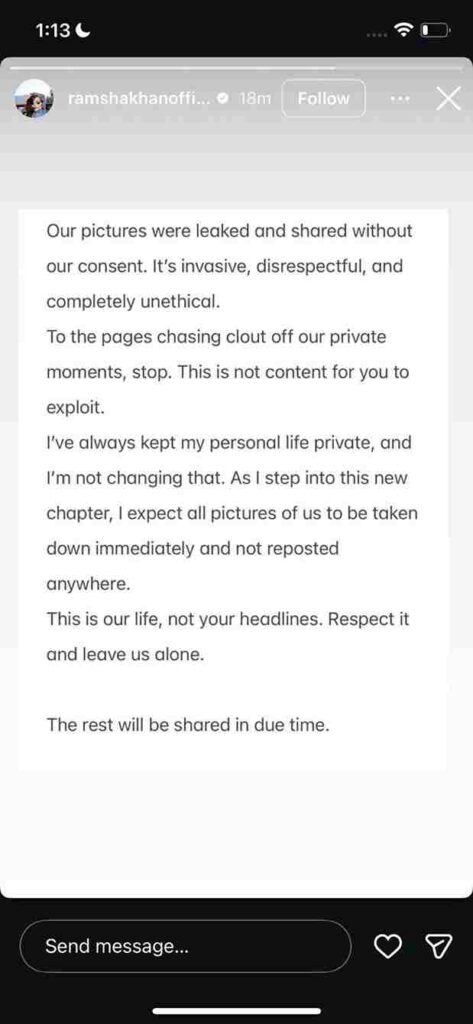
In her Instagram story, she called the situation “invasive, disrespectful, and completely unethical,” directly addressing the pages and individuals resharing the content. She urged them to stop exploiting what she called their private moments, making it clear that these images were never meant for public consumption. That’s precisely what makes this situation so uncomfortable when you sit with it for more than a second.
Her mention of “pages chasing clout” is particularly telling, because it highlights an entire digital culture that thrives on immediacy over integrity. There’s an urgency to be the first to post, the first to break something, the first to go viral. And in that urgency, basic considerations – like whether the people in those images ever consented to them being shared – are often ignored. But it doesn’t stop at those pages. What gives that content power is the engagement it receives. The likes, the shares, the curiosity-driven clicks. It’s a cycle, and everyone who participates in it, even passively, becomes part of the problem.
And this is where the conversation shifts from just media behavior to something more personal – ethics.
Because, if you strip away the fame, the following, the public personas – what you’re left with are two individuals who experienced a private moment made public without their permission. If that feels wrong in any other context, it should feel wrong here too. The idea that celebrities somehow “owe” the public access to their personal lives is one that has been normalized for far too long. But ethically, it doesn’t hold up. Being visible doesn’t mean being available. Being known doesn’t mean being owned.
What Ramsha’s statement does, quite effectively, is reclaim that space
Her words don’t try to soften the situation or reframe it for public comfort. Instead, they hold a mirror up to the audience and the platforms alike. They ask an uncomfortable but necessary question: just because you can see something, does that mean you were meant to? And more importantly, what do you choose to do once you do see it?
Her closing note – that the rest will be shared “in due time” – reinforces a simple but powerful idea: everyone has the right to tell their story when they are ready.
Because in the end, this isn’t just about a few images going viral.
It’s about a culture that has become increasingly comfortable crossing lines, often without even recognizing that they exist. And moments like this – when someone speaks up, clearly and unapologetically – are important. Not just for setting the record straight, but for reminding everyone watching that respect, even online, should never be optional.

