

Trigger Warning: This article contains mentions of domestic abuse and violence that may be distressing to some readers. Please proceed with caution.
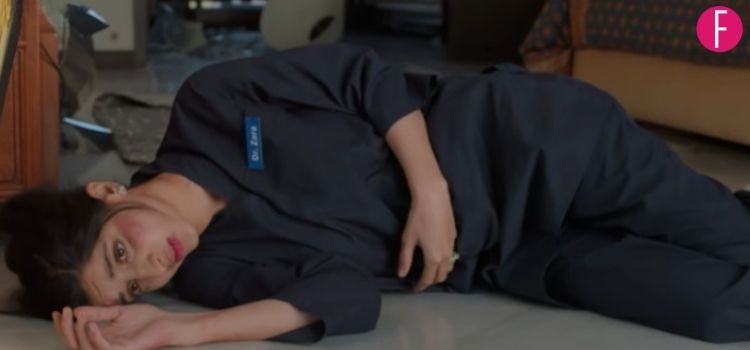
There’s something uniquely terrifying about watching someone lose control, that moment when their humanity slips away and violence becomes their language. Jafaa manages to capture this horror with a realism that shakes even those of us who pride ourselves on being emotionally resilient, unaffected by the emotional rollercoasters of television.
It’s too real, too close to life, like something ripped straight from the shadows of so many homes. As the scene unfolded, I felt a knot of dread in my stomach, goosebumps spreading over my skin. The fear I felt wasn’t just for Zara—it was for every woman who’s ever been in her shoes, stuck in the cycle of giving second chances, hoping against hope that things will change.
But Jafaa delivers a harsh, undeniable truth: once an abuser raises his hand, they don’t stop. That first slap, that first moment of violence, is not an isolated incident. It’s the beginning of a downward spiral, where things escalate until one day, like Zara, you find yourself in a hospital bed, bruised and broken. The drama perfectly captures the cycle of abuse, the way victims like Zara get caught in the trap of believing that their abuser will change. It’s a dangerous hope and Jafaa shows that this hope is often misplaced. There is no magic, no sudden transformation where abusers become loving partners. Instead, what starts as a slap can quickly become something much worse.
What makes Jafaa so powerful is how it portrays the insidious manipulation of abusers. Hassan, like so many real-life abusers, doesn’t just use violence—he uses charm, apologies, and promises to keep Zara tethered to him. He’s manipulative, weaving a web of lies that makes Zara believe he can change, that this time will be different. But it never is. And this is the devastating reality for so many women. They’re not weak; they’re hopeful. They want to believe that the person they love can be better and that the violence was just a mistake. But as Jafa so brutally shows, this hope can be a trap.
Jafaa doesn’t just depict domestic abuse—it holds a mirror to the insidious dynamics that allow it to fester, unchecked, in households across society. It reveals the deep-rooted belief that abusers, like Hassan, will somehow change, that things will magically improve. But what Jafaa emphasizes, with gut-wrenching clarity, is that abusers don’t change because the system around them doesn’t demand change. And this is where the drama strikes an even harder chord, demonstrating that people like Hassan’s Dadi—those who turn a blind eye or make excuses—are just as much a part of the problem. Her false promises and denial are not just naïve; they are complicit. She’s she’s living in a delusional world where she believes an abuser can turn over a new leaf merely by begging and pleading him to do so. And how many such women do we know? How many households keep their daughters tied to abusers under the guise of respectability and family unity?
The statistics tell a chilling story. According to the National Commission for Human Rights (NCHR) 2023 policy brief, 80% of the 63,000 gender-based violence cases in Pakistan were domestic abuse-related. It’s a staggering number, and it makes Jafaa’s portrayal feel even more immediate, more urgent. This isn’t just happening on TV—it’s happening in homes across Pakistan, from the most privileged to the most impoverished. The drama doesn’t sugarcoat the truth: no matter how educated a woman is, no matter her social standing, domestic abuse is a pervasive threat. Men like Hassan aren’t anomalies—they are painfully common. And while we often see them as the perpetrators, Jafaa reminds us that the enablers—those who excuse or ignore the abuse—are just as culpable. Hassan’s Dadi is a powerful symbol of the silence that surrounds domestic violence, a silence that allows it to continue.
Hassan’s Dadi isn’t just responsible for enabling his abusive behavior in the present—she’s complicit in hiding the very roots of his trauma. By keeping Hassan’s childhood trauma a secret, she set the stage for the inevitable destruction of his marriage to Zara. Knowing full well that revealing this past might prevent the marriage, she chose silence over honesty.
Women, from a young age, are often conditioned to keep the details of their relationships private, to suffer in silence rather than seek help. This deeply ingrained notion is reflected in Zara’s Dadi’s advice to her, urging that “not everything is meant to be told.” It’s this toxic belief that traps women like Zara in abusive relationships, silencing them when they need to be heard the most. Zara, following this misguided principle, keeps quiet even when Numair, one of the few people who genuinely cares for her, approaches and asks if something is wrong. By not confiding in Numair, she inadvertently shields Hassan’s abuse and deprives herself of the support she so desperately needs. This silence, a product of societal conditioning, ensures that no one fully understands the gravity of the situation until it’s too late. It’s a tragic reflection of how the culture of secrecy perpetuates abuse, forcing victims to endure their suffering alone.
Perhaps what hit hardest was how Jafaa delves into the myth of a child as the ultimate fixer of a broken relationship. The idea that bringing a child into the world will somehow repair the damage, and heal the wounds of abuse—it’s a dangerous fallacy. Jafaa dispels this notion with a refreshing bluntness. Zara and Hassan’s relationship is beyond repair, and a child won’t miraculously undo the trauma. The drama opens up an important conversation about birth control, which is still a taboo subject in many households. It’s an important step in showing that children should not be used as emotional band-aids, especially in situations where the underlying issues are so deeply destructive.
And then, of course, there’s the acting. Mawra Hocane delivers her finest performance yet, capturing Zara’s inner turmoil with such raw intensity that you can’t help but feel her pain, her fear, her hopelessness. Mohib Mirza, as Hassan, brings a terrifying authenticity to his role, embodying the insidious charm that many abusers hide behind. Usman Mukhtar, too, deserves applause for his understated yet impactful portrayal. These performances weren’t just good—they were searing, unforgettable. They brought the story to life in a way that felt almost too real.
Jafaa isn’t just a drama—it’s a call to action, a bold statement about the realities of domestic abuse that too many people are still afraid to confront. It’s uncomfortable because it’s true. And that’s what makes it brilliant. The next time a hand is raised, will we look away, like Hassan’s Dadi? Or will we finally stop pretending and do something about it?
Jafaa delivers a gut-wrenching reality check. It forces us to confront the brutal truth that domestic abuse is not a mistake, it’s a choice, and once that choice is made, the cycle only intensifies. The powerful portrayal of Zara’s suffering is a wake-up call for all those who believe in second chances for abusers, showing that hope can be a prison if it’s built on denial. The message is simple yet searing: when the hand is raised once, walk away—because staying only guarantees more pain.
While Jafa depicted and executed the scene of abuse aptly, the audience would have appreciated a trigger warning. It would’ve given viewers a moment to brace themselves, especially for those who find such intense moments difficult to watch.

