

Renowned for her compelling narratives and cultural activism, Jhumpa Lahiri has declined the 2024 Isamu Noguchi Award in protest of the museum’s decision to terminate employees for wearing keffiyeh headscarves.
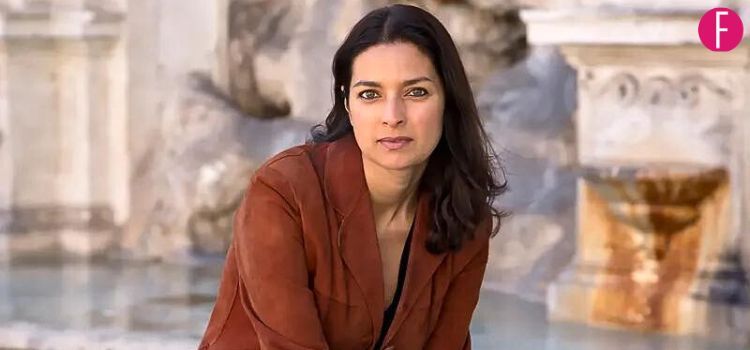
Jhumpa Lahiri, an acclaimed author known for her poignant exploration of the immigrant experience, has made significant contributions to contemporary literature. Born to Indian immigrant parents in London, Lahiri moved to the United States at a young age. She received the Pulitzer Prize in 2000 for her debut short story collection, “Interpreter of Maladies,” a work that delves into the lives of Indian immigrants navigating the complexities of cultural identity and displacement. Moreover, Lahiri’s literary prowess extends beyond English; she has also published works in Italian and currently directs the creative writing program at Barnard College in New York. Her accolades include numerous awards and nominations, solidifying her reputation as a powerful voice in literature.
Her debut novel, “The Namesake” (2003), received widespread praise and was later turned into a well-received film. Critics praised “Unaccustomed Earth” (2008), which earned the Frank O’Connor International Short Story Award. “The Lowland” (2013) was shortlisted for notable honors such as the Man Booker Prize and the National Book Award for Fiction.
Declining the Noguchi Award
Pulitzer Prize-winning author Jhumpa Lahiri recently declined to accept the 2024 Isamu Noguchi Award from New York City’s Noguchi Museum. This decision came after the museum terminated three employees for wearing keffiyeh head scarves, an emblem of Palestinian solidarity, following an updated dress code. The museum’s policy, which prohibits clothing or accessories that express political messages, slogans, or symbols, sparked controversy and led to significant backlash from the community.
“Jhumpa Lahiri has chosen to withdraw her acceptance of the 2024 Isamu Noguchi Award in response to our updated dress code policy,” the museum stated. “We respect her perspective and understand that this policy may or may not align with everyone’s views.”
A Symbol of Solidarity
A keffiyeh (also spelled kufiya or kefiyah) is a traditional Arab head scarf, typically made of cotton. The keffiyeh, typically checkered in black and white but available in other color combinations, is commonly worn by men in the Middle East and North Africa. It serves both as a fashion accessory and for practical purposes, such as protecting the head and face from the sun and sand. An agal, a black cord, often holds the keffiyeh in place. Moreover, the keffiyeh has become a symbol of Palestinian self-determination and resistance. Across the globe, protesters don the black-and-white keffiyeh to demand an end to genocidal war in Gaza. Historical figures like Nelson Mandela have also worn the keffiyeh, highlighting its significance in movements against oppression. However, supporters of Israel argue that the scarf signals extremism.
The Noguchi Museum, founded by Japanese American sculptor Isamu Noguchi, announced the policy change in August, aiming to maintain neutrality and avoid unintentional alienation of visitors. The dress code update was met with immediate opposition from employees and community members. Over 50 staff members signed a petition condemning the policy, arguing that it undermines the museum’s credibility and public image.
Fans & Palestine Supporters Praise Jhumpa Lahiri

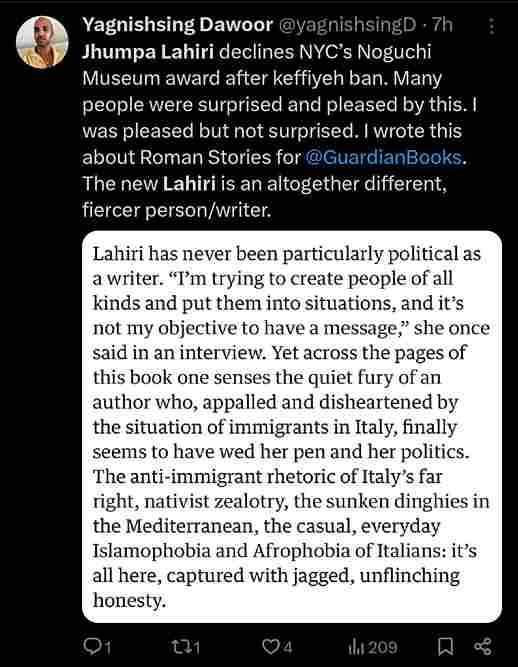
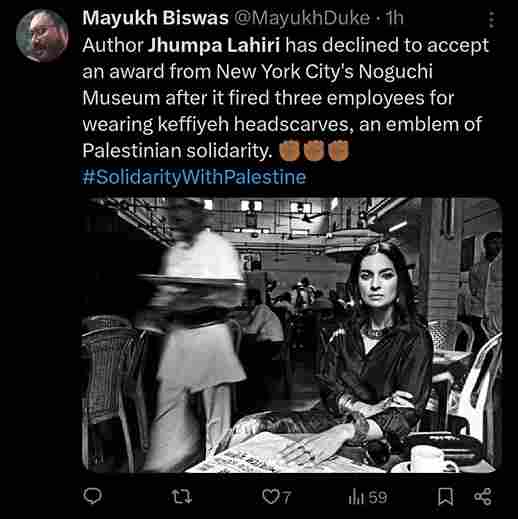
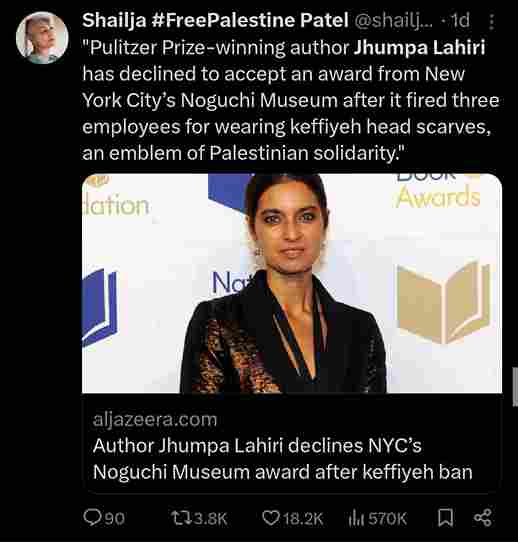
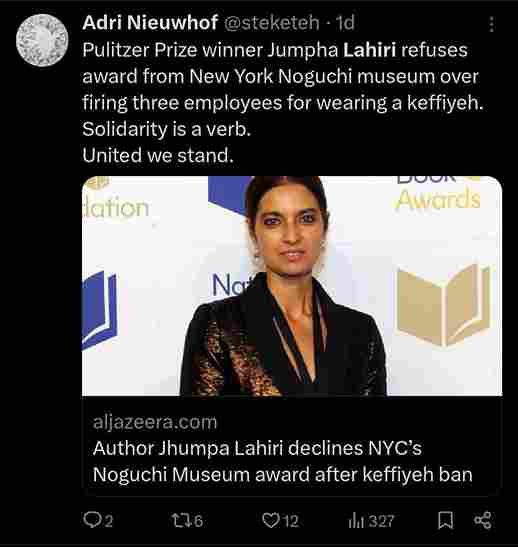
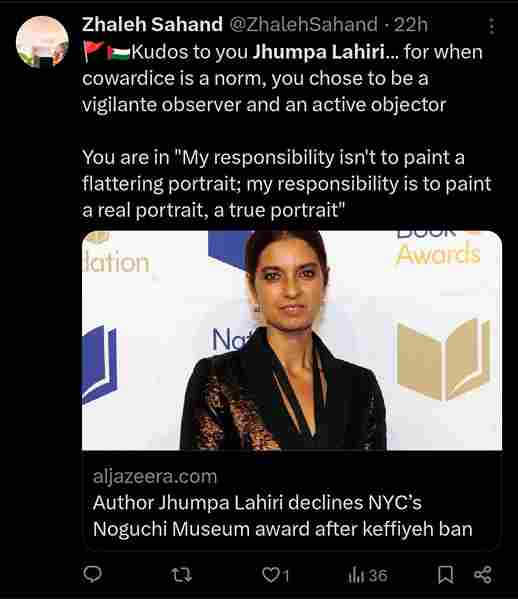
X Users propose that other authors and artists use their conscience and stand up for important causes.

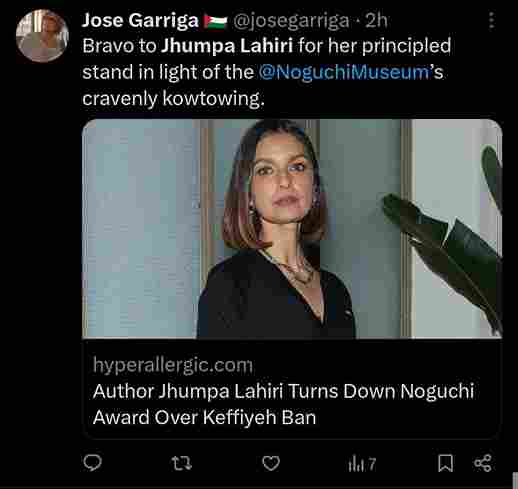
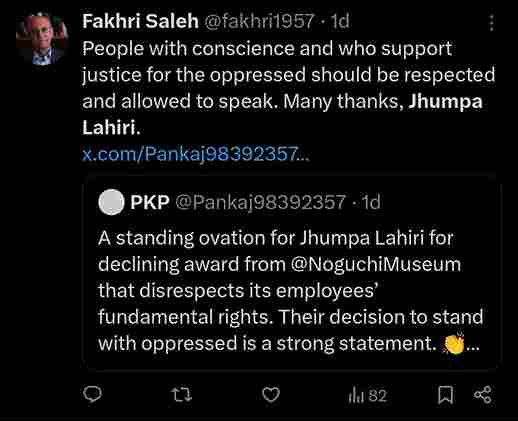

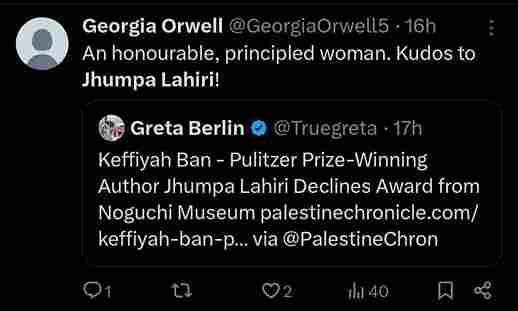
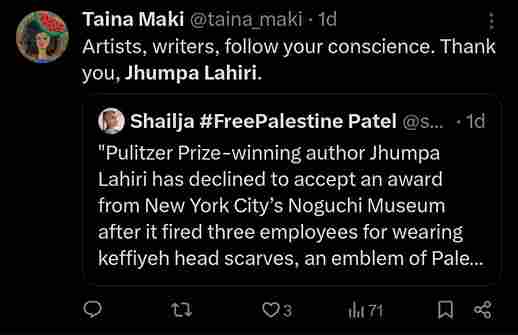
Solidarity & Protest
Lahiri’s decision to reject the award is not an isolated act of protest. She is among thousands of scholars who have expressed solidarity with Palestinians and criticized the Israeli military campaign in Gaza. This solidarity has often come at a cost; in the U.S., individuals have faced job losses due to their stance on the genocidal war. For example, a New York City hospital fired a Palestinian American nurse after she called Israel’s actions in Gaza a “genocide” during an award acceptance speech.
The firings and subsequent backlash at the Noguchi Museum highlight the contentious nature of political expression in the workplace. While the museum defends its policy as a means to prevent alienation, critics argue that it stifles important cultural and political discourse. Lahiri’s withdrawal from the award serves as a significant statement, reinforcing her commitment to activism and solidarity. In a broader context, the incident underscores the ongoing struggle for Palestinian rights and the complex dynamics of political expression in cultural institutions. Thus, the museum’s actions and Lahiri’s response reflect the broader societal debate over freedom of expression, solidarity, and the role of cultural institutions in political issues.

