

For years, climate scientists have warned that glaciers would become one of the clearest indicators of a warming planet. This summer, those warnings are unfolding before our eyes. Switzerland’s glaciers, which have shaped the country’s mountains and supplied water to much of Europe for centuries, are melting at a pace that researchers describe as deeply alarming. The combination of another disappointing winter, soaring temperatures and an early-season heatwave has pushed the country’s glaciers into territory that is usually not reached until much later in the year, raising fresh concerns about what lies ahead for the Alps if global temperatures continue to climb.
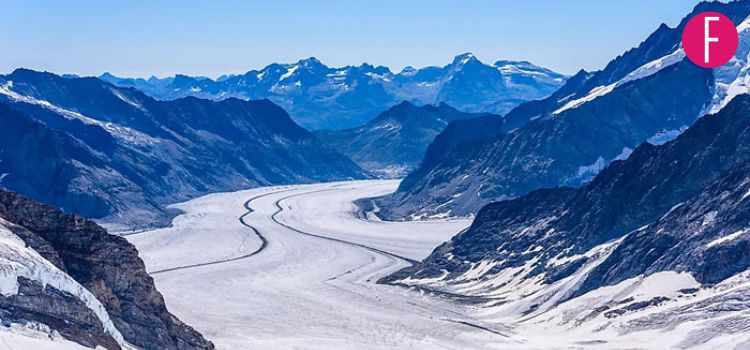
Researchers now expect Switzerland to reach what is known as “glacier loss day” before June ends, an unusually early milestone that means every bit of snow accumulated during the previous winter will already have disappeared. From that moment onward, every additional spell of hot weather no longer melts seasonal snowfall but instead eats directly into the ancient glacier ice itself. Unlike winter snow, that ice cannot simply be replaced when temperatures cool again, making every warm day through the rest of summer a permanent loss.
The problem did not begin with this heatwave
It may be tempting to blame the current European heatwave alone, but scientists say the situation has been building for months. Switzerland entered spring after another winter that delivered significantly less snowfall than usual, leaving glaciers with a much thinner layer of snow protecting them from the sun. Snow plays an important role beyond simply making the mountains look white. It reflects sunlight back into the atmosphere and acts as insulation for the dense ice lying underneath. When that layer is too thin, glaciers become exposed much earlier, allowing warmth to penetrate directly into ice that has taken centuries to form.
The unusually warm temperatures recorded in May only worsened the situation by melting away much of that limited snow cover weeks ahead of schedule. By the time Europe entered another intense heatwave in June, many glaciers had already lost the natural protection they normally rely on throughout early summer. Instead of a gradual seasonal melt, scientists are now witnessing conditions that would usually belong in August, despite July not even having arrived.
That shift in timing is what concerns glaciologists the most. Extreme heat has always affected glaciers, but seeing these conditions so early in the season means there are still months of summer left during which glaciers will continue shrinking with little opportunity to slow the process.
The scale of melting is unlike anything a healthy glacier should experience
The numbers being recorded across the Swiss Alps help explain why researchers are sounding the alarm. Current estimates suggest glaciers are releasing roughly 400 cubic metres of meltwater every single second. To put that into perspective, that is enough water to fill an Olympic-sized swimming pool once every six seconds, continuously, throughout the day and night. It is an extraordinary amount of freshwater pouring out of the mountains, and while it may sound abundant, it actually represents centuries-old ice disappearing far sooner than it should.
Recent inspections have painted an equally worrying picture on the ground. Scientists studying the Rhône Glacier found that around one metre of ice had vanished in just ten days, a rate of melting that would once have been considered exceptional. Across the Alps, snow-covered surfaces are rapidly giving way to bare ice, exposing glaciers directly to sunlight and speeding up the cycle even further.
This year’s “glacier loss day” is expected to arrive as the second earliest recorded since systematic monitoring began this century, surpassed only by the devastating glacier season of 2022, which remains the benchmark for extreme ice loss across Switzerland. Researchers fear 2026 is beginning to follow an alarmingly similar path.
Why Switzerland is warming faster than much of the world
Glaciers around the globe are shrinking because of climate change, but Switzerland has become one of the countries where the consequences are especially visible. The country’s average temperature has been rising considerably faster than the global average, partly because it is surrounded by land rather than oceans, which normally help regulate heat. The Alps themselves also contribute to the problem in an unfortunate cycle.
As snow and ice disappear, darker rock surfaces are left exposed. Unlike bright snow, these darker surfaces absorb far more solar energy, trapping additional heat instead of reflecting it back into the atmosphere. That extra warmth accelerates further melting, exposing even more rock and creating a cycle that becomes increasingly difficult to reverse.
The consequences are already impossible to ignore. Switzerland has lost more than a third of its glacier volume since the turn of the century, while well over a thousand smaller glaciers have disappeared altogether over the past five decades. Scientists warn that unless greenhouse gas emissions are reduced substantially and global warming slows, many of the glaciers that define the Alpine landscape today could survive only as small fragments by the end of this century.
The disappearing ice is a warning for far more than Switzerland
It is easy to see glaciers simply as spectacular natural landmarks, but they perform a far greater role than providing postcard views of the Alps. They act as vast freshwater reservoirs, feeding major European rivers such as the Rhine and the Rhône, supporting agriculture, drinking water supplies, hydroelectric power and ecosystems across several countries.
For now, rapid melting temporarily sends more water downstream. Eventually, however, that reserve begins to run out. As glaciers continue shrinking year after year, less meltwater will be available during the hottest months, increasing pressure on communities, industries and ecosystems that depend on those rivers.
For scientists, this year’s exceptionally early glacier loss is not simply another climate statistic. It is another reminder that changes once expected decades into the future are arriving much sooner than anticipated. Every intense heatwave leaves glaciers smaller than before, every disappointing winter makes them more vulnerable the following summer, and every passing year makes it increasingly difficult for these ancient ice masses to recover. The Swiss Alps have long stood as one of Europe’s defining landscapes. Today, they are also becoming one of its clearest warnings about the accelerating reality of climate change.
Sources: Anadolu Ajansi, The Guardian, Seoul Economic Daily, World Radio, The Local
For more news, head over to our Instagram:

