

“I never thought my family would go hungry because I would be forced to stay home. Now, I have no income. Even worse, I have no mahram, so it is hard for me to access humanitarian aid for my children. We must rely on the generosity of our neighbors.” — Meena, women in Afghanistan
Afghanistan has become a prison for its women, where the simple act of existing as a female has become a perilous endeavor. Not long ago, women like Meena were pillars of their communities. On August 14, 2021, Afghan women were students, judges, artists, and leaders; on August 15, 2021, they became invisible.
In a chilling return to power, the Taliban has plunged Afghanistan into a darkness where being born female is a life sentence. Women are no longer citizens; they are prisoners in their own country, shackled by a regime that views them as nothing more than property. Education, work, even the simple act of leaving home—all of it is forbidden unless sanctioned by a male relative. The spaces where women once gathered, found solace and sought help—beauty salons, schools, shelters—have been shut down, leaving them isolated and vulnerable.
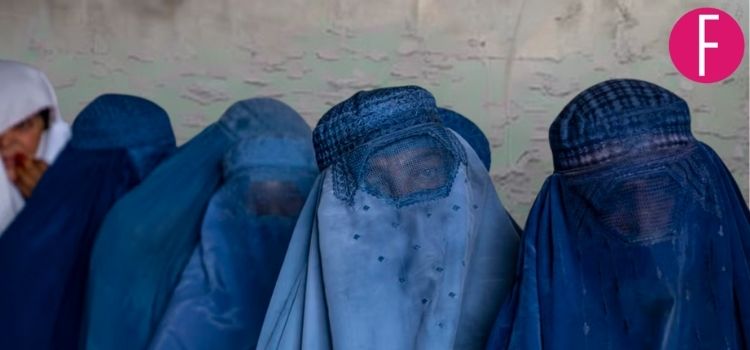
Imagine a world where your very existence is a crime, where the sound of your voice or the sight of your face is deemed too dangerous to be allowed. In Afghanistan, this dystopian nightmare has become a horrifying reality for millions of women and girls.
The Taliban, relentless in their quest to obliterate women’s rights, have enacted laws so draconian that they strip away the last remnants of female autonomy. This is not just oppression—it’s the systematic erasure of half a nation’s population, turning women into invisible, unheard shadows in their homeland.
The “Vice & Virtue” Law
The Taliban recently introduced new “vice and virtue” laws that impose severe restrictions on Afghan women, which the UN and human rights organizations have strongly condemned. According to these laws, women are required to fully cover their bodies, including their faces, in thick clothing whenever they are in public, to prevent them from tempting men or leading them into immoral behavior.
The laws also ban women from speaking or allowing their voices to be heard in public, as the Taliban view women’s voices as potential sources of immorality. This restriction extends to women singing or reading aloud, even within the confines of their homes. Women are also prohibited from making eye contact with men who are not their relatives by blood or marriage.
Additionally, taxi drivers face punishment if they transport women who a male guardian does not accompany. Women and girls who violate these laws risk being detained and subjected to penalties deemed appropriate by Taliban officials responsible for enforcing these new regulations.
UN’s Response
The Taliban’s new morality law in Afghanistan has drawn strong condemnation from the UN Human Rights Office (OHCHR), which urged its immediate repeal. This law called the “Law on the Promotion of Virtue and the Prevention of Vice,” severely restricts women’s rights, effectively erasing their presence in public. Women are now required to cover their entire bodies, are banned from being heard in public, and face strict limitations on movement without a male relative.
Ravina Shamdasani, OHCHR’s Chief Spokesperson, called the law “utterly intolerable” and a clear violation of international human rights. The law also imposes restrictions on men, such as requiring them to grow beards, and it grants state agents broad powers to enforce these rules, further deepening the country’s human rights crisis.
An Act Of Defiance
In response to the Taliban’s recent laws banning women from singing or reading in public, Afghan women have turned to social media to voice their anger. Many have launched an online protest by sharing videos of themselves singing in defiance of these oppressive rules. Women from both within Afghanistan and abroad are participating, using their songs to express their struggle for freedom. These videos, often showing women singing while wearing burkhas to protect their identities, have flooded social media, demonstrating their resistance to the Taliban’s draconian laws.
Gender Apartheid
Imagine waking up one morning to find that your voice has been stolen—not by illness or accident, but by law. In Afghanistan, this nightmare is the reality for millions of women and girls under the Taliban’s brutal regime. Since seizing power in 2021, the Taliban have methodically erased women from public life, turning them into ghosts in their own country.
It’s heartbreaking to witness how, since 2021, the Taliban have systematically dismantled the autonomy and rights of Afghan women and girls. What was once a fight for basic freedoms has turned into a relentless war on their very existence. The situation has spiraled into what human rights groups are rightly calling a “gender apartheid,” where women are being pushed out of public life altogether.
This isn’t governance; this is gender apartheid. The Taliban’s systematic oppression has denied women access to education, employment, and the simplest of freedoms, like taking a walk in a park or visiting a beauty salon. They’ve barred women from almost every aspect of life, trapping them in a prison without walls.
What’s most alarming is the speed and precision with which the Taliban have moved to enforce this “gender apartheid.” In just three years, they’ve managed to exclude women from almost every aspect of public life and deny them access to justice. It’s a chilling reminder of how fragile freedoms can be and how quickly they can be taken away when extremists are in power.
The international community cannot afford to look away. This isn’t just about the women of Afghanistan—it’s about human rights and dignity for everyone. If we allow this oppression to continue unchecked, we send a message that such violations are acceptable. Afghan women and girls deserve our support, our voices, and our actions. They deserve to live as full human beings, with the right to learn, work, and live freely.
Sources: Atlantic Council, Human Rights Watch

