

“Hindustan had become free. Pakistan had become independent soon after its inception but man was still slave in both these countries — slave of prejudice … slave of religious fanaticism … slave of barbarity and inhumanity.” – Manto
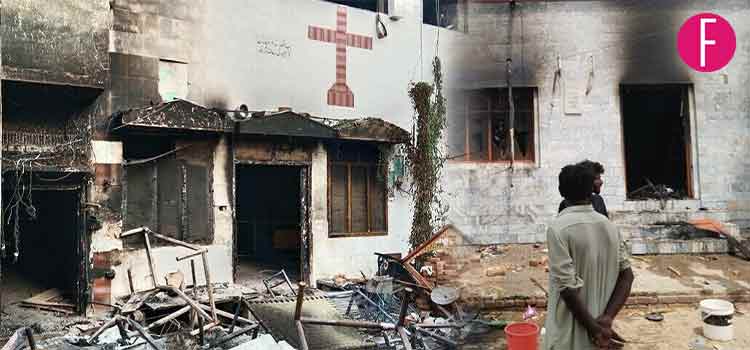
In a troubling incident that recently unfolded in Punjab province’s Jaranwala town, armed mobs descended upon two churches, accusing Christian residents of blasphemy. This incident underscores the urgent need for Pakistan to reevaluate its approach to blasphemy allegations and ensure the protection of religious minorities.
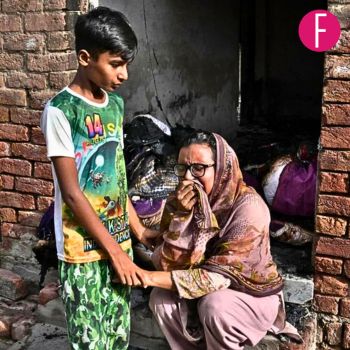
The images and videos circulating on social media are deeply disturbing — hordes of individuals armed with batons and sticks, attacking places of worship and homes, setting them ablaze. Amidst this chaos, innocent Christians are being subjected to harassment, torture, and false accusations of violating the Holy Quran. The spark that ignited this turmoil was the discovery of torn Quranic pages with alleged blasphemous content near a Christian colony.
Tragically, this is not an isolated occurrence. Over the years, Pakistan has witnessed a distressing number of blasphemy cases, often leading to dire consequences for those accused. Data compiled by the Centre for Social Justice reveals a staggering 2,000 blasphemy-related accusations since 1987, with at least 88 deaths resulting from these allegations. The most recent incident involving a teacher’s death and the lynching of a suspect for alleged desecration are grim reminders of the deeply entrenched issue.
Pakistan’s blasphemy laws were meant to protect faith, but they have become tools of persecution. In a nation that prides itself on its Islamic identity, it’s a paradox that these laws are leading us further away from the essence of the faith they seek to defend. Instead of fostering harmony and understanding, they have bred a culture of fear and division.
As a voice trying to navigate the tumultuous landscape of our thoughts and emotions, I find myself grappling with a turmoil that mirrors the paradoxes our nation faces. It’s a struggle familiar to many – the battle to put words to our feelings, especially when our country’s celebrations of independence seem to clash with the harsh reality that unfolds just days later.
How do you express the poignant irony of a nation’s jubilation turning into a cacophony of fear and anguish for its very own citizens? The colorful parades, the spirited chants of patriotism, and the waves of national unity on Independence Day seem to exist in a parallel universe to the images of homes destroyed, lives shattered, and a sense of security shattered.
In the quiet moments of introspection, I can’t help but feel the weight of a collective failure – a failure to uphold the ideals that our founding father, Quaid-e-Azam Muhammad Ali Jinnah, envisioned for our nation. It’s a sentiment that reverberates through the very core of my being, a realization that despite our celebrations of independence, we have fallen short of the grandeur of his words and the promise they held.
Jinnah’s words, “You are free to go to your temples, you are free to go to your mosques or to any other place of worship in this state of Pakistan,” were more than a mere statement; they were a call to arms, an invitation to forge a nation where diversity was meant to flourish, not wither under the weight of intolerance. And yet, as the days unfold, we find ourselves grappling with a stark contrast between his vision and the unsettling reality we inhabit.
The white, they say, is meant to represent the nation’s religious minorities, a canvas of unity amidst diversity. Yet, as we gaze upon this emblem of inclusivity, our hearts are struck not by inspiration, but by a chorus of voices pleading for the promise to be fulfilled.
In the blinding blaze of intolerance that engulfs places of worship, in the desperate cries for justice from those falsely accused, we see the very essence of that white strip being desecrated. Our flag, designed to be a testament to a nation’s commitment to unity, has become a painful reminder of the plight of those who hold faiths other than the majority.
Blasphemy Laws
A report from Amnesty International highlights the troubling misuse of Pakistan’s blasphemy laws, often targeted against religious minorities and falsely accused individuals. The laws have become a breeding ground for vigilantes who employ threats and violence. Amnesty’s Director of Global Issues, Audrey Gaughran, points out that the laws violate human rights, incite extrajudicial actions, and create an atmosphere of fear.
The report, titled “As good as dead”: The impact of the blasphemy laws in Pakistan, highlights the struggle individuals face to prove their innocence after being accused of blasphemy. Police can arrest the accused without proper investigation, often succumbing to pressure from crowds and religious figures. Even acquittal doesn’t ensure safety, as threats persist.
Pakistan’s Supreme Court has acknowledged that “the majority of blasphemy cases are based on false accusations” and are driven by ulterior motives. Such motives, the report says, are rarely scrutinized by the authorities and can vary, from professional rivalry to personal or religious disputes to seeking economic gain.
Between 1987 and the beginning of 2021, over 1,800 individuals faced charges of blasphemy under Pakistan’s diverse anti-blasphemy laws. As of March this year, nearly 40 people found themselves in the grim predicament of serving life sentences or awaiting execution due to blasphemy convictions. Since 1990, a distressing tally of more than 80 individuals has fallen victim to fatal violence stemming from alleged blasphemy accusations. (Eurasia Review)
The blasphemy laws are embedded deep within the collective consciousness, to the extent that even questioning the legitimacy of such accusations can be construed as an act of blasphemy in itself.
Despite the constitutional guarantee of free speech in Pakistan, this safeguard does not extend to speech deemed blasphemous. The protection of Islamic sensitivities often overshadows the right to free expression. It’s rare for the constitutional right to free speech to be invoked as a defense in blasphemy cases. Instead, legal defenses typically focus on challenging the validity of the accusations or arguing that the alleged act does not constitute blasphemy.
In Chapter 2, Verse 256, the Quran’s unequivocal declaration rings out: “There is no coercion in religion.” This resounding affirmation underscores the profound value Islam places on individual agency, demonstrating that the path of faith is one that must be freely chosen, unburdened by force or duress. Similarly, in Chapter 4, Verse 140, the Quran guides Muslims to disengage from blasphemous conversations: “When you hear the verses of God being rejected and mocked, do not sit with them.” Here, the Quran imparts wisdom in advocating a peaceful response to offensive discussions, rather than resorting to aggression.
The graveyards, replete with stories of lives extinguished too soon, beckon us to confront the sobering reality that vigilantism is no righteous path to justice. Instead, it drapes us in the cloak of collective guilt, eroding the very values we claim to protect.

