

The recent face covering or niqab to go into effect on Jan 1st, 2025 in Switzerland is a strange yet predictable exception to the rule in a country where personal liberties are valued over all else. From smokers being allowed to smoke in public places, (including children’s parks), to practically zero ban on nudity, a regulation on what to wear or not to wear by a certain religious community or ethnicity is perhaps, an overstep on personal freedom? One might go ahead and even call it an infringement of basic rights or, a manifestation of the inherent bias that many Muslims see as a given when they settle into lands where Islam might not be the prevalent religion or Muslims, are not present in large numbers.
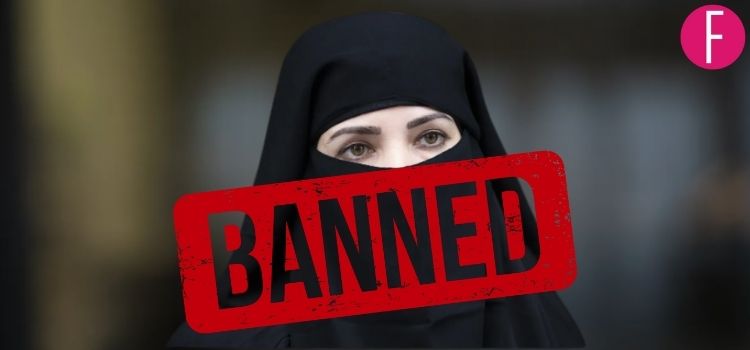
It is but small relief that the referendum (Switzerland votes on everything), was a close cut with roughly 51% of voters saying yes to the ban on a national level. On a cantonal level, Switzerland compromises 23 cantons, 5 of them voted against the ban: Bern, Geneva, Basel Stadt, Zurich, and Appenzell Innerhoden, which demonstrates that most large cities with a cross-section of ethnicities inhabiting the region, tried to hold on to the ‘less-biased’ version of Muslims that is slowly losing its grip in global opinion polls, if there ever were such a thing. Do note that France has already effected a Hijab ban in certain public places, and the fear for many who call out this Swiss ban is that it might be the first step towards effecting a wider ban, that covers the Hijab (head covering) as well.
It is notable to point out that while face covering is a practice perceived more as followed by extremist religious groups, the Hijab or head covering, is practiced by a sizeable proportion of Muslims across the globe, and many of them participate actively in Western and eastern public and professional life, be they teachers, doctors, lawyers, corporate professionals or involved in many other public spheres of life.
Now for the deconstruct: (If we disregard the intention that those who have voted for the ban are doing so because of inherent Muslim bias), here’s what else might be questionable about the ban:
Switzerland is a country where nudity bans are not likely any time soon. One could argue that just like, despite there being no ban on publicly delayering oneself, there should be none on publicly layering oneself, right? So, in the spirit of personal freedoms, let nud-ism and niqab-ism sit side by side to bring home the true taste of Europe. That being said, one hardly encounters a nude person in public, unless one manages to step into a sauna, or steam room, or a naturist hike. In the same way, a public survey estimated that in 2021, there must be a handful or a few more in all of Switzerland who practice the Niqab, yet the referendum went through with a move to ban face covering in Switzerland.
One could also argue that as a rule, covering the face is a personal matter, not one for state regulation. However, compliance is a thing in Switzerland with most of the population knowing that eating or drinking on public trams can be subject to a fine, picking fruit off a tree in open fields is not a done thing, just as recycling or throwing garbage where it belongs is necessary to avoid being fined for not doing so.
Perhaps face coverings in themselves are a matter of debate. Concealing your identity is not the most comfortable way to live one’s life? One would question if their child was being taught by a kindergarten teacher whose face she or he cannot see, or hold a conversation with someone in the tram, or sit beside someone in a public space, not knowing if it’s a man or a woman they’re sitting next to.
But should it matter? Will it matter to a mother or a public citizen? While they might not want their child’s class teacher to cover his or her face, should it be fine if an individual walking in a public area is wearing a face covering?
Will it matter if one is sitting next to a nude someone on the park bench? Or taking their child to the neighborhood park where children are playing in the great outdoors and a group of mothers is smoking in a group near the park benches? Is this acceptable to a non-smoking parent as long as their child is not inhaling the nicotine-flavoured air, but yet, watching them smoke, a visual that might stay with them and become normalized, to try out later?
The question, my dear Watson, is not about what you or I feel is right or wrong, but about personal liberty and freedom, in a land and region that values it highly. And it is in appreciation of this personal liberty that many have made it their home.
In a country where smoking weed is subject to barely any regulations if at all, and there is no minimum age limit to sexual interaction, one wonders, why the Niqab ban took centre-stage, so much so, that a country had to change its constitution over the sight of a few odd people who might be covering their face in a country of nearly 9 million in 2021, the year the Niqab referendum was carried out? (Worldometer).
Western governments and voters who want to clamp down on religious extremism might fail to read the room, as in, in banning a practice that is observed by a handful of people because of whatever reason or threat to the state they deem necessary, they might be alienating a larger segment of society, those Muslims who do not practice the niqab but respect the personal freedoms of those who do. It also calls into question a parallel on human liberty like those mentioned above; is the state really upholding personal liberties or picking and choosing the definition of the same, depending upon who has the louder voice, or vote?
Nations could set themselves up for a challenge once the vote bank shifts, and that, in a country where the workforce is becoming more diverse as we speak, might be a looming issue.
Another referendum in another age? Never say never!
Aur bhi gham hain zamane mein mohabbat (Niqab) ke siwa –Faiz Ahmed Faiz
There are other sorrows in our age, greater than love, says acclaimed writer, poet, philosopher, deep thinker. And we would say the same on the choice to wear or not to wear a piece of cloth.

