

Today, Sikhs and admirers of spiritual wisdom around the world celebrate the 556th birth anniversary of Guru Nanak Dev Ji, the founder of Sikhism and one of history’s most revered spiritual leaders.
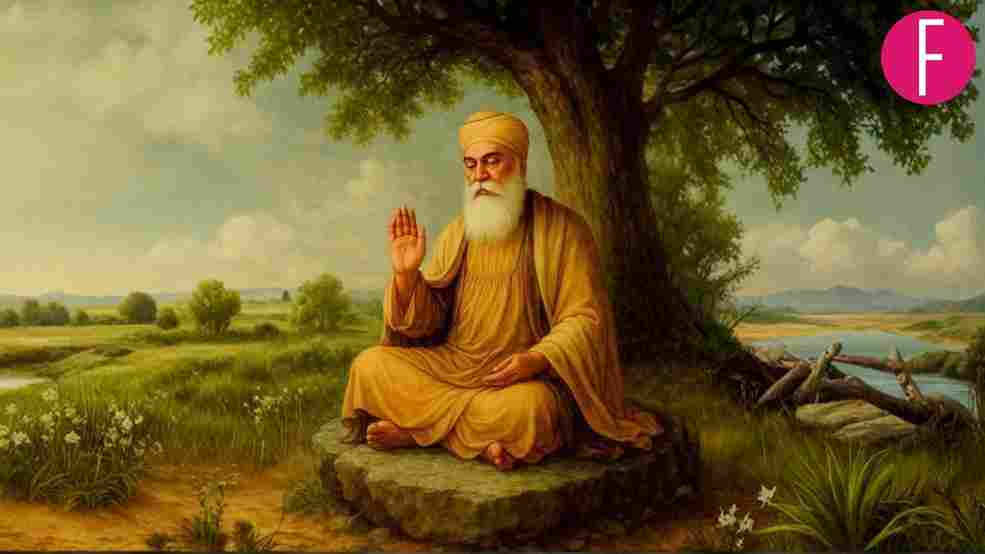
Born on 15 April 1469 in Rai Bhoi Di Talwandi (now Nankana Sahib, Pakistan), Guru Nanak’s life and teachings continue to inspire millions with a message of equality, devotion, and service to humanity.
As per historical and traditional records, Guru Nanak Dev Ji was born in 1469 in Rai Bhoi Di Talwandi (present-day Nankana Sahib, Pakistan) into a Khatri family. His father, Mehta Kalu, was a local revenue official, and his mother, Mata Tripta, nurtured him in a household that valued moral and spiritual principles. From a young age, Nanak showed remarkable intelligence, curiosity, and a contemplative nature. He was deeply aware of spiritual matters and often reflected on the nature of life and God. Even as a child, he is said to have questioned ritualistic practices, social hierarchies, and the inequalities of his society, demonstrating an early inclination toward spiritual insight, justice, and compassion.
Around the age of 30, Guru Nanak Dev Ji experienced a profound spiritual awakening. As recorded in tradition, he disappeared for three days while bathing in a river, and when he returned, he spoke of the oneness of God and the unity of all humanity. This experience became the turning point of his life, deepening his realization that God is formless, eternal, and present in everyone. From that moment onward, Guru Nanak devoted his life to guiding people toward truth, compassion, and righteous living, emphasizing that all human beings are equal in the eyes of the Divine.
Core Teachings
Guru Nanak Dev Ji’s philosophy is grounded in Ik Onkar, the belief in one universal, formless God. He taught that the essence of spiritual life is recognizing this singular Divine presence in all creation and aligning one’s actions with its guidance.
Central to his teachings are three key principles for living a meaningful and spiritual life. The first is Naam Japo, which emphasizes meditating on and remembering God’s name throughout daily life. The second is Kirat Karo, the practice of earning a livelihood honestly and living a life of integrity. The third is Vand Chhakko, which encourages sharing one’s wealth, resources, and blessings with others, fostering equality and community.
In addition to these principles, Guru Nanak strongly advocated Seva, or selfless service to humanity, as a way to live in harmony with God’s will. He rejected social hierarchies, caste distinctions, idol worship, and empty rituals, teaching that true spiritual connection is direct and accessible to every individual, regardless of social status or background. His teachings were revolutionary in their time and continue to inspire millions to live ethically, spiritually, and in service to others. Guru Nanak also strongly condemned idol worship.
Guru Nanak undertook extensive spiritual journeys known as Udāsīs, traveling across South Asia and beyond. These travels allowed him to engage with diverse religious and cultural communities. He promoted unity, peace, and devotion, and challenged societal norms and religious dogmas. While traditional accounts speak of visits to Mecca, Baghdad, Tibet, and Sri Lanka, the essence of these journeys lies in his universal message rather than literal geography.
Kartarpur – A Model Community
In 1522, Guru Nanak settled in Kartarpur, on the banks of the Ravi River (now in Pakistan), establishing the first Sikh community. Kartarpur became a model of communal living, emphasizing equality, shared labor, and the Langar, a community kitchen where all, regardless of social status, could eat together. Guru Nanak demonstrated that spiritual devotion must be paired with honest work and service to humanity.
Guru Nanak composed numerous hymns and poetic works, many of which are included in the Guru Granth Sahib, the central scripture of Sikhism. His compositions, including the Japji Sahib and Asa di Var, continue to guide spiritual practice, moral conduct, and communal life for millions of followers.
He passed away in 1539 in Kartarpur, appointing Bhai Lehna (later Guru Angad Dev Ji) as his successor, establishing the lineage of Sikh Gurus. His life, teachings, and principles laid the foundation of Sikhism and continue to inspire devotion, social justice, and interfaith harmony worldwide.
On this 556th birth anniversary, devotees honor Guru Nanak by reflecting on his life and teachings. Pilgrimage sites such as Nankana Sahib and Kartarpur attract millions of visitors annually. The Kartarpur Corridor, inaugurated in 2019, allows Indian pilgrims visa-free access to the Gurdwara Darbar Sahib in Pakistan.
Guru Nanak Dev Ji’s message transcends time and geography. He taught that true spirituality is a combination of devotion, ethical living, equality, and selfless service. He never judged anyone based on their religion, caste, or background, emphasizing that God is the same for all, whether Hindu, Muslim, or of any faith. His teachings continue to inspire millions to lead a life of honesty, compassion, and universal harmony, making him not only the founder of Sikhism but a timeless guide for all humanity.


Comments 1