

Nearly five tonnes of a toxic, explosive material have been blown up by the US Army in Iowa, bringing an unusual and controversial military operation to a head. While officials say the controlled blasts went better than expected, concerns remain over whether the explosion could leave traces of toxic lead in the surrounding environment, including farmland, homes and water sources.
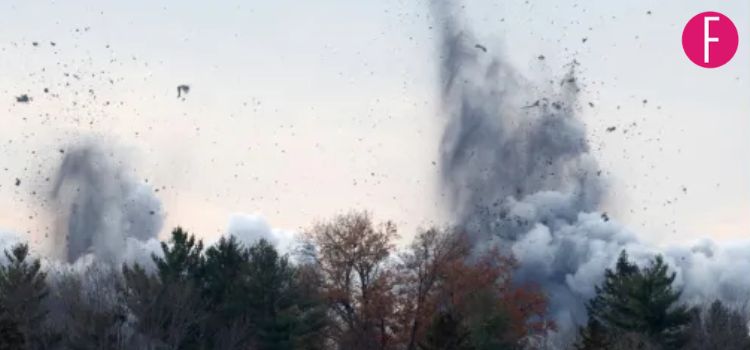
The detonation took place on Wednesday, November 25, at the Iowa Army Ammunition Plant near Middletown, in southeastern Iowa. The operation involved destroying approximately 68 drums containing nearly 9,700 pounds (around 4.4 tonnes) of lead azide, an explosive compound used in the manufacture of ammunition.
Two plumes were seen rising above the facility shortly after the operation began at around 9am local time. Although the explosion itself was over relatively quickly, the environmental questions surrounding it are far from settled.
What exactly was detonated, and why?
At the centre of the operation was lead azide, a highly sensitive explosive compound historically used in ammunition and detonators. While it is an effective material for triggering larger explosions, it also contains lead, a toxic heavy metal that can pose serious health risks to humans and animals.
The material had been stored at the Iowa Army Ammunition Plant, but a routine inspection earlier this year revealed that 68 drums had deteriorated significantly. Over time, the lead azide had recrystallised, making it increasingly sensitive to friction, vibrations, heat and even minor physical disturbances.
In other words, the very material that had been sitting in storage for years had become a potential safety hazard. Moving the drums, opening them or attempting to treat the contents chemically could trigger an accidental explosion.
After months of evaluating possible disposal methods, the Army concluded that destroying the material where it was stored was the safest available option. Officials also warned that falling temperatures could make the already unstable stockpile even more unpredictable, adding pressure to resolve the situation before winter conditions worsened.
Why did the Army’s decision raise concerns?
While the military maintained that a controlled detonation was safer than allowing the material to remain unstable, the proposed operation was not without its risks.
Blowing up a lead-containing explosive could release tiny lead particles into the air, creating a dust plume that might travel beyond the ammunition plant before settling on nearby land and surfaces.
This was particularly concerning because lead is a neurotoxin, and exposure can have serious health consequences. Children, especially those under six, and pregnant women are among the most vulnerable. Lead exposure can affect brain development and the nervous system, while prolonged exposure in adults has also been linked to kidney damage, high blood pressure and other health problems.
There were also concerns about what could happen once the dust settled. Lead particles landing on soil, playgrounds, homes, livestock grazing areas or water sources could create another route of exposure, even after the airborne plume had passed.
Environmental groups challenged the EPA permit that allowed the operation, seeking to stop the detonation over concerns about the potential spread of toxic material. The plan also faced criticism from local residents and officials, particularly over how much information had been shared with the surrounding communities.
The operation was postponed several times amid public backlash, legal challenges and discussions over safety measures. A federal appeals court eventually cleared the way for the Army to proceed.
Why Iowa’s farming landscape made this a bigger concern
One reason the proposed detonation attracted so much attention was its location. Iowa is not just another American state with a few agricultural communities; farming is central to its economy and identity.
Known for its extensive corn and soybean production, Iowa is among the country’s biggest agricultural producers. According to the US Department of Agriculture, the state produced approximately 2.77 billion bushels of corn and 596 million bushels of soybeans in 2025.
This made the possibility of lead particles settling on agricultural land particularly worrying. Farmers, livestock owners and environmental groups wanted to know whether the explosion could affect crops, grazing areas, animals and water supplies.
The concern was not necessarily that the entire state’s agricultural industry would be affected, but that even localised contamination could have consequences for people and livelihoods in the surrounding region.
Around 350 farms were considered potentially exposed to the projected plume, according to reporting by Reuters. However, the actual extent of any contamination will depend on environmental testing rather than projections alone.
What precautions were taken before the explosion?
The Army and several federal agencies put together a series of measures intended to contain the blast and limit the amount of lead dust released into the surrounding environment.
These included constructing large sand barriers around the storage structures, using water systems to suppress dust, and covering parts of the site with foam and other containment materials. The ground around the detonation area was also saturated with water to reduce the possibility of particles travelling through the air.
The Environmental Protection Agency (EPA), alongside other agencies, deployed monitoring teams to collect air, soil and water samples before and after the operation. Researchers also monitored the plume to better understand where particles might travel.
Residents of Middletown and people living in a designated five-mile area southwest of the plant were advised to temporarily relocate. Others in potentially affected areas were told to remain indoors, keep windows and doors shut and limit exposure to outside air.
The operation was eventually carried out on Wednesday morning, with officials saying the extensive precautions were intended to minimise the environmental impact.
What happened after the blasts? Are there any signs of contamination?
The initial reports following the detonation have been encouraging, at least as far as airborne lead is concerned.
According to the EPA, its air-monitoring equipment did not detect lead in the air around the facility following the explosion. Officials also reported that the containment measures appeared to have worked, with the operation successfully destroying the stockpile.
An all-clear was issued around nine hours after the detonation, allowing residents who had temporarily left their homes to return.
However, that does not necessarily mean the environmental impact has been fully established. Air monitoring is only one part of the investigation, and authorities still need to assess whether lead particles settled on nearby soil, farms, homes, playgrounds or water sources.
Further testing by government agencies and independent researchers is expected to provide a clearer picture of what remains in the area. The results will be particularly important in determining whether any locations require additional cleaning or remediation.
For now, there is no confirmed evidence of widespread contamination, but neither is there enough information to rule out localised deposits of lead.
The explosion may have eliminated the Army’s immediate problem with an unstable stockpile, but for the communities around Middletown, the focus has now shifted to what the blasts might have left behind.
Sources: The Mirror, CNN, FOX 4, Everett Post

