

The Prevention of Electronic Crimes Act (PECA) is a law in Pakistan that governs cybercrimes, online content regulation, and digital rights. Enacted in 2016, it was introduced to combat issues like cyber harassment, hate speech, identity theft, and financial fraud in the digital space. However, it has faced criticism for being used as a tool for censorship and political suppression.
Background and Introduction
The Prevention of Electronic Crimes Act (PECA) was introduced in 2016 by the Pakistan Muslim League-Nawaz (PML-N) government with the stated goal of curbing cybercrimes, harassment, and hate speech. The bill was passed at a time when national security concerns were heightened, particularly in the aftermath of the 2014 Peshawar Army Public School (APS) attack. The government justified the law by emphasizing the need to protect citizens from digital threats, misinformation, and online harassment.
However, from its inception, PECA faced criticism from human rights activists, journalists, and digital rights organizations for its vague and broad provisions, which many feared could be weaponized against dissent. The act granted extensive powers to law enforcement agencies, particularly the Federal Investigation Agency (FIA), to investigate and prosecute individuals for online activities deemed offensive, defamatory, or anti-state.
The Widening Scope of PECA: A Tool for Political Control?
While PECA was initially marketed as a necessary shield against cybercrimes, in practice, it has been purpotedly used as a tool for political suppression and censorship. Over the years, it has frequently been invoked to target politicians, journalists, activists, and ordinary citizens who have criticized the government or military on digital platforms.
Since 2017, numerous cases have surfaced where individuals were arrested or harassed under PECA for social media posts that were perceived as critical of state institutions. The act’s ambiguous definitions of “cybercrime” and “fake news” allowed authorities to interpret and apply it selectively, often leading to politically motivated cases. PECA’s provisions on defamation and the protection of state institutions were particularly controversial, as they criminalized online speech that would otherwise be protected under freedom of expression laws.
Amendments and Legal Challenges
In 2022, the Pakistan Tehreek-e-Insaf (PTI) government, under Prime Minister Imran Khan, introduced amendments to PECA, further tightening its grip on digital discourse. The amendments made defamation of state institutions a criminal offense with increased penalties, including up to five years of imprisonment. These changes were widely condemned by media bodies and human rights organizations, which saw them as an attempt to muzzle independent journalism and suppress political dissent.
The Pakistan Broadcasters Association (PBA), All Pakistan Newspapers Society (APNS), and other media organizations challenged the amendments in the Islamabad High Court (IHC), arguing that they violated fundamental constitutional rights, particularly Articles 19 and 19-A, which protect freedom of speech and access to information. In April 2022, the IHC declared the PECA amendments unconstitutional, stating that criminalizing defamation and restricting free speech were contrary to democratic values. The court struck down key provisions of the ordinance, including those that criminalized harming the reputation of individuals or institutions.
The New Amendments
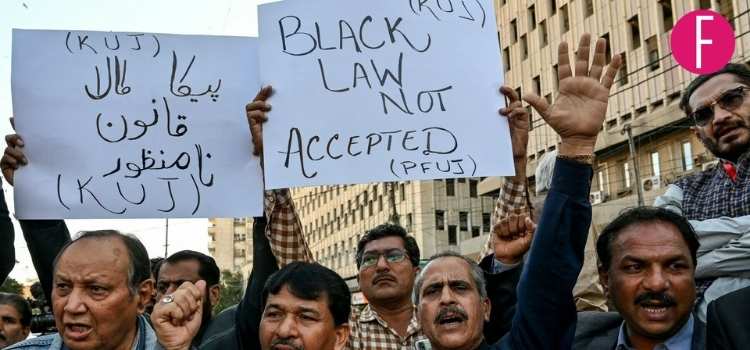
The Senate recently passed amendments to the Prevention of Electronic Crimes Act (Peca) 2016, introducing stricter regulations on online content, particularly targeting “fake news.” These changes have sparked widespread protests from media organizations, fearing they will be used to suppress journalism.
A key addition is Section 26(A), which criminalizes the intentional spread of false information that could incite fear, panic, or unrest. Offenders could face up to three years in prison, a fine of up to Rs. 2 million, or both. President Asif Ali Zardari has now signed these amendments into law.
The legislation also introduces a new regulatory body, the Social Media Protection and Regulatory Authority, tasked with overseeing digital content. This authority will have the power to regulate, block, and remove online material and will require social media platforms to register with it, potentially imposing additional conditions and fees.Under the new provisions, individuals who feel harmed by false information can request the authority to take action, with a response mandated within 24 hours. The authority will also be empowered to order the removal of content deemed contrary to Pakistan’s ideology, inciting lawlessness, or encouraging damage to public and private property.
PECA 2025: A Digital Gag Order Disguised as Regulation
At the heart of this controversy is Article 19 of the Constitution of Pakistan, which ostensibly guarantees freedom of speech and expression. However, like many fundamental rights enshrined in the Constitution, it comes with caveats—permitting restrictions in the name of national security, public order, decency, and morality. Historically, these exceptions have been used as tools of suppression rather than protection. The new amendments to PECA follow the same troubling pattern, providing authorities with an unchecked mandate to determine what constitutes “fake news” or “content against the ideology of Pakistan.” The language of the law is deliberately ambiguous, allowing it to be weaponized against journalists, political dissenters, and ordinary citizens who express critical opinions online.
One of the most troubling aspects of the amendment is the introduction of Section 26(A), which criminalizes the dissemination of any information that could create “fear, panic, or unrest” in society. These terms are so broad that they can be interpreted to mean virtually anything that challenges the state’s preferred narrative. A journalist exposing corruption? That could incite public unrest. A citizen criticizing government policies? That might be construed as causing panic. By failing to define these offenses with precision, the law grants authorities near-limitless discretion to target individuals selectively, turning the judicial process into an instrument of persecution rather than justice.
Beyond the vagueness of the language, the punitive measures outlined in the amendment are deeply disproportionate. With penalties of up to three years in prison and fines reaching Rs. 2 million, the law treats digital expression as a crime more severe than many acts of physical violence. These heavy-handed punishments are not designed to protect the public from genuine harm but to instill fear, ensuring that citizens think twice before speaking their minds online. This climate of self-censorship is particularly chilling for journalists, whose role as watchdogs of democracy depends on their ability to report freely and critically. If every exposé or investigative piece carries the risk of arrest, the result will be a press that is either silent or complicit—both disastrous outcomes for democratic accountability.
Equally concerning is the creation of a Social Media Protection and Regulatory Authority, tasked with monitoring and regulating online content. The introduction of such an authority signals a move toward centralized digital control, where state-appointed regulators will have the power to demand the removal of posts, block accounts, and even require social media platforms to register with the government. This bureaucratic oversight extends beyond mere regulation—it lays the groundwork for systematic surveillance, empowering authorities to track dissenters and eliminate critical voices with efficiency. The prospect of an entity with the power to erase online discourse within 24 hours of a complaint raises serious concerns about due process and fairness. If individuals can be silenced before they even have a chance to contest allegations, the digital space ceases to be a platform for free exchange and becomes a state-controlled echo chamber.
The broader implications of these amendments are grave. In any democracy, free speech is not merely an abstract right—it is the oxygen that sustains political debate, holds those in power accountable, and fosters an informed citizenry. When the government assumes the role of sole arbiter of truth, dissent is automatically branded as deception, and truth itself becomes a casualty. The amendments to PECA do not merely stifle individual voices; they undermine the collective consciousness of society, forcing people into silence out of fear of retribution.
This pattern of repression is not new. Over the years, PECA has allegedly been used as a tool of political victimization, with politicians, activists, and journalists subjected to summons, FIRs, and arbitrary arrests under its provisions. The latest amendments only accelerate this downward spiral, transforming a flawed law into a draconian weapon. Democracy cannot survive in a vacuum where only sanctioned narratives are permitted. A nation that punishes its citizens for speaking their truth is not protecting its people—it is controlling them.
Is Pakistan’s sliding toward digital authoritarianism? The passage of these amendments might mark yet another step in that direction. The right to express, question, and criticize must not be seen as privileges granted at the government’s discretion but as inalienable freedoms that define a just and open society. It is, therefore, imperative for journalists, civil society, and legal experts to resist this encroachment—because once a society accepts silence as the norm, it becomes nearly impossible to reclaim its voice.

