

Are you in love with the vision of Sarmad prepping exotic dishes, brewing chai, and clearing up the kitchen? Or is it Adam’s slight obsession with cleanliness that’s so refreshing? Or maybe it’s Neha’s academic competitiveness (and excellence) or Maha’s total lack of interest in ghareloo matters? Hum Tum is throwing us youth goals that will challenge young men and women to be … themselves? A whisper of a Naya Pakistan, if we want to work towards one.
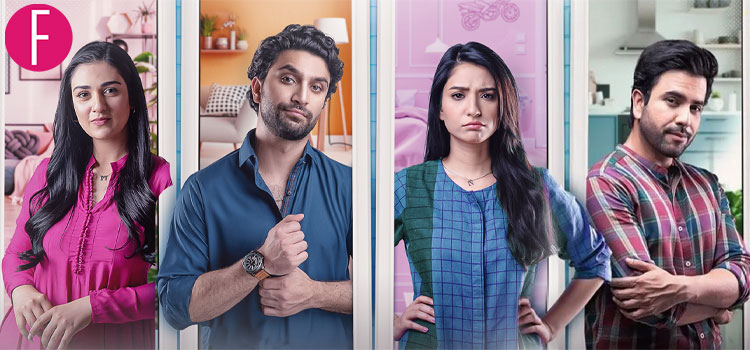
Here are 5 reasons why we feel Hum Tum might help create a Naya Pakistan!
1. Reality Check
At the same time, one can argue that Qutbuddin and Ulfat serve as a stark reminder of how things are in many desi households, their relationship dynamics are far from perfect, and though Ulfat attempts to have her say in a hugely one-sided affair, the utterly dismissive attitude of her husband and the father of her daughters towards the women of the house puts a damper on the otherwise ‘Naya’ storyline. But it also serves as a reminder not to forget that many professor Qutbuddins and Ulfats exist amidst us. And that’s precisely why Hum Tum nudges us to celebrate the Sarmads in our lives and even the Haleemas – non-judgmental young men and sons and self-assured, independent wives and mothers who carry on living, attempting to keep the respect alive in a relationship going very wrong for very long.
There is something endearing about Sarmad & Adam’s frustration yet patient acceptance of their father’s errant ways, and something equally endearing about Maha & Neha’s stance towards their very authoritarian & often unappreciative dad. They might criticize their parents’ actions inwardly, but they keep the respect alive – perhaps because that’s what their moms have taught them. Mind you, it’s not a submissive kind of respect that allows Qutbuddin or Sultan to walk all over them. It’s more of a loving, yet sad kind of respect, coming to terms with people who cannot, will not change but to whom they are bound as family.
2. Hum Tum Highlights A New Face Of Feminism
You don’t have to put down the opposite sex or compete with them if you want to change the way you do things. Hum Tum puts out subtle messaging that just because you, as a woman are more financially successful than the man – case in point, Sultan and Haleema, you can still maintain the semblance of a normal relationship, and not direct your disdain at your spouse, if only for the sake of keeping a pulled-together family life. If Ulfat is criticized by the very dominating and very male prejudiced Qutbuddin, she is assertive enough to stick to her inner Ulfat – she doesn’t sacrifice her self-esteem, she sides with him before her daughters to maintain respect for their father, yet she also empathizes with them where she feels they are in the right.
3. Changing Stereotypes Don’t Stop There!
Daddu shows us how it’s done with a thriving TikTok career and when we throw in Sacha with her IT sharp mind and Mille with her Karate training – you know you have touched the hearts of millions of young and old people who want to change the narrative because it’s what resonates with them! The writer is keeping it balanced and being all inclusive – where our youth want change, perhaps we need to not judge the older generation too, from doing their own thing! Life doesn’t stop at 60, or even 70, and Daddu is showing us how!
4. All This With A Sense Of Humour
Ramazan dramas will only catch the crowd if you serve up a healthy dose of humour. Messages alone, no matter how powerful, will not stick unless they’re packaged in good old comic timing, even if a tad lame, to get the audience listening. And this is where Hum Tum is hitting the high notes.
When Sarmad covertly arranges biryani for Maha’s burnt dinner disaster, when Neha challenges Adam to a Chemistry viva rematch or drives a Vespa, when Sacha fixes dada’s phone IT woes – normalizing nontraditional moments like a breath of fresh air – aaah – life is good! I dream of a Naya Pakistan where these and other stories are possible!
There have been other stories, though admittedly few and far between, where older people are into social media, where women pursue a career or men, a non-traditional male role, but this drama is doing it with flair.
5. A Note Of Appreciation
The success factor here lies with the script, dialogues, situations, and performances that are hitting it out of the park. Junaid Khan is handing out chef goals to aspire to, Ramsha Khan makes us sit up and notice her sharp chemistry skills, Muhammad Ahmed is adding miles to TikTok dada, Sara Khan as Maha is not dismissive of kitchen or housework, she’s merely disinterested in what is deemed as a ‘traditional’ female role in our society, and those subtle nuances make all the difference!
It is imperative that we laud stories and characters laid out in dramas like Hum Tum. And here writer Saima Akram Chaudhry and director Danish Nawaz deserve due credit. They show a middle ground, a way forward minus toxic saas-bahu melodramas, and with a sprinkling of real emotion and hopes – your daughter can grow up to be an IT technician, programmer, or chemical engineer, and your son, a chef, who not only pursues it as a career but also enjoys serving up a meal at home.
Hum Tum is serving perhaps, to liberate us from puraanay role models & also encourage new ones! So tell me folks, if you agree – If Hum Tum is not promising a Naya Pakistan for us, then what is?

