

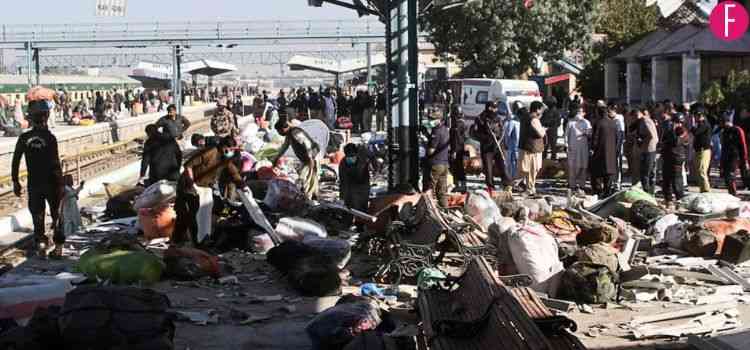
On Saturday 9th November 2024, a devastating suicide bombing at Quetta Railway Station claimed the lives of at least 25 individuals and left at least 50 injured, according to Express News. The attack occurred on the platform as passengers were preparing to board the Jafar Express, which was scheduled to depart for Peshawar at 9:00 AM.
Law enforcement and rescue teams swiftly responded to the scene following the explosion, which caused widespread panic among the crowded platforms. Emergency services were immediately dispatched, and the injured were transported to the Civil Hospital in Quetta, where an emergency was declared. Dr. Abdul Sattar, Medical Superintendent at Civil Hospital, confirmed the casualties included both men and women, with several in critical condition. “Among the injured, 46 have been brought to Civil Hospital, where they are receiving immediate medical attention,” a hospital spokesperson stated.
The explosion, which appeared to be a suicide attack, also injured two railway police officers, Head Constables Ghulam Rasool Jamali and Bhoral Khan, according to SSP Operations Muhammad Baloch. The blast occurred near the reservation office of the station, a location that was heavily populated with passengers waiting for the Jafar Express.
Official Reactions and Condemnations
In response to the attack, Balochistan Chief Minister Sardar Baloch condemned the bombing and called for an immediate investigation into the incident. He expressed his anger over the continued targeting of innocent civilians, stating that the perpetrators would be brought to justice. “These terrorists are now targeting ordinary civilians, workers, women, and children, and they will be held accountable,” Baloch said.
The banned militant group Balochistan Liberation Army (BLA) has claimed responsibility for the blast. Provincial government spokesperson Shahid Rand and Health Minister Bakht Kakr also spoke to the media, suggesting that the blast appeared to be a suicide bombing, and confirmed that several victims’ conditions remained critical. “Seven injured persons are in critical condition,” Rand noted.
The Quetta Division Commissioner Hamza Shafqaat and deputy commissioner of Quetta confirmed that the bombing was likely carried out by a suicide bomber who bypassed the station’s walk-through gates. “The attacker entered through the open entry points of the station,” the Commissioner said. Authorities have initiated snap-checking in various parts of the city, with police and Frontier Corps deployed for increased security.
Broader Implications
Pakistan Railways had resumed train services between Quetta and Peshawar on October 11, following a suspension of over six weeks. The suspension had been enforced after a blast on August 26 destroyed a crucial railway bridge between Kolpur and Mach, an attack claimed by the BLA as part of a series of coordinated assaults across the province. Dr. Noor Ullah of Civil Hospital Quetta reported that an emergency had been declared at the hospital, with additional doctors and staff called in for medical assistance.
This tragic incident is part of a larger surge in attacks by separatist ethnic militants in Balochistan province and Islamist militants in northwest Pakistan. The decades-old insurgency in Balochistan has created significant security concerns for projects trying to access the province’s untapped resources. The BLA, a separatist militant group seeking independence for Balochistan, has been the most active in these insurgent activities.
The Quetta railway station bombing has once again highlighted the severe security challenges faced by Pakistan, particularly in Balochistan province. Thus, as investigations continue and security measures are heightened, the nation mourns the loss of innocent lives and hopes for swift justice against the perpetrators.
Sources: Tribune, Reuters, Bol

