

Words will fail you.
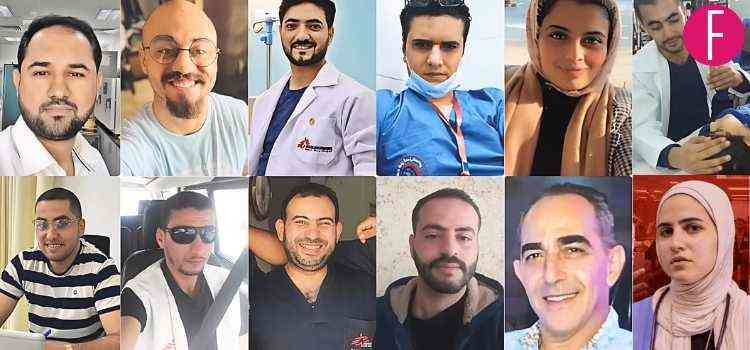
Gaza: Doctors Under Attack was originally commissioned by the BBC but later dropped, before being picked up by Zeteo and Channel 4. The documentary exposes the deliberate and systematic destruction of Gaza’s healthcare system, documenting how over 1,500 doctors, nurses, and healthcare workers have been killed in their homes or workplaces since October 7, 2023. Through harrowing testimony – including accounts of torture, denial of anaesthesia during procedures, and the persecution of medics—the film presents compelling evidence of war crimes and what many experts now describe as ethnic cleansing. It challenges global inaction, questions the silence of world powers, and forces us to confront the chilling possibility that we have normalized the erasure of an entire people.
There is a sinister normalcy in perpetual injustice, suffering, and pain of the same people again, and again, and again. And that is what the perpetrator wants: that we should perceive the suffering as background noise — as a forgotten coffee mug on a kitchen shelf too high to reach, like your child’s lost toy, fallen behind the bedside table, out of sight, out of mind — an abandoned conscience nudged into action only when we shake it hard, really hard.
Abandoned. Just like the people of Gaza.
That’s what Gaza: Doctors Under Attack tries to do. To nudge your sleeping conscience.
It shouldn’t have to try very hard.
Gaza: Doctors Under Attack outlines the systematic destruction of healthcare facilities in Gaza.
Hospital after hospital, doctors, medics, and caregivers under attack.
They were pulled down one by one. The patients, spotted — almost like moving targets — along with the people who cared for them.
This film documents, with witness testimonies, a conscious effort to prevent babies from being born in Gaza, doctors from treating the sick, wounded, pregnant, elderly, and the newborn. It details the persecution and murder of healthcare providers, bringing the population to a subsequent state of malnourishment today, as survivors have dwindling access to food and water.
Gaza: Doctors Under Attack should be on your watchlist before you stream the next Netflix show, drama, or watch a movie in cinema.
Watch it. Share it. Talk about it.
It’s not F1, or Mission Impossible, or Jurassic World.
It’s Gaza: Doctors Under Attack.
And this should be your next watch.
If there is a collective guilt, it should awaken here.
If there is a collective conscience, it should resurface here.
If you want to share your next watch — it should be this one.
The documentary includes disturbing testimony from Dr. Adnan al-Bursh, who was arrested by the Israeli military in December 2023 and, according to a UN report, “subjected to sexual violence in an Israeli prison before he died in Israeli custody.”
It also features shocking accounts of torture at the Israeli prison Sde Teiman, from an anonymous Israeli doctor there, who accuses fellow Israeli medics of being complicit in the abuse of Palestinians held in detention.
There are accounts of performing procedures on patients without the use of anaesthetic, blindfolding them to mute any sensitivity one might feel towards them.
Around 1,500 doctors, nurses, and healthcare workers have been killed at home or in their workplaces in Gaza since the October 7th attack — a conservative estimate — and many have been illegally taken into Israel where they, their relatives, human rights groups, and watchdogs allege they have been tortured, and some of them killed. Attacks on hospitals and healthcare workers are prohibited under international law, but started almost the day after Hamas’s attacks on October 7, 2023, which killed 1,200 Israelis.
With this documentary, the persecution of Gazans at the hands of the Israeli forces has now been documented with evidence that points directly towards ethnic cleansing and genocide.
But it is mind-boggling to perceive that world powers — those who matter, the stakeholders who have a say in global decision-making — aren’t doing enough and more to stop the horrific and harrowing ordeal on Gazans, even as we write this.
Gazans are deprived of access to essential healthcare, water supply, food supply, shelter, and safety. With bullets, missiles, and drones raining down on a population — with children, women, newborns, and babies still inside their mothers’ wombs — one wonders which holy grail the perpetrators and the powers backing them are following.
The question to ask ourselves is:
Would the world sit back and watch if the faces dying in Gaza belonged to a different race, creed, or color?
Why can’t you see them?
In a world where racism still finds its roots in the heart of many conflicts the world over, it is often the quiet conditioning many of us have grown up with, witnessing attitudes and perspectives around us that prevent us from ever really “seeing” the suffering of others who do not look or seem like us.
Perhaps this can be best illustrated in excerpts from a novel written many years ago – a 1989 legal thriller by John Grisham, but whose perspective still stands true today, although we wish it didn’t:
To quote Jake Tyler from John Grisham’s A Time To Kill, who addresses an all-white jury in his closing statement to attain justice for the rape and beating of a ten-year-old black girl:
“Can you see her? Her raped, beaten, broken body, soaked in their urine, soaked in their semen, soaked in her blood — left to die.
Can you see her? I want you to picture that little girl.
Now imagine she’s white.”
The Israeli armed forces are not allowing media personnel to report from Gaza. Hence, any news that comes out — evidence-based testimonies, reports, and experiences — is largely an effort of independent newsmakers, against the repeated clarifications from Israel that they were hunting down Hamas terrorists and suspected the medics, doctors, and caregivers were working for Hamas.
The danger that such logic will become a norm — that medics who treat wounded, injured victims of war are guilty of participating in the act of war or terrorism itself, merely because they treat either:
A) suspected terrorists,
B) the injured who might have sympathies with suspected terrorists
makes these healthcare providers complicit and therefore guilty of terrorism. This is a rationale that goes against international law and, in fact, can be considered a war crime.
But the impact of such skewed reasoning can be dangerously far-reaching in times where the world is riddled with conflict-ridden zones; that what is unfolding before us in real time, of punishing healthcare workers and justifying it as a moral battle code for merely doing their job in saving lives and tending to the sick and wounded, is a dangerous shift in narrative and a new rule-of-war playbook that might be exploited by perpetrators as a precedent in future conflicts.
Perhaps this vision is meant to disturb our sensitivities, to urge action where inaction persists, to flip the narrative and most urgently, and desperately, to save lives where death has become an everyday reality – a new normal.
News Source: Zeteo, Channel 4

