

I flipped this over in my mind multiple times. Did I really witness this? A Pakistani drama hero demanding a rapist marry the woman he raped in order to make amends for his actions? Do our drama creators really believe a woman needs to marry the person who caused her immense physical, mental and emotional trauma – a criminal by all definitions. Is this our way of serving justice? Humrahi just lost the plot.
The Real Life Story
Dawlat Khan, 25, had been sentenced to life imprisonment in May 2022 by the district court of Buner, in north-western Khyber Pakhtunkhwa province, for the rape of a young deaf woman.
This is an excerpt from an article that appeared in The Guardian 2022
After an intervention by the area jirga, or council of elders, a deal was struck between Khan and the family of the woman, who had a child as a result of the attack. Khan was released on Monday after the deal was accepted by the Peshawar high court.
“The parties have patched up the matter by the intervention of the relatives and elders of the family members, which is in the best interest of the parties. The compromise was affected in the best interest of the child and his mother being a special person,” read the court document.
The Fault In the Narrative
Pakistani dramas get many things wrong (and some right), but not this. Not the hero advocating for a marriage between a rapist and a rape survivor – And if you’re wondering why I’m repeating the story so many times, it’s because I have trouble believing an entire production house, director, script writer and cast could allow this plotpoint to slip through the radar… did no one spot the problem here?
Are actors responsible for the characters they play onscreen, one that often endears itself to fans all over the world? The debate is not new – the more seasoned the actor, the bigger the social media and fan following, the more responsibility they shoulder when they reflect a certain persona onscreen. Because by default, they influence more people through the roles they play.
Pakistani drama fans make up a mass following of young people who ascribe qualities in real life to the heroes and heroines they see onscreen. If a hero is seen to stalk a girl he finds cute, to hold her hand without asking her, to forcibly expel a wife or sister out of his house, or physically harm her, the story plays out in multiple homes who might or might not be witnessing a similar real life story line of their own – very similar to the one we see onscreen.
Just like Dawlat Khan’s story.
So when this hero, who has amassed a following, does the same onscreen, with a careless flip of a gun, or an aggressive ‘hero-like’ stance, he endorses the actions of every man offscreen who perpetrates the same in real life, on real people. You cannot shake off the responsibility. Whether we like it or not, Pakistani dramas influence audiences, they are the most biggest social messaging tool we have as a nation and they must be handled with care – the utmost care, more like, a warning banner under every problematic scene that reads: Do not try this at home.
A Script That Failed to Read the Room
That is not to say an actor can’t play a villain, a negative character who represents all the wrongdoings in our society. Because these too, are real life roles that send out messages – how a villain meets his fate. But when it is our main character, a hero or heroine who is shown as a positive character, walking a problematic tight rope – forcing rapist to marry his victim – one has to pull out all the stops. Did no one, absolutely no one, from the drama cast right down to those vetting the script, see anything wrong with the narrative?
How can one be so tone deaf in a world where problematic dialogues are memeified, problematic scenes are held up against a social media filter that screens the tiniest subversion, and problematic plot twists are called out the moment they drop onscreen precisely for what they are – problematic.
Flawed Heroes vs Problematic Messaging
This is not to say that we can’t have grey heroes – heroes or heroines who have flawed reasoning and perhaps – that is a different kind of characterization altogether, and not one we see in Sayhaan, other than his scarred relationship with his dad. And there too, Sayhaan is fully aware of his father’s misdeeds and acknowledges them to be wrong. The message in Humrahi – Sayhaan putting a gun to the villain’s head, asking him to right a wrong by marrying his victim was perhaps a moment that real life women like Rania (Hajra Yamin’s character who was r**ped in the drama) have fought against all their lives.
Forcing a woman to marry her abuser is condemning her to a life of perpetual abuse, terroroizing her for life, binding her in a relationship that the world sees as sacred, and that is merely carried out to protect the very man who should be punished not only for his own crimes, but also be held accountable for his actions – a warning message to all other potential r*pists.
Did anyone say consent?
Rania had already told her potential rapist she didn’t want to be with him. In response, he decided to kidnap her, tie her up and subsequently, rape her. The script so far seemed to tie up as Sayhaan the hero, drops in Superman-like to save her or punish her abuser. But then comes the sad and shocking twist.
“There is only one way out for you” utters Sayhaan. “You have to marry her.”
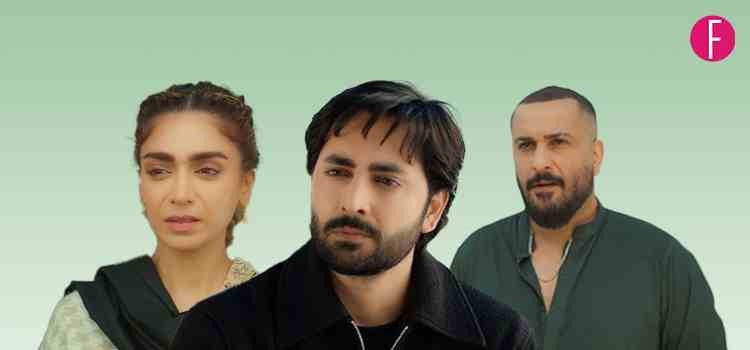
Sayhaan (Danish Taimoor’s character) in Humrahi
I’m at a loss for words…
Rania had already told her potential rapist she didn’t want to be with him. In response, he decided to kidnap her, tie her up and subsequently, rape her. The script so far seemed to tie up as Sayhaan the hero, drops in Superman-like to save her or punish her abuser. But then comes the sad and shocking twist. “There is only one way out for you” utters Sayhaan. “You have to marry her.”
I’m at a loss for words…
This narrative not only allows the rapist to escape punishment but also tarnishes one of the most sacred unions in our world – marriage.
Women in Pakistan have been witness to and victims to this onscreen drama twist in real life. Families have ‘patched up’ in order to help the rapists escape a jail sentence. Local jirgas have accepted this compromise and courts have apparently accepted the jirga decisions over the rule of law. Hence, if anyone watching a drama where the rapist has been forced to marry his victim under the guise of justice served, needs to rethink the perspective – it’s not just a drama. On the other side of the screen might be a woman, a real one, a young girl perhaps, whose rapist wasn’t shot dead by mistake, as in Humrahi, but ended up marrying her.
Humrahi is penned by Zanjabeel Asim, directed by Babbar Javaid and is produced under the BJ Productions banner. The cast ensemble includes Danish Taimoor, Hiba Bukhari, Shahzad Nawaz, Ayub Khosa, Laila Wasti, Nida Mumtaz, and more.
For more, head over to our Instagram:

