

Last night’s episode of Mein helped us note a familiar pattern in our dramas surrounding Haq Mehars. Scroll on to find out what we are talking about…
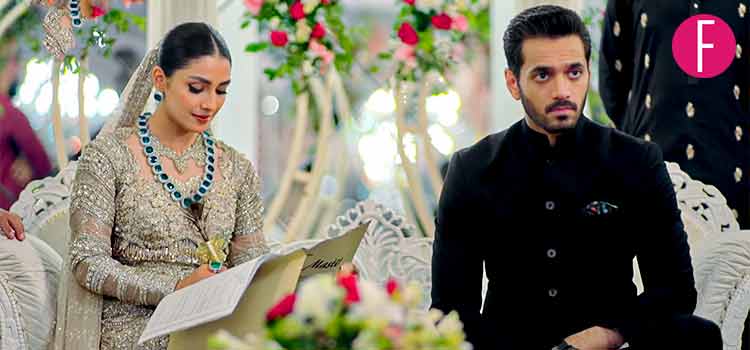
So finally in last night’s episode of Mein, Mubashira (or rather her dad) found her a groom and is now also married in what seemed like a fast forwarded, emergency wedding in only 2 days with a whole new designer dress created for her, from scratch along with customised bespoke emerald and diamond jewellery because after all Mubashira just wants to look the absolute best – not happy, just the best. Zaid is the chosen scapegoat (But he had a part to play too) for Mubashira to try her hand (once again) at an ego boost, oh we meant marriage.
Zaid whom we thought was level headed, grounded and a “say it as it is” kinda guy also fell prey to his ego and “mein” and chose to exact revenge in a rather bizarre manner. Just because his ladylove Ayra audaciously decided (like most normal people) to not entertain his brazen and impatient demand of getting married in court and to declare him as the sole purpose of her life but rather, prioritised her brother who has taken care of her all her life – he decides he is ready to marry Mubashira.
What Caught Our Attention
While Ayra’s dramatic entrance into the wedding venue though unfortunate was rather painstakingly expected and hilarious – the perfect example of the same old stuff. But what caught our attention was when, (by this point the quite recognisable) Molvi Saab announced Mubashira’s Haq Mehar; an entire whopping 1 crore.
What Is A Haq Mehar? (As Per Our Research)
What is a Haq Mehar? Mehar is the obligation in Islam usually in the form of money, jewellery, goods, furniture or land, paid by the groom to the bride at the time of marriage. Marriage contracts or Nikkah nama’s specify the mehar to be paid. In Islam, it is the right of the bride/wife.
While that’s well and good for her, right? But we spotted a pattern…
A Familiar Pattern In Our Dramas
A pattern in our dramas has recently become quite wide-spread… narratives often experiment with the Haq Mehar amount to amplify parts of their storylines or convey the sentiments of the scene. But we wonder should script writers and drama creators not take things like Haq Mehar more seriously? Invest some thought and research before deciding to incorporate it in the storyline? Because at present, they are leaning on a crucial legal and religious clause as a crutch for justifying certain scenes, parts of story line or the best example; to signify class and social status.
Perhaps it’s possible, if we casually keep tossing around the concept of Haq Mehar, we might just end up undermining the contribution and value that this legal clause holds for all women, losing its impact and worth.
Aghu Jaan Having A Problem With Umeed’s Haq Mehar In Fairytale
Another audience favorite drama; Fairytale mapped a similar pattern. Okay sure, the story did add in a wholesome and sentimental bit about Aghu Jan’s memory of her Nikkah and her romantic demand from Dada Jaan for her Haq Mehar to be just Rs. 25 with the promise to love for a lifetime, but if the husband and wife (Umeed & Farjaad) have mutually agreed, Aghu jaan really shouldn’t have grounds for objecting and… was it really fair to compare dowry to Haq Mehar? Anyways, Umeed chimed in how you cant even get a box of fries for Rs. 25 (we agree Umeed) and then in a light hearted manner they reduced the Haq meher amount from Rs 50 lakh to Rs 25.
Does that not jeopardize the entire concept of Haq Mehar being an important religious and legal obligation on the groom’s part and being the wife’s right?
Mubashira’s Whopping Haq Mehar Had A Subliminal Message
And then as we discussed above, in Mein we saw an obnoxiously high amount of Haq Mehar and its tough to deny how it was aimed at amplifying a part of the storyline which was to depict the massive wealth, high social status and class Zaid’s family holds. Is it being loosely used to turn a legal and religious concept into proof of the character’s affluence.
Do We Have A Responsibility?
Are we furthering the negligence of the importance of Haq Mehar for a girl? Are we telling their future in-laws that it can be decided by just anyone in the family when actually, it needs to be mutually decided in a conversation by the bride and groom, or can it be changed and played around with, based solely on sentiments or has to be used as a prop to showcase their riches?
Is this all we are implying the Haq mehar should be based on or related to? Dramas are an impactful source of addressing important concepts and we wish it was done so, in a balanced way guiding the audience in the right direction. So maybe another look at its purpose might help make our stories more convincing, powerful and meaningful!
Do you agree? We aim to initiate a dialogue and meaningful conversations around a topic that affects many in our society. So do let us know your thoughts below.

