

As winter loosens its grip and the days stretch a little longer, millions around the world prepare to welcome Nowruz—the Persian New Year—a celebration of renewal, hope, and the arrival of spring. Steeped in over 3,000 years of tradition, this 13-day festival brings together communities across Iran, Central Asia, the Caucasus, the Balkans, and parts of the Middle East in a joyful embrace of the season’s fresh start. Recognized by the United Nations on March 21 as International Nowruz Day, the holiday is marked with vibrant feasts, music, dancing, and the beloved ritual of deep-cleaning homes to sweep away the past. Translating to “new day” in Persian, Nowruz symbolizes nature’s rebirth and the triumph of light over darkness, making it a cherished time of reflection, renewal, and togetherness.
What Is Nowruz?
While much of the world welcomes the new year in the dead of winter, counting down to midnight with fireworks and resolutions, millions across the Middle East, Central Asia, and beyond wait for a different kind of celebration—one dictated not by the hands of a clock, but by the rhythm of nature itself.
Nowruz, meaning ‘New Day’ in Persian, does not arrive with a date on the calendar, but with the arrival of spring itself. It is a festival as ancient as the Persian Empire, rooted in the Zoroastrian belief that light will always conquer darkness and that the changing of the seasons reflects the cycles of renewal in our own lives. Unlike the modern New Year, which often focuses on personal resolutions and looking ahead, Nowruz is an immersive experience—a blend of ancestral wisdom, natural harmony, and communal joy.
With roots stretching back over 3,000 years, Nowruz is deeply intertwined with Zoroastrianism, an ancient Persian religion that predates both Christianity and Islam. While many historical festivals have faded over time, Nowruz has endured, passed down through generations, making it one of the oldest continuously celebrated holidays in the world. Today, it is observed by nearly 300 million people across Iran, Azerbaijan, Afghanistan, and Central Asia, as well as by Kurdish, Turkic Uyghur, and Parsi communities in South Asia and beyond. It is also an important occasion for Kurdish communities in Iraq, Syria, and Türkiye, as well as for Zoroastrians and Parsis in India and Pakistan, who trace their ancestry to Persian migrants who settled in South Asia between the 8th and 10th centuries.
Nowruz aligns with the spring equinox, the moment when the sun crosses the celestial equator, bringing nearly equal hours of daylight and darkness across the Northern Hemisphere. This astronomical event, which usually occurs around March 20 or 21, symbolizes the rebirth of nature and the triumph of light over darkness. In 2025, the equinox falls on Thursday, March 20, at 12:31:30 PM Iran Standard Time (9:01:30 GMT).
How Is Nowruz Celebrated?
For nearly 300 million people across Iran, Afghanistan, Azerbaijan, the Caucasus, and parts of South Asia, Nowruz is more than just a new year—it’s a sensory explosion of colors, sounds, and flavors. Families embark on Khaneh-Tekani (spring cleaning) to remove the weight of the past year, symbolically sweeping away misfortunes. Streets come alive with Chaharshanbe Suri (fire-jumping celebrations), where people leap over flames, chanting “Give me your redness, take my pallor”—a ritual meant to purge sickness and bad luck. At home, the Haft-Seen table takes center stage, carefully arranged with seven symbolic items, each representing a wish for the year ahead: sabzeh (sprouted wheat for growth), seer (garlic for health), and sumac (the sunrise of a new year).
But Nowruz is not just about looking inward—it is a time for community, reflection, and reconnection with nature. Unlike Western New Year’s traditions, where the focus is often on individual resolutions, Nowruz is deeply tied to collective renewal. The 13-day festival culminates in Sizdah Bedar, when families leave their homes to embrace nature, picnicking in parks and tossing sprouted wheat into flowing water, symbolizing the release of past burdens and the hope for a fertile year ahead.
Food
No celebration is complete without food, and Nowruz is no exception. Across cultures and borders, the Persian New Year is marked by a feast of symbolic dishes that reflect prosperity, renewal, and abundance. While traditions vary, one thing remains constant—food is at the heart of every Nowruz gathering.
In Iran, the table is filled with dishes that celebrate the arrival of spring. Kookoo sabzi, a vibrant green herb frittata, represents rebirth and good fortune, while sabzi polo ba mahi, a fragrant rice dish with fresh herbs and fried fish, symbolizes growth and life. Another staple is reshteh polo, a dish of aromatic rice and noodles that is believed to bring success in the year ahead.
For Azerbaijanis, no Nowruz celebration is complete without plov, a richly spiced rice dish with countless variations incorporating meat, vegetables, and dried fruits. Kebabs and dolma (stuffed vine leaves) are also popular, while sweet treats like baklava and shekerbura—a moon-shaped pastry filled with sugar, nuts, and cardamom—add a festive touch.
In Uzbekistan, sumalak takes center stage—a thick, sweet pudding made from sprouted wheat, slow-cooked in massive cauldrons for hours. The preparation itself is a communal event, with families and neighbors gathering to stir the pot while sharing stories and songs.
For Afghans, a Nowruz meal often includes sabzi challow, a flavorful lamb and spinach curry served over rice. Desserts play a key role, with kolcheh nowrozi, delicate rice flour biscuits, and haft mewa, a traditional dried fruit and nut compote soaked in syrup, bringing sweetness to the table.
Meanwhile, in Kazakhstan, the star dish of Nowruz is nauryz kozhe, a hearty soup made with barley, horse meat, and milk, symbolizing nourishment and unity.
From the delicate herbs of Persian dishes to the rich stews of Central Asia, Nowruz is a celebration that connects people through food. Across continents and cultures, the flavors of Nowruz tell a story of history, heritage, and the universal joy of gathering around the table.
The Haft- Sin Table
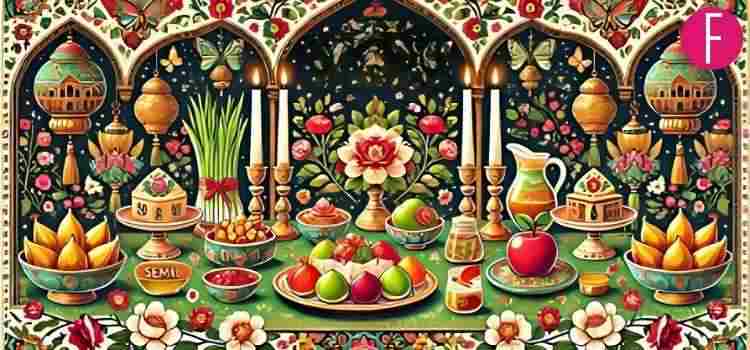
The Haft Sin table is one of the most cherished traditions of Nowruz, bringing families together to welcome the Persian New Year with symbolic offerings. The name “Haft Sin” translates to “Seven S’s”, as the table is adorned with seven items that all begin with the Persian letter “س” (Sin), each carrying deep meaning and representing different aspects of life, renewal, and prosperity.
Before the new year arrives, a special cloth is spread over the table, and the carefully selected items are placed on it. Though the exact origins of this tradition remain uncertain, it is believed to date back to ancient Persia, where people associated certain natural elements—such as fruits, herbs, and spices—with protection, spiritual energy, and good fortune.
The number seven itself holds profound significance in Persian culture and Zoroastrian beliefs, symbolizing creation, balance, and the fundamental elements of existence—sky, earth, water, plants, animals, fire, and humans. Over time, the practice of setting the Haft Sin table became an essential part of Nowruz celebrations, reflecting themes of growth, rebirth, and the hope for a prosperous year ahead.
Special Symbols On The Haft- Sin Table
Each item on the Haft Sin table is carefully chosen for its symbolic meaning, representing different aspects of life, renewal, and prosperity:
- Sabzeh (sprouted wheat, lentils, or barley) – A powerful symbol of renewal and growth, Sabzeh is grown in the days leading up to Nowruz and discarded on the 13th day of the festival, signifying the release of old energy and the embrace of new beginnings.
- Samanu (sweet wheat pudding) – This rich, naturally sweet dish embodies patience, strength, and abundance, as it is made from wheat that requires time and care to sprout and develop.
- Senjed (dried oleaster fruit) – A representation of love and wisdom, Senjed is believed to strengthen relationships and bring emotional stability.
- Seer (garlic) – Known for its medicinal properties, garlic symbolizes health and protection against misfortune and negative forces.
- Seeb (apple) – A vibrant red apple represents beauty and good health, serving as a reminder of vitality and well-being.
- Serkeh (vinegar) – Aged and fermented over time, vinegar signifies patience, wisdom, and the passage of time, acknowledging the lessons that come with experience.
- Sumac (crushed red berries) – With its deep red hue, sumac symbolizes sunrise and the triumph of light over darkness, reinforcing the Nowruz theme of renewal and hope.
Together, these seven elements create a harmonious display of nature’s blessings, reminding families of the values that guide them into the new year—growth, health, wisdom, and love.
Beyond the seven symbolic items, families often personalize their Haft Sin with additional meaningful objects such as a mirror (symbolizing reflection), candles (representing light and wisdom), decorated eggs (for fertility), and even a live goldfish, which signifies the cycle of life.
As the new year dawns with hope, light, and fresh possibilities, may your heart be filled with happiness and your home with laughter. Wishing you a joyful and prosperous Nowruz to all those who celebrate!
Source: Al Jazeera, National Geographic

