

Pakistan’s military has challenged India’s claim that a senior Lashkar-e-Taiba (LeT) commander was killed in an operation in Indian-administered Kashmir, presenting a retired Pakistan Army soldier, identified as Mohammad Asif, alive before the media in Rawalpindi on Thursday.
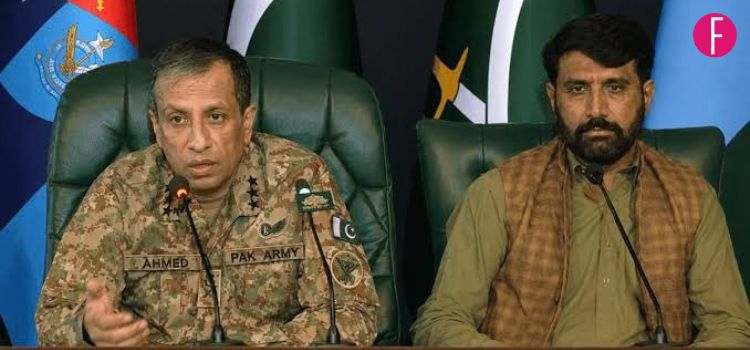
This development followed reports by Indian military and media sources that a militant named Asif, alias Musa or Asif Fauji, was killed in a counterterrorist mission in the region of Korag-Yousmarg in Kashmir. The Pakistani government disputed the claim, with the ISPR Director General Lt General Ahmed Sharif Chaudhry presenting the soldier in front of the press.
Press conference is drawing renewed focus to the competing claims from the two nuclear powers regarding militancy in the disputed territory of Kashmir.
Indian Reports and Pakistan’s Response
As per media reports, this matter came up on September 29, when India’s Chinar Corps declared that a joint operation had been initiated by Indian Army, Jammu & Kashmir Police, and Central Reserve Police Force in the Korag-Yousmarg region based on intelligence information.
The next day, Indian military officials confirmed the recovery of the body of a militant from the Lashkar-e-Taiba group during the course of a search operation. The dead person was later revealed by Indian news agency ANI as Mohammad Asif and by Indian official sources as Musa or Asif Fauji.
As per the statements made by the Ministry of Home Affairs of India, the death of the militant was a huge blow for the organization, saying that he was a high-ranking commander responsible for some big attacks in the region in 2022. As per Indian officials, this man was the only remaining one out of four commanders. But, as per the claims made by the military of Pakistan, the man who was mentioned by Indian sources was a former Pakistan Army officer who had been retired in 2023.
While addressing the press conference in Rawalpindi on October 1, Lt Gen Ahmed Sharif Chaudhry took the reporters through the chronology of the statements by the Indian army and their media coverage. The General termed the incident a “false flag” operation and alleged that the Indian military was trying to connect Pakistan to militancy in Kashmir.
Who Is Mohammad Asif?
Mohammad Asif was seen in the press conference along with the Chief ISPR and responded to the media about the reports of his killing. According to Asif, he joined the Pakistan Army in 2000 and was a member of the Special Services Group (SSG) since 2005. He has served in the army for 18 years and retired as havildar in 2023.
After his retirement, Asif claimed that he was working with a private security firm and had been living with his family in Rawalpindi for the last three to four months. According to him, he was at his residence when his friends called him as they saw the reports of his killing by Indian forces in Kashmir.
Asif informed the reporters that he had convinced his friends that he was doing fine. Moreover, he claimed to be receiving calls from people in India asking for details about his identity, location, and involvement in the militant activities happening in Kashmir.
Denying all the accusations against him, Asif said that the news labeling him as a militant was all wrong. He was surprised at how the Indian media could report him dead by using his national identity card picture.
ISPR Chief Accuses India of Fabricating Claims
The ISPR chief called on India to provide evidence supporting its allegations, saying that the information could be shared directly with Pakistan or presented to a third party for independent examination.
He further alleged that India was attempting to shift attention away from its internal challenges in Kashmir by linking militant activity to Pakistan. These allegations were made by the Pakistani military and have not been independently established.
Lt Gen Chaudhry also warned that any further military escalation would prompt a severe response from Pakistan. He said the country’s armed forces were prepared to respond to any potential threat, while stressing that Pakistan’s counterterrorism efforts should not be influenced by political considerations.
“The counterterror fight cannot be sacrificed at the altar of anyone’s politics,” he said, reiterating the military’s stated position on continuing operations against militant groups.
Indian officials have yet to respond to Pakistan’s claims or address the appearance of the retired soldier, leaving questions surrounding the identification and circumstances of the reported killing unanswered.

