

Torrential monsoon rains continue to batter Pakistan’s Punjab province in what is rapidly becoming one of the most destructive floods in recent years.
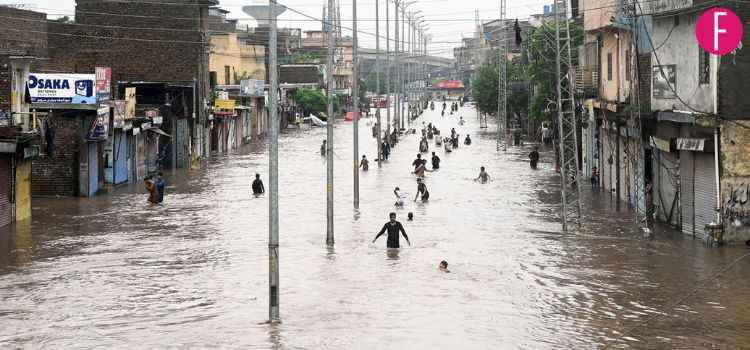
Beginning in late June and intensifying through July, the monsoon has delivered rainfall levels far beyond seasonal averages, submerging major urban centers, destroying infrastructure, and claiming lives daily. Authorities have declared a state of emergency across multiple districts, with evacuations ongoing and the threat of further rainfall looming over the already strained region.
Lives Lost, Cities Drowned: Punjab Buckles Under Monsoon Fury
The scale of the flooding is unprecedented in recent memory. Punjab has recorded over 450 mm of rain in some districts within just 24 hours—a volume normally expected across several weeks. In Chakwal, Rawalpindi, and Jhelum, rain totals broke local records, overwhelming drainage systems and causing widespread flash floods. In Rawalpindi alone, 63 people died in a single day, with the provincial death toll rising above 180 as of July 18. Many victims were children. Most fatalities were caused by electrocution, building collapses, and drownings in low-lying areas. Critical transportation infrastructure has also been severely affected: Motorway M1 has been completely closed due to flooding, while M2 is partially blocked by accumulated water near Chakri. In Islamabad, the F-8 Interchange to 9th Avenue remains closed due to road damage, and traffic congestion has been reported along the Expressway, particularly under bridges where floodwaters have pooled.
What is unfolding in Punjab is not an isolated meteorological event. According to the Pakistan Meteorological Department, rainfall across the country between July 1 and 15 was 82% above the national average. In Punjab, that figure was an alarming 124% higher than the same period in 2024. Meteorologists and climate scientists point to a disturbing confluence of factors: intensified monsoon patterns, record-breaking heat, and accelerated glacial melt.
Rising temperatures are a major contributor to the current crisis. In Gilgit-Baltistan and other northern regions, thermometers have reached highs of 48.5 °C – levels never previously recorded at such altitudes. These extreme temperatures have triggered rapid glacial melt, swelling the tributaries of the Indus River system that flow into Punjab. This excess meltwater, combined with extreme rainfall, is fueling widespread flash flooding across the province.
Streets Became Rivers, and Help Came Late
The ongoing catastrophe has exposed the severe weaknesses in Pakistan’s urban planning and disaster management systems. Many of the buildings that collapsed during recent storms were constructed without adherence to safety regulations, and informal housing developments along nullahs and riverbanks proved especially vulnerable. In urban centers like Lahore and Rawalpindi, outdated and poorly maintained drainage systems were overwhelmed within hours. Entire streets turned into rivers, vehicles were washed away, and thousands of homes were inundated.
Despite the growing scale of the disaster, emergency response has remained reactive rather than preventive. The Punjab government declared an emergency across multiple districts, imposed Section 144 to restrict public gatherings and movement in affected areas. The National Disaster Management Authority (NDMA), Rescue 1122, and Pakistan’s armed forces have been deployed to evacuate residents by boat and helicopter, and to deliver food, clean water, and medical supplies to flooded areas.
Rs 795 Billion Later, Still No Real Warning System
Yet these efforts, while critical, underscore the deeper issue: the absence of climate resilience and long-term planning. In June 2025, the Punjab government unveiled a Rs 795 billion allocation under its “Climate Resilient Punjab” framework, promising to invest in disaster-proof infrastructure, early warning systems, and climate adaptation. However, critics and civil society organizations now question how those funds are being utilized. There is little evidence of substantial progress on flood defenses, urban drainage modernization, or relocation of vulnerable communities.
Videos circulating widely on Instagram and other social media platforms have sparked a wave of concern. In Rawalpindi, footage shows local volunteers and municipal workers walking through flood-hit streets using hand-cranked mechanical sirens to warn people to evacuate. These sirens, which emit a high-pitched sound when manually rotated, have been used in place of any formal or automated early warning system. The use of such rudimentary tools in 2025 has raised serious questions among the public: where is the climate resilience budget going if flood-prone cities still lack basic alert systems? Despite the Punjab government’s pledge of Rs 795 billion under the “Climate Resilient Punjab” plan, the visible absence of functioning warning infrastructure has intensified scrutiny over whether funds are being allocated effectively – or reaching communities at all.
Pakistan’s vulnerability to climate change is among the highest in the world, yet it contributes less than 1% to global greenhouse gas emissions. The monsoon, which accounts for up to 80% of Pakistan’s annual rainfall, has become increasingly erratic and intense under global warming. The 2022 floods, which killed over 1,700 people and displaced more than 30 million, were a stark warning. The events of 2025 confirm that little structural change has occurred since.
A Nation Underwater, A Government Unprepared
Experts warn that without urgent, measurable action, climate-related disasters in Pakistan will become more frequent and deadlier. Climate adaptation cannot remain a slogan – it must be translated into tangible measures such as reinforced riverbanks, reliable early warning systems, investment in resilient housing, and strict enforcement against unsafe construction. The combined effects of monsoon precipitation and glacial melt – both intensified by human-driven climate change – are rapidly escalating the country’s vulnerability. Glacial Lake Outburst Floods (GLOFs) are becoming increasingly common, placing Pakistan’s fragile mountain ecosystems and downstream regions at constant risk. Pakistan ranks among the world’s most climate-vulnerable nations. Yet, adaptation remains painfully slow: of the $10 billion pledged by international donors after the 2022 floods, just $2.8 billion has actually been disbursed. Meanwhile, climate resilience on the ground continues to be hampered by poor governance, fragmented planning, and chronic underinvestment. Without a decisive shift from reactive crisis management to long-term preparedness and prevention, the country will remain trapped in an ever-worsening cycle of disaster and recovery.
As rains continue across Punjab and forecasts predict further downpours into late July, thousands remain at risk. Relief camps are overwhelmed, and infrastructure – including roads, bridges, and hospitals – has sustained massive damage. Rescue operations are ongoing, but they remain hampered by weather conditions, logistical challenges, and fragile infrastructure.
What is happening in Punjab is not simply a natural disaster – it is a climate-driven humanitarian crisis made worse by years of inaction, underinvestment, and neglect. The government has made promises, pledged billions, and declared intentions. The floods of 2025 demand that those words finally translate into action – before more lives are lost and before the next monsoon season strikes.
Sources: DAWN News, Pakistan Today, CNN, BBC, and Al Jazeera.

