


At least 12 people have been killed and more than 300 injured in an attack on Saudi Arabia’s King Khalid International Airport in Riyadh, in what has been described as the deadliest attack on the kingdom in more than a decade. The strike on Saturday, October 10, also brought air traffic to a halt in the Saudi capital, with flights cancelled or diverted as emergency teams rushed to treat the wounded.
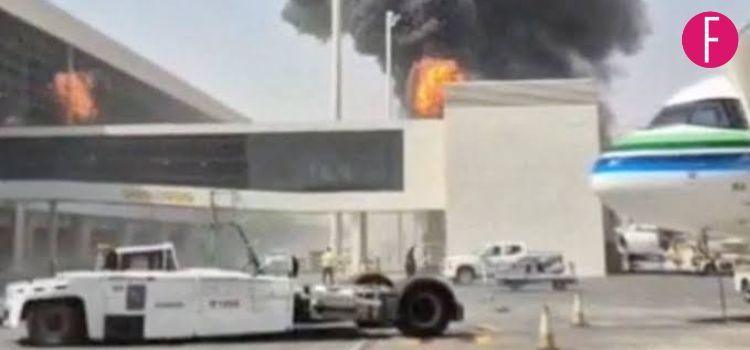
The casualties included four Saudi nationals, two people from Bangladesh and one person each from the United States, Jordan, Palestine, Syria, Sudan and Egypt, according to Saudi authorities. The number of injured was reported at 309, with some in critical condition.
The Saudi-led military coalition blamed Yemen’s Iran-backed Houthi group for the attack and vowed a decisive response, describing the strike on the civilian airport as a war crime. The incident marks a serious escalation in a conflict that has already been spilling beyond Yemen’s borders, with Saudi Arabia increasingly caught up in a wider regional confrontation.
Houthis Warn Airlines and Passengers to Avoid Saudi Airports
The attack was the latest in a series of strikes targeting Riyadh’s airport this week. Earlier attacks had already caused casualties and damaged a Saudi commercial aircraft parked on the tarmac, raising concerns over the safety of one of the kingdom’s key transport hubs.
Following Saturday’s deadly incident, Houthi military spokesperson Yahya Saree issued a warning to airlines and passengers, urging them not to use Saudi airports or airspace. He said the facilities were exposed to targeting and described Saudi airspace, apart from the areas over Makkah and Madinah, as a theatre of military operations.
The group also warned that Saudi Arabia would bear responsibility if its air defences failed to intercept further attacks. The statement raised fresh concerns for international airlines operating in the region, particularly as Riyadh remains an important destination for business travel, religious journeys and international conferences.
Air traffic was severely disrupted after the attack, with flights diverted to other airports and many services cancelled or delayed. Several foreign embassies, including those of the United States, Canada, Germany and Spain, advised their citizens to avoid the airport and surrounding areas.
The warning also puts travellers in a difficult position. Saudi Arabia is home to Makkah and Madinah, two of Islam’s holiest cities, and a major destination for pilgrims. Reports indicated that some passengers travelling towards Makkah were among those injured while waiting for their flights.
Pakistan, UN and US Condemn the Attack
The attack has drawn condemnation from governments and international officials, with calls for an immediate halt to strikes targeting civilians and civilian infrastructure.
Prime Minister Shehbaz Sharif condemned the attack on Sunday, reaffirming Pakistan’s commitment to Saudi Arabia’s sovereignty, territorial integrity and security under the Makkah Joint Defence Agreement. He said attacks on civilian and critical infrastructure were unacceptable and posed a serious threat to regional peace and stability.
United Nations Secretary-General António Guterres also condemned the strike, stressing that attacks on civilians and civilian infrastructure violate international law and must stop. The UN’s special envoy for Yemen, Hans Grundberg, described the latest attacks as a grave escalation that could further threaten regional security and complicate efforts to find a peaceful resolution to the conflict.
The United States has also signalled the possibility of a stronger response. President Donald Trump said Washington was considering whether to join Saudi Arabia in military strikes against the Houthis. US Secretary of State Marco Rubio condemned the attack, noting that an American citizen was among those killed, and expressed solidarity with Saudi Arabia and the victims’ families.
Meanwhile, the Saudi-led coalition has promised to respond to the strike. Although the precise form and timing of any further military action remain uncertain, the combination of the coalition’s warning and Trump’s comments has raised the possibility of a wider confrontation.
Another Front Opens in an Already Tense Gulf
The Riyadh airport attack comes at a particularly volatile moment for the region. The conflict in Yemen, which has involved Saudi Arabia and the Houthis for years, has intensified again after a ceasefire reached in 2022 unravelled over the summer. Saudi Arabia supports Yemen’s internationally recognised government, while the Houthis have continued fighting to maintain and expand their control over territory.
The latest escalation has also unfolded alongside the wider war involving Iran, the United States and Israel, increasing the risk that conflicts across the region could become more closely connected. The Houthis’ recent advances around the Bab al-Mandab Strait — a strategic passage for international shipping in the Red Sea — have added another layer of concern, given the importance of the route to global trade and energy supplies.
Saudi Arabia has carried out air strikes against Houthi-held territory in support of Yemeni government forces, while the group has continued to threaten Saudi targets. The airport attacks show how the renewed fighting is affecting not only military positions but also civilian infrastructure and international travel.
The disruption extends beyond the immediate danger to passengers. Riyadh is due to host major energy and investment events, and the attacks have raised questions about security for international visitors, airlines and businesses operating in the kingdom. Organisers have said scheduled conferences will proceed, but travel warnings and flight cancellations could complicate attendance.
For now, the immediate concerns are the wounded, the safety of travellers and whether further attacks will follow. But the wider question is what happens next. If Saudi Arabia responds militarily and the United States becomes directly involved, the consequences could extend well beyond the airport and deepen an already dangerous regional crisis.
The deaths in Riyadh have made the stakes painfully clear: as the conflict spreads, civilian spaces are increasingly being caught in the crossfire, while the prospect of another round of retaliation threatens to make an already unstable situation even harder to contain.
Sources: Wall Street Journal, BBC, Reuters, Business Reporter