

As conflicts continue to reshape the Middle East, three of the Muslim world’s most influential nations have taken a major step towards strengthening their security ties. Saudi Arabia, Pakistan and Türkiye signed the Mecca Joint Defence Agreement on Friday, marking the first trilateral defence pact between the three countries.
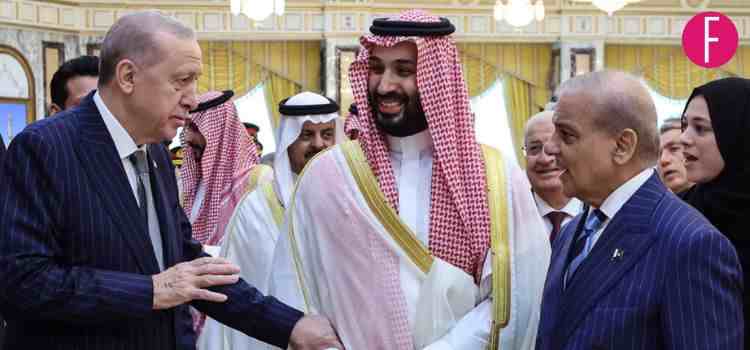
Signed in the holy city of Mecca by Saudi Crown Prince Mohammed bin Salman, Turkish President Recep Tayyip Erdoğan and Pakistani Prime Minister Shehbaz Sharif, the agreement comes at a time when the region is facing mounting instability, from the US-Iran conflict to renewed Houthi attacks on Saudi Arabia and growing concerns over maritime security in the Red Sea.
While officials have repeatedly stressed that the agreement is defensive in nature and not directed at any particular country, it still represents one of the biggest shifts in regional security cooperation in recent years.
What Is the Mecca Joint Defence Agreement?
At its core, the agreement is built around the idea of collective defence. The three countries have agreed that if one member comes under armed attack, it will be treated as an attack against all three.
Alongside that commitment, the pact aims to deepen military cooperation across several areas, including defence planning, security coordination, joint production, military technology, training and future defence projects. Although the full text of the agreement has not been made public, leaders from all three countries described it as a framework for long-term strategic cooperation rather than a temporary response to current events.
Importantly, Türkiye, Saudi Arabia and Pakistan have all clarified that the pact is not intended to replace their existing alliances or international commitments. Turkish officials have also emphasised that the agreement remains compatible with Ankara’s obligations as a NATO member, while Saudi Arabia has insisted that it is neither the beginning of a military bloc nor an attempt to trigger a regional arms race.
Why Now?
The timing isn’t a coincidence.
The Middle East has experienced one of its most volatile periods in years. The US-Israel war on Iran has changed the region’s security landscape, while attacks by Iran-backed groups, e.g. Houthi, have expanded beyond traditional battlefields. Saudi Arabia has once again found itself facing missile and drone attacks from Yemen’s Houthi rebels, with tensions spilling into vital shipping routes such as the Red Sea and the Strait of Hormuz.
Against that backdrop, countries across the region have increasingly begun looking closer to home for security partnerships instead of relying solely on outside powers. The Mecca agreement reflects that changing mindset. Rather than creating an entirely new military alliance, it signals that regional powers are becoming more willing to coordinate their own security, intelligence and defence capabilities when faced with common threats.
Why This Partnership Matters
Each country brings something different to the table, making this far more than a symbolic agreement.
Saudi Arabia contributes enormous financial resources, strategic geography and influence across the Gulf. As home to Islam’s two holiest sites and one of the world’s largest energy producers, its stability carries regional and global significance.
Pakistan adds one of the region’s largest militaries along with extensive operational experience and the distinction of being the Muslim world’s only nuclear-armed state. Its armed forces have long maintained defence cooperation with Saudi Arabia through military training and joint security initiatives. Türkiye, meanwhile, has emerged as one of the fastest-growing defence manufacturers in the world. From advanced drones to military technology and defence exports, Ankara has spent years expanding its defence industry while maintaining NATO’s second-largest military.
Together, the three countries combine financial strength, military capability and growing defence industries under a single security framework.
Building on Existing Defence Ties
The agreement also didn’t appear out of nowhere.
Saudi Arabia and Pakistan had already signed a Strategic Mutual Defence Agreement last year, committing both countries to support one another in the event of external aggression. The new Mecca pact expands that existing partnership by bringing Türkiye into the equation, creating a broader trilateral framework instead of relying on separate bilateral relationships.
The three countries have also steadily increased defence cooperation in recent years through military exercises, defence exports, training programmes and discussions on joint defence production. Friday’s agreement effectively formalises many of those growing ties under one umbrella.
What Happens Next?
The agreement outlines broad principles rather than detailed military obligations, meaning many practical questions remain unanswered. How each country would respond during a future regional conflict, what level of military assistance would be expected and how joint operations would work in practice will likely become clearer over time.
For now, however, the pact serves another important purpose: deterrence.
The message is that any potential attack on one member would no longer be viewed in isolation. Whether or not the agreement is ever activated militarily, it raises the political and strategic cost of aggression by signalling that three influential regional powers now stand behind one another.
As the Middle East continues to navigate shifting alliances and an increasingly uncertain security environment, the Mecca Joint Defence Agreement could prove to be more than just another diplomatic signing. It reflects a broader regional trend towards closer cooperation, greater defence self-reliance and a security architecture increasingly shaped by regional powers themselves rather than outside actors.
Sources: BBC, Dawn, France24, The New York Times, Financial Times, Middle East Eye

