

If there is one place where almost every global crisis ends up sharing the same room, it is the United Nations General Assembly. The 81st session is currently underway in New York, bringing together nearly 130 heads of state and government for the UN’s biggest diplomatic gathering of the year. The high-level general debate runs from September 22 to 28, with leaders using the famous UN podium to talk about wars, diplomacy, humanitarian crises, climate change, security and the issues shaping the world right now.
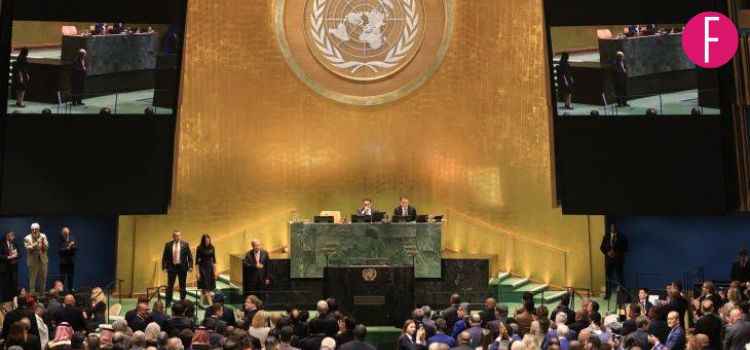
Image Credits: Al-Jazeera
And this year, there is no shortage of things to talk about. The ongoing US-Iran war, Gaza, Ukraine, the future of the UN itself and even the Strait of Hormuz have all found their way into speeches and behind-the-scenes diplomacy. There have also been some particularly striking moments already — from Iran’s president holding up photographs of victims of the war to Emmanuel Macron delivering what is his final UNGA address.
So, as world leaders continue to take the podium, here are five of the biggest moments and talking points from UNGA 2026 so far.
1. Erdoğan Calls For An End To The Gaza War
Turkish President Recep Tayyip Erdoğan did not exactly ease into this year’s UNGA. His address focused heavily on Gaza, with a call for the international community to put greater pressure on Israel to end the war and for countries that have not recognised Palestine to reconsider their position. He also criticised the UN Security Council and once again pushed for reform of a system he argues gives too much power to its five permanent members.
Erdoğan described the situation in Gaza in extremely harsh terms and questioned how the international community could continue watching the humanitarian crisis unfold. He also pointed to the absence of Palestinian Authority President Mahmoud Abbas, who was unable to attend the UN in person after the US denied him a visa.
What made the speech particularly noticeable was how much of it was about the UN itself. Erdoğan argued that an organisation created to protect international peace has struggled to fulfil that purpose when the world is facing multiple wars at once. His wider message was essentially that diplomacy cannot mean much if the international system cannot actually stop conflicts from escalating.
2. Pezeshkian Walked Into The UN With Photos Of Khamenei And Children Killed In The War
If one speech was always going to dominate the headlines this year, it was going to be Iran’s.
Iranian President Masoud Pezeshkian addressed the General Assembly on Wednesday, just a day after US President Donald Trump had stood at the same podium and threatened that Iran could face “annihilation” if it refused to make a deal. Pezeshkian’s response was defiant: Iran, he said, had not surrendered and would not bow to pressure. At the same time, he insisted that Tehran remained open to negotiations — just not negotiations conducted through threats or force.
But it was the images he carried to the podium that really changed the tone of the speech. Pezeshkian held up photographs of the late Iranian Supreme Leader Ali Khamenei, who was killed at the beginning of the war, as well as images of more than 150 Iranian schoolchildren killed during the opening days of the conflict. He used the photographs to argue that Iran had been the victim of attacks rather than the aggressor, telling world leaders that Iranian civilians, including children, had been targeted.
The contrast was impossible to miss. Just 24 hours earlier, Trump had been talking about the possibility of destroying Iran. Pezeshkian arrived with photographs of people Iran says were killed by the attacks and told the US president that Tehran was still willing to talk, but would not accept what he called the “language of force.” A US delegation walked out during his speech.
And what are Iranians themselves making of all this? The reaction is far from one-sided. Al Jazeera spoke to people in Tehran ahead of the speech, with some saying Pezeshkian going to New York was better than staying away but expressing little hope that the UN would actually end the war. One resident said there could be an opening for diplomacy if politicians wanted it, but questioned whether they actually did. At the same time, officials and political factions inside Iran have publicly differed over whether negotiations should happen alongside military pressure.
So while Pezeshkian’s speech was defiant, there was another message running underneath it: Iran is saying it is willing to talk, but it does not believe it should have to surrender first.
3. Macron’s Final UNGA Speech Was Anything But A Farewell
For Emmanuel Macron, this UNGA carries a little more weight because it is his final appearance at the General Assembly before he leaves office next year.
And rather than using his farewell to soften his language, the French president used the podium to warn that the world risks sliding back into what he described as a “law of the jungle”. His speech focused on Gaza and Ukraine, arguing that the international community cannot simply accept a world where violations of international law become normalised.
Macron was particularly critical of the way the Gaza situation was being presented as a diplomatic success. Speaking shortly after Trump had promoted his Gaza peace plan, Macron pointed out that humanitarian access had not actually been restored and questioned what credibility the international community could claim if it remained inactive while civilians continued to suffer.
He also reaffirmed France’s support for Ukraine and warned against allowing attacks on civilian infrastructure to become part of the new normal.
Basically, Macron’s last UNGA speech was less of a goodbye and more of a warning: if international rules only matter when powerful countries decide they matter, then what exactly is left of the international system?
4. The Strait Of Hormuz Has Become A Diplomatic Issue, Not Just A Military One
The Strait of Hormuz may sound like a geographical detail most people would normally scroll past, but it has become one of the most important issues surrounding the US-Iran war.
The narrow waterway connects the Persian Gulf with the Gulf of Oman and is a major route for global energy shipments. The conflict has disrupted shipping through the strait, pushed energy prices higher and turned freedom of navigation into a major issue being discussed at the UN. US officials have said that keeping major international waterways open is a priority, while Iran has linked reopening the strait to wider conditions surrounding the war.
Iranian officials have said Tehran could reopen the strait within seven days if the United States eases military pressure and lifts its blockade of Iranian ports. Iran has also made clear that it does not want the waterway used to move weapons that could then be used against Iran.
That makes Hormuz more than just another issue in the US-Iran conflict. It is now tied directly to diplomacy, international shipping and the global economy.
And interestingly, the UNGA has become one of the places where those negotiations are happening. US and Iranian representatives have held indirect discussions through mediators on the sidelines of the assembly, with the future of the war and the Strait of Hormuz among the issues on the table.
5. The Walkouts Were Almost As Loud As The Speeches
If there is one thing UNGA speeches have taught us over the years, it is that sometimes leaving the room can make just as much of a statement as staying in it. That happened during Erdoğan’s address on September 22, when members of Israel’s delegation walked out of the General Assembly chamber as the Turkish president launched into his criticism of Israel’s conduct in Gaza and the occupied West Bank. Erdoğan accused Israel of what he described as a “genocidal mindset” and argued that the international community could not simply allow the situation in Gaza to become normalised.
And then, just a couple of days later, the walkout happened again — this time as Benjamin Netanyahu took the UN podium. Diplomatic delegations left the chamber as the Israeli prime minister began his address, leaving him speaking to a dramatically thinned-out room.
6. Spain’s Pedro Sánchez Wants To Rewrite The Rules Of The UN
Spanish Prime Minister Pedro Sánchez used his UNGA address to call for major reforms to the UN Security Council, arguing that all regions should have fairer representation and that the veto power of its five permanent members should be removed. His argument was that no country, no matter how powerful, should effectively be able to act as judge in matters where it has its own interests at stake. Sánchez also called for the next UN secretary-general to be a woman from Latin America, pointing out that all nine people to have held the position so far have been men.
Gaza was another major focus of Sánchez’s speech. He reiterated Spain’s condemnation of Israel’s actions in Gaza, describing them as genocide, and highlighted measures Spain has taken in response, including an arms embargo on Israel. His comments came alongside a broader warning that the principles behind the international system — including peace, sustainability and equal opportunities — are facing growing pressure, with Sánchez arguing that weakening international institutions could eventually make them even less capable of dealing with global crises.
For Sánchez, the answer is not to move away from multilateralism but to strengthen it. He argued that countries need to restore trust in the UN and protect the international rules that govern relations between states. With Security Council reform, Gaza and the future of the UN all featuring heavily in this year’s speeches, his address added another layer to one of the biggest questions hanging over UNGA 2026: how can an organisation created for the whole world remain effective when its structures no longer reflect the world it is supposed to represent?
7. Guterres Is Saying Goodbye — And Leaving The UN With Some Very Big Problems
While world leaders have been talking about the crises outside the UN, Secretary-General António Guterres has also been looking inward.
This is Guterres’ final UNGA as secretary-general after a decade in the job, and his farewell address was essentially a diagnosis of a world that has become increasingly difficult for the UN to manage. He warned about widening divisions over war and peace, inequality, climate change and artificial intelligence, while also calling for reforms to the UN Security Council and stronger international cooperation.
AI, in particular, has become a surprisingly big part of this year’s UN conversation. Guterres has repeatedly argued that the technology needs international rules and oversight, especially when AI begins influencing decisions that can affect people’s lives. At the same time, he has called for the UN to remain relevant in a world where wars are multiplying and trust in international institutions is increasingly being questioned.
And that may actually be the bigger story of UNGA 2026.
For all the dramatic speeches, walkouts, threats and diplomatic meetings happening in New York, the underlying question is whether the UN can still function as the place where countries come together when they cannot agree on almost anything else.
This year’s theme is “Restoring trust, managing transformation: a United Nations that delivers for all.” Judging by the first few days, restoring that trust may be considerably easier said than done.
But that is also why UNGA still matters. For one week, countries that are fighting each other, negotiating with each other and sometimes barely speaking to each other are all forced into the same room. Whether that produces peace is another question — but right now, with wars stretching across the Middle East and Europe, there are few places in the world where those conversations can happen on quite this scale.
Sources: Al-Jazeera, CNN, Aaj News, CNBC, Daily Sabah, Dawn

