

After a record-breaking tenure as Bangladesh’s longest-serving leader, Sheikh Hasina’s reign came to a dramatic end this Monday. Having served as prime minister for 15 consecutive years, with an earlier five-year term, Hasina held the title of the world’s longest-serving female head of government. Her sudden resignation and flight from the country marked a turning point in Bangladesh’s political landscape.
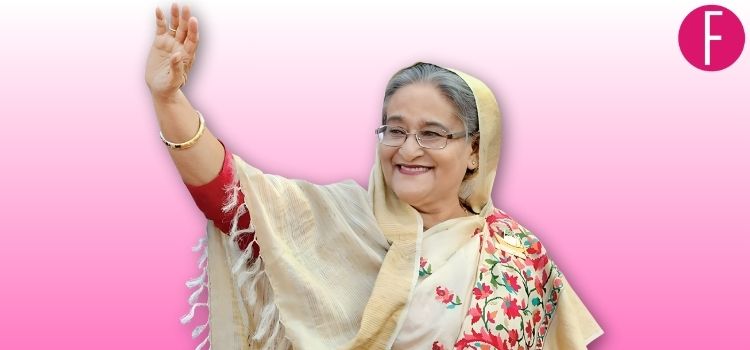
The catalyst for this upheaval was a wave of violent protests against a controversial quota system for government jobs, which quickly evolved into a broader outcry against her administration and the Awami League party. As Bangladesh enters a new era, local media captured the dramatic scenes of protesters storming Hasina’s official residence, the Ganabhaban, celebrating the end of her rule. To know more about her, read on.
A Journey Of Loss
Sheikh Hasina, daughter of Sheikh Mujibur Rahman—Bangladesh’s “Father of the Nation” who led the country’s independence from Pakistan—suffered immense personal loss when her father and several family members were assassinated in a 1975 military coup. Following this, Hasina and her sister sought refuge in India, where they lived in exile for several years. Upon returning to Bangladesh, Hasina took on the leadership of the Awami League, continuing her father’s legacy in the country’s political arena.
During General Hussain Muhammed Ershad’s military rule, Sheikh Hasina joined forces with other political parties to lead pro-democracy street protests. Her role in these movements helped elevate her to the status of a national icon. She first assumed office in 1996, and her tenure was marked by significant achievements, including negotiating a water-sharing agreement with India and a peace deal with tribal insurgents in south-eastern Bangladesh. However, her government also faced criticism for alleged corruption in business dealings and for being perceived as overly accommodating to India.
The Battling Begums
In 2001, Sheikh Hasina was defeated by Begum Khaleda Zia of the Bangladesh Nationalist Party (BNP), who had once been her ally but had become a fierce rival. Both women, as heirs to prominent political dynasties, dominated Bangladesh’s political landscape for over three decades, earning the nickname “battling begums”—where “begum” signifies a woman of high rank in Muslim tradition. Their intense rivalry led to severe political unrest, including bus bombings, disappearances, and extrajudicial killings. Despite this tumultuous period, Hasina returned to power in 2009 through elections held under a caretaker government.
Under Sheikh Hasina’s leadership, Bangladesh has undergone a remarkable transformation. Once one of the poorest nations globally, it has become one of the fastest-growing economies in the region since she took office in 2009. The country’s per capita income has tripled over the past decade, and the World Bank reports that over 25 million people have been lifted out of poverty in the last 20 years. This impressive economic progress is largely driven by the garment industry, which has seen significant growth and now represents the majority of Bangladesh’s exports, catering to markets in Europe, North America, and Asia.
Politics of Terror?
Sheikh Hasina returned to power in 2009, overseeing notable economic growth but also becoming increasingly autocratic. Her administration has been marked by a crackdown on free speech, dissent, and opposition. Critics accuse her of using security forces, including the controversial Rapid Action Battalion, to target and even eliminate opposition members and dissenters, as well as to manipulate election outcomes.
The judiciary, traditionally a bipartisan institution, also faced criticism for being compromised during her tenure, with a chief justice fleeing the country after opposing her rulings. The mainstream media, largely controlled by businesses linked to the Awami League, has been allegedly used to shape a narrative that portrays Hasina’s supporters as the rightful custodians of the country’s legacy, while depicting dissenters from the Bangladesh Nationalist Party and Jamaat-e-Islami as treasonous or extremist. In this climate, former Prime Minister and opposition leader Begum Khaleda Zia was imprisoned in 2018 on corruption charges, and a prominent figure from Jamaat-e-Islami was executed in 2016.
Downfall Marked By Student Protests
The latest protests have presented Sheikh Hasina with the most significant challenge since she assumed office. These demonstrations followed a contentious election in which her party secured a fourth consecutive term. What began as a protest against job quotas in civil service expanded into a broader anti-government movement. Hasina’s administration responded with a violent crackdown, using a police force that resulted in over 200 deaths and many injuries.
As pressure mounted for her resignation, Hasina remained steadfast, denouncing the protesters as “terrorists” and calling for strong measures to suppress them. Her government detained hundreds of people and leveled criminal charges against many more. The unrest was exacerbated by the rising cost of living and economic struggles post-pandemic, including skyrocketing inflation, a sharp decline in foreign exchange reserves, and a doubling of foreign debt since 2016.
Critics attribute these economic issues to the government’s mismanagement and argue that the previous economic successes benefited only those aligned with Hasina’s Awami League due to widespread corruption. They also contend that the country’s economic growth came at the expense of democracy and human rights.
The protests intensified after Hasina labeled the demonstrators as “Razakars,” a term referring to those who collaborated with Pakistan during the 1971 war. Between July 10 and July 20, the unrest saw more than 180 fatalities during one of the most turbulent periods of Hasina’s 15-year rule. The Supreme Court intervened on July 21, abolishing the job quota policy and mandating that 93 percent of positions be filled based on merit.
Despite the policy change, protests continued, with students and other citizens rallying to demand justice for the victims and calling for Hasina’s resignation. Hasina and her cabinet members maintained their defiant stance, attributing the unrest to opposition forces.
It’s fascinating how the essence of revolution has been redefined by younger Bangladeshis, particularly Gen-Z students, who have risen as the unexpected force challenging Sheikh Hasina’s entrenched authority. Often dismissed by older generations as apathetic or idealistic, these young activists have demonstrated a remarkable blend of resilience and ingenuity. This uprising illustrates a critical shift: the tools of modern connectivity are not just auxiliary but central to contemporary movements. It raises profound questions about the traditional dynamics of power and the evolving role of youth in shaping political landscapes. As we witness this shift, it’s clear that the so-called ‘naive’ generation is not merely a passive observer but a formidable force capable of redefining the boundaries of activism and governance.

