

Farhan Saeed and Mamya Shajaffar, who we will soon see together in the Eid ul Adha release Luv Di Saun, took some time out to sit down with us at FUCHSIA HQ for a conversation about the film and more. Read up!
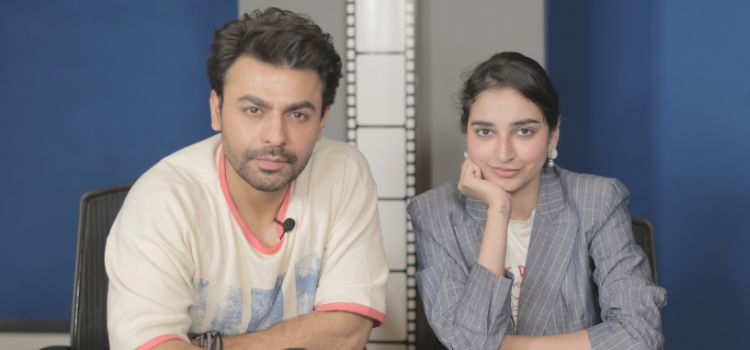
This article is an excerpt from FUCHSIA’s YouTube interview!
Why did you guys sign this film? — A candid chat with Farhan Saeed & Mamya Shajaffar
We were genuinely curious going into this one — what made them say yes to Love Di Saun, and how did the whole thing even land in their lap?
Farhan Saeed didn’t hesitate to take us back to the beginning. For him, it wasn’t just another script that came through the usual channels — it was personal. He shared that the film is produced by Irfan Malik, someone he’s known and worked closely with for years, especially from projects like Tich Button and various ARY dramas.
“He’s like a brother to me,” Farhan said, talking about Irfan Malik.
And that connection mattered. After Tich Button, the offer came again — but this time, it wasn’t just the relationship that pulled him in. It was the story. Farhan explained that when the director, Imran Malik, narrated it to him, his first reaction was honestly surprise.
“The first expectation you get from a film script is either a romcom… or a romcom,” he said with a laugh. “But this wasn’t that at all.”
He made it clear — he has nothing against romcoms, but this film stood out because it wasn’t one. Instead, it was something layered.
“It’s a serious subject… there’s a message. There’s comedy, drama, action — everything a good script needs.”
What really excited him was that it felt different from anything he’d seen in Pakistani cinema before. That uniqueness, he said, is what pulled him in. But he also got real about the process — it wasn’t all smooth sailing. Farhan admitted that the shooting style surprised him. Coming from dramas and more modern film setups, this felt… old-school in a way.
“There are five dialogues in a scene, and one is said from one angle… that’s it. We’re not used to that anymore.”
He explained how today’s actors usually do full master shots and let editing shape the scene later — but here, everything was planned in a very “classic Lollywood” way. And honestly, he said, that initially confused them… even frustrated them.
“It made us angry, I won’t lie,” he admitted honestly. “But eventually you let go… and become a director’s actor.”
Over time, he says he learned to trust the vision completely — surrendering to the director’s process instead of trying to control it. He also praised the overall set experience, calling it very “filmy” in the best way possible, especially working with cinematographer Faisal Bukhari and a team of highly experienced filmmakers.
“It was different for us… music videos aren’t like this, dramas aren’t like this. It was a new learning experience.”
Mamya Shajaffar also echoed a similar feeling — for her, it was the story that sealed it. She said Irfan Malik was very convincing, but more than that, the script itself felt like something she hadn’t seen before.
“The story was very sellable for me,” she shared. “Farhan was right — it’s something you haven’t really seen before.”
She described it as a genre-bending film with spice, emotion, tragedy, and action all packed together. “It’s not just one thing… it’s a mix of everything.”
And that, she said, is what made her want to be part of it — something fresh, something different, and something that doesn’t fit neatly into one box.
Does cinema shape our idea of love? — Farhan Saeed & Mamya Shajaffar get candid
We asked them something a little deeper this time — do films actually shape how we understand love? Do they quietly teach us what romance should look like?
Mamya Shajaffar felt this impact is real, even if we don’t always notice it. She said it works both ways — good and bad — and a lot of it depends on what people grew up watching.
“I think subconsciously, somewhere it happens… in a good and a bad way.”
She pointed out that earlier films often shaped how people expressed love in real life, especially when emotional openness wasn’t commonly taught. She gave a very honest example — how boys, in particular, often learned ideas of romance from movies because they weren’t really taught how to express feelings directly. And sometimes, she said, that blurred the line between cinema and reality in ways that didn’t always feel healthy.
Farhan Saeed, on the other hand, brought in a more controversial but very honest take — he said men and women often experience love and romance in completely different emotional worlds.
“There are two different worlds we live in — one is girls’ world, one is guys’ world.”
According to him, women tend to be more observant and emotionally expressive, while men often don’t naturally process or communicate emotions in the same way. He admitted this gap can create misunderstandings in relationships.
“Girls are so sensitive and deep observers of everything… that’s romance for them.”
For him, this difference is exactly where the struggle lies — and why communication and constant reminders matter so much in relationships.
Does love stay exciting forever? — Farhan Saeed & Mamya Shajaffar on what really changes after marriage
We asked them something many people wonder about — does love stay exciting forever, or does it naturally settle into something calmer over time? Is it a myth that the “spark” should always remain the same?
Mamya Shajaffar shared a very grounded take — for her, love doesn’t lose excitement, it just changes shape. She said calmness is actually a beautiful part of love, not something to be disappointed by.
“Calmness is great. It brings peace, it brings stability.”
For Mamya, a complete relationship has space for both peace and passion — not one without the other. She explained that people are always changing, and so relationships naturally evolve too.
“A person keeps changing… as you grow, your partner is also changing.”
And instead of resisting that change or pretending to stay the same, she believes couples need to grow together — because that shared growth is what keeps things alive. If people pretend nothing is changing, she says, that’s where the real distance starts.
Farhan Saeed agreed, but put it in a very straightforward way — expecting constant excitement, he said, is actually a wrong idea.
“Thinking that excitement would stay the same is a bad idea.”
For him, love starts with excitement, but eventually transforms into something deeper: comfort, friendship, and emotional safety. He described it as learning how to live with someone in every sense of the word.
“How much can you talk, how much can you share, how much can you laugh, how much can you cry… that becomes everything.”
He also made an important distinction — excitement doesn’t disappear, but it shouldn’t be the only foundation of a relationship.
“For excitement, do other things. Don’t use somebody only for excitement.”
To him, the strongest relationships are the ones that settle into comfort without losing connection.
Want to hear more? Stay tuned for full conversation coming out soon on FUCHISA’s YouTube channel!

