


Kharg Island is not the kind of place that usually makes headlines, but right now, it’s at the centre of a conversation that goes far beyond its size.
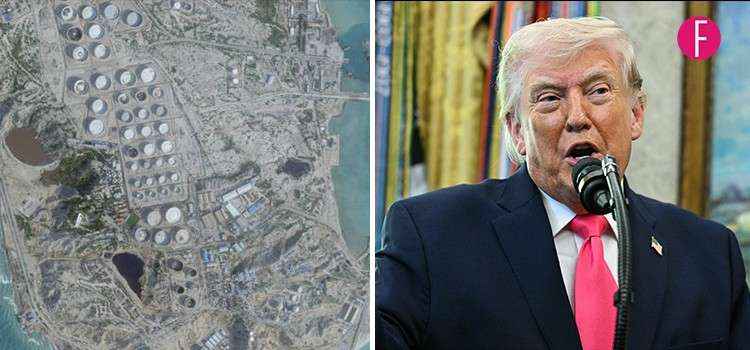
Sitting just off Iran’s southern coast in the Persian Gulf, Kharg is a small, tightly controlled island that functions as the backbone of Iran’s oil exports. It doesn’t produce oil itself, but almost everything Iran pumps out eventually passes through here. Pipelines from major oil fields lead straight to this island, where crude is stored and loaded onto tankers before being shipped across the world. That’s what makes it so critical. It’s not just another facility, it’s the main exit point for a country whose economy heavily depends on oil.
This is exactly why Donald Trump has been openly talking about it. In recent statements, he’s suggested that the United States could target or even take control of Kharg Island as part of its pressure strategy against Iran. The idea, at its core, is about leverage. If you control the point where a country exports most of its oil, you’re not just disrupting trade, you’re directly squeezing its economy.
But that’s where things stop being straightforward. On paper, Kharg might look like an easy target because of its size. In reality, it’s anything but. The island sits very close to Iran’s mainland, which means any foreign presence there would be within immediate reach of Iranian military response. Missiles, drones, naval forces, all of it can be deployed quickly. Taking control of Kharg is one thing, but holding it in the middle of an active conflict zone is a completely different challenge.
The United States has been signaling that a ground operation targeting Kharg Island is on the table, with military planners discussing the deployment of paratroopers and Marines to seize or raid the strategically crucial oil hub. While no official decision has been confirmed, the buildup of forces and logistical preparations suggest the possibility of such an operation is being seriously considered. President Donald Trump has even hinted that U.S. forces could take control of the island “very easily,” framing it as a tool to pressure Iran into reopening shipping lanes and making concessions. On the Iranian side, the Islamic Revolutionary Guard Corps (IRGC) has responded with stern warnings, stating that any attempt to occupy or attack Kharg would be met with decisive and forceful retaliation. Iran has reportedly bolstered defenses on the island, adding troops, missile systems, and air defenses to deter or respond to any incursion. The situation reflects a high-stakes standoff, where U.S. ambitions for strategic leverage collide with Iran’s determination to defend one of its most vital economic and energy assets.
There’s also the question of what happens next. Even if the US were to successfully disrupt or take over operations on the island, the consequences wouldn’t stay contained. Iran’s economy would take a hit, yes, but the reaction wouldn’t be passive. There’s a strong possibility of retaliation, not just on Kharg, but across the region. Oil infrastructure in neighbouring countries, shipping routes, and military assets could all become targets. That’s how a single strategic move can quickly escalate into something much bigger.
And then there’s the global angle. Kharg Island isn’t just important to Iran, it’s part of a larger system that keeps global oil supply moving. Any disruption there affects prices, supply chains, and economic stability far beyond the Middle East. We’ve already seen how sensitive global markets are to conflict in this region. A direct hit to a major export hub like Kharg could push things even further, sending oil prices up and creating ripple effects worldwide.
What makes this situation even more complicated is the uncertainty around Trump’s actual objectives. He has hinted at multiple aims—pressuring Iran over the Strait of Hormuz, influencing negotiations on their nuclear program, or even applying broader economic pressure—but it’s not entirely clear which, if any, would define a final goal. When the strategy targets something as critical as Iran’s main energy lifeline, the consequences are rarely contained, and the risks can spiral far beyond the immediate aim.
At the end of the day, Kharg Island is a reminder of how something geographically small can carry enormous weight politically and economically. Any move to control it isn’t just about territory, it’s about influence, power, and the kind of consequences that don’t stay contained for long.
Sources: Dawn, Al-Jazeera, CNN, Sky News
Comments 1