

The legal status of Basant in Pakistan remains suspended between nostalgia and necessity—between a cultural tradition beloved across Punjab and a public safety framework that has, for two decades, treated the festival as a lethal threat. As of late 2025, however, the conversation has shifted. Lahore’s administration is preparing a cautiously engineered “controlled revival” for early 2026, raising fresh questions about whether Basant can return without repeating its tragic history.
The Law: What Actually Governs Basant?
The primary legislation is the Punjab Prohibition of Kite Flying Ordinance, 2001, a law that does not outlaw kite flying in its entirety but places sweeping restrictions on all “dangerous kite flying activities.”
Under this ordinance, it is illegal to use:
- metallic wire,
- nylon cord (tandi), and
- chemically or glass-coated manjha (sharp string designed to cut opponents’ kites).
Because these materials have caused numerous deaths and infrastructure failures, violations fall under cognizable and often non-bailable offences, empowering police to arrest individuals without a warrant. Over the years, amendments have further stiffened penalties—ranging from months to years of imprisonment—against both users and manufacturers of hazardous materials.
Importantly, traditional cotton dor is still legal. The major legal and safety problem has never been the kite itself, but the lethal evolution of the string.
How Basant Turned from Celebration to Crisis
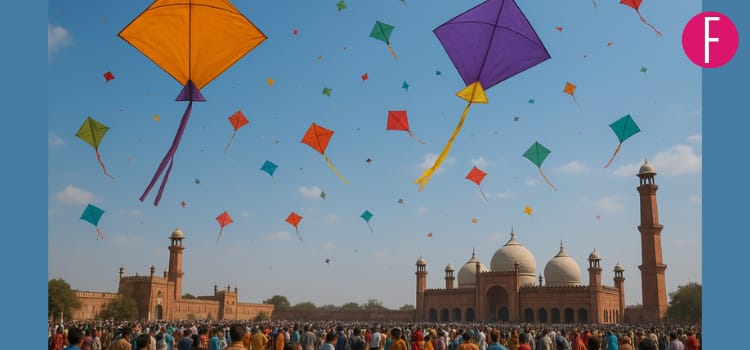
Basant—rooted in the centuries-old spring festival of Vasant Panchami—remains one of Punjab’s most iconic cultural practices. Lahore, in particular, transformed the event into a citywide spectacle, with yellow-clad crowds, rooftop festivities, and skies filled with dancing kites.
Yet by the early 2000s, a recreational tradition turned violent. The rise of paicha—competitive kite battles—triggered an arms race in string manufacturing. Cotton thread was replaced with:
- crushed-glass-coated manjha,
- chemical strings,
- metal wire, and
- industrial-strength nylon.
These strings were not merely dangerous—they were lethal. Motorcyclists were the primary victims, with razor-sharp strings slitting throats and causing fatal accidents. Power lines were routinely entangled, damaging WAPDA’s grid and causing widespread outages that cost billions.
Public outrage peaked in the mid-2000s. The situation prompted the Supreme Court’s suo moto intervention, leading to successive bans in 2005 and again in 2007 after a brief, failed attempt to restore Basant for 15 days. The deaths during that short relaxation erased political will for revival, and the ban has, effectively, held ever since.
The 2025–2026 “Safe Basant” Revival Attempt
Two decades after the ban, Punjab’s government is experimenting with a more regulated model. As of late 2025, Lahore authorities are moving toward a highly controlled relaunch of Basant for 2026—an approach that attempts to preserve the festival while addressing the underlying safety crisis.
Key components of the revival plan include:
1. Designated Kite-Flying Zones
The new Basant will not take place across rooftops citywide. Instead, kite flying is proposed only in specific controlled areas—such as Changa Manga, designated parks, or open grounds far from main roads. The goal: eliminate the threat to motorcyclists.
2. Strict Material Regulation
Only cotton dor will be permitted. Any nylon, manjha, or metal string will fall under zero-tolerance enforcement.
3. Traceable Supply Chains
Authorities are considering barcoded kites and string spools, enabling the government to track manufacturers and sellers.
4. Motorcycle Safety Measures
The city is promoting “wire guards”—antenna-like devices mounted on bikes to deflect stray strings. This has been used in India and parts of China with some success.
The revival is being marketed not as a return to the old Basant, but as a new, systematized festival modelled on regulated public events.
Will the Controlled Revival Work?
Analysts and citizens remain sharply divided. The debate centers on whether regulation can overcome the deep-rooted behaviours that made Basant dangerous in the first place.
Whether the controlled revival of Basant will actually work is still a big question mark. On paper, the new plan makes sense—bring the festival out of the underground market, regulate the materials, and use tech like barcoded spools and designated kite-flying zones to keep things safe. Plus, the economic incentive is huge; Basant has always been a money-maker for Lahore. But the real challenge is the city’s rooftop culture and the thrill of paicha. For many kite flyers, the whole point is cutting someone else’s kite, and that simply isn’t possible with the safe cotton thread the government wants to enforce. That’s exactly why people might slip back into using the dangerous manjha, no matter how many rules are in place. And history doesn’t help—every past attempt to lift the ban led to immediate casualties. So the revival might work, but only if the city is willing to embrace a very different Basant: one that’s more about flying kites for fun than fighting battles in the sky. Whether Lahoris can make that switch is what will decide its fate.

