

What began as a routine press conference ahead of this year’s Aurat March in Karachi quickly spiralled into one of the most controversial political and civil rights flashpoints of 2026.
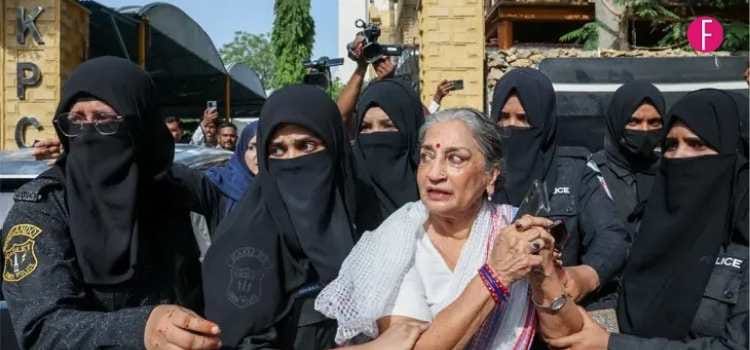
Videos of women activists being dragged away by police outside the Karachi Press Club flooded social media, triggering outrage from activists, journalists, politicians and celebrities alike. Within 24 hours, the Sindh government suspended three police officers, while public debate over women’s right to protest once again returned to the centre of Pakistan’s political discourse.
The confrontation unfolded on May 5, when organisers of Aurat March Karachi arrived at the press club to address the media about difficulties in obtaining a No Objection Certificate (NOC) for their planned march at Seaview on Mother’s Day weekend. According to organisers, several activists — including veteran activist and classical dancer Sheema Kermani, transgender rights activist Shehzadi Rai and other members of the Aurat March team — were stopped, manhandled and briefly detained by police before they could even enter the venue. Videos circulating online showed plainclothes and veiled police personnel forcibly removing activists and pushing them into police vehicles.
For many Pakistanis, the most shocking images were those involving Sheema Kermani. At 75, Kermani is not only one of Pakistan’s most recognizable feminist voices but also a towering figure in the country’s cultural history. A classical Bharatanatyam dancer, theatre practitioner and founder of Tehrik-e-Niswan, she continued performing and advocating for women’s rights during the restrictive years of General Zia-ul-Haq’s regime, when dance itself was treated with suspicion by the state. Over decades, she became synonymous with progressive art, feminist resistance and public cultural expression in Pakistan. Seeing her forcibly removed by police outside the press club struck a nerve far beyond activist circles.
Organisers later alleged that police used abusive language and rough treatment during the detentions. Activists said the gathering was meant to be a peaceful press briefing, not a public rally, and argued that there was no legal basis for the crackdown. Several detainees were reportedly taken to Artillery Maidan police station before being released later the same day following intervention from senior officials and mounting public pressure online.
The backlash was immediate. Human rights groups condemned the incident as part of an increasingly worrying pattern of shrinking civic space in Pakistan. Social media platforms filled with criticism of the police action, with many users questioning why peaceful assembly continues to face resistance whenever Aurat March organisers attempt to mobilise publicly. Others pointed out the symbolism of women activists being detained simply for trying to speak at a press conference inside one of the country’s most prominent journalistic institutions.
Celebrities and public figures also joined the criticism. Actor and model Erica Robin publicly voiced support for Aurat March shortly before the controversy erupted, arguing that silence had “not really gotten us anywhere” and encouraging women to continue showing up despite backlash. Following the arrests, several celebrities, activists and online commentators described the detentions as “shameful” and accused authorities of intimidating women exercising their constitutional rights. Television personalities, actors and digital creators amplified footage of the arrests, with many arguing that the treatment of elderly activists like Sheema Kermani reflected a broader intolerance toward dissenting voices. The outrage spread rapidly across X and Instagram, where hashtags linked to Aurat March and civil liberties began trending.
The growing criticism eventually forced an official response. On May 6, Sindh police announced the suspension of three officers allegedly involved in the mistreatment of Aurat March activists. The suspended officials included Saddar DSP Nasir Afridi, Women SHO Hina Mughal and Artillery Maidan SHO Nadeem. According to official statements, the action was taken after allegations of violence and misconduct during the detentions. Sindh Home Minister Ziaul Hasan Lanjar said action had been ordered against officers involved in the incident.
Yet the controversy surrounding Aurat March 2026 is larger than a single arrest or suspension. For supporters, the incident reinforced exactly why the movement remains necessary: women and marginalised groups in Pakistan still struggle for access to public spaces, freedom of assembly and bodily autonomy without intimidation. For critics of the march, however, the event once again reopened debates around feminism, public morality and the political messaging associated with Aurat March. As in previous years, the movement has become both a protest platform and a cultural battleground over what kind of society Pakistan wants to be.
Despite the crackdown, Aurat March organisers vowed to continue. In many ways, that determination has become the defining story of Aurat March itself. Since it first emerged in 2018, the movement has evolved from a relatively small feminist gathering into one of Pakistan’s most visible — and controversial — civil rights platforms. Every year, it generates fierce opposition, intense online debate and accusations, yet every year it also draws thousands demanding protection from violence, economic justice, labour rights and equal access to public life.
In the days since the crackdown, Aurat March 2026 has come to represent more than a dispute over permits or policing. For supporters, the arrests exposed how quickly women’s voices can still be treated as disruptive when they demand space in public and political life. For others, the swift suspensions and public backlash showed how dramatically the conversation around women’s rights in Pakistan has evolved — where incidents that may once have passed quietly now trigger nationwide outrage and scrutiny.
This is a developing story.
Sources: DAWN News, The Express Tribune, and Reuters Connect.


Comments 2