

Gaza has become the deadliest place on earth for journalists. The Committee to Protect Journalists (CPJ) reports that with Monday’s five deaths, the toll has climbed to at least 247 media workers killed since the war began on October 7, 2023. Every one of those killed has been Palestinian, as Israel continues to block foreign correspondents from entering Gaza. Among those who lost their lives on Monday were Hussam al-Masri, a Reuters photojournalist; Moaz Abu Taha, who worked with NBC; Mariam Abu Dagga, a reporter for The Independent Arabia and the Associated Press; and Ahmad Abu Aziz of Middle East Eye. Mohammad Salama, a cameraman with Al Jazeera, was also killed in the strike.
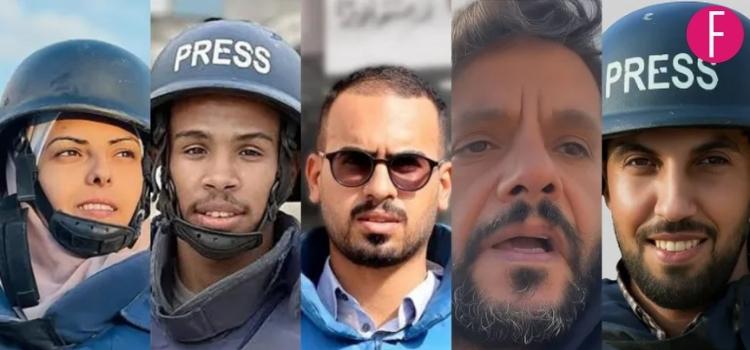
Gaza’s Journalist Toll Surpasses Every Major War in Modern History
According to the Committee to Protect Journalists (CPJ), this is the highest journalist death toll of any U.S.-involved war since the Civil War—and, in fact, it surpasses the combined toll of journalist casualties in the U.S. Civil War, World War I, World War II, the Korean War, the Vietnam War (including U.S. assaults on Cambodia and Laos), the Yugoslav Wars, the War in Afghanistan, and even the ongoing Ukraine War. To put this in perspective, the deadliest year on record for journalists worldwide was 2013, when 142 were killed during conflicts such as the war in Syria. Yet Gaza’s toll in less than two years has already exceeded that figure, underscoring just how unprecedented and devastating the current assault has been for the press.
Are There Any Laws That Protect Journalists in War Zones?
International law recognizes journalists as civilians and grants them explicit protection during armed conflicts. Under the Geneva Conventions and Additional Protocol I (Article 79), journalists reporting in war zones must not be targeted and are entitled to the same safeguards as any civilian, unless they take direct part in hostilities. The Rome Statute of the International Criminal Court further categorizes deliberate attacks on journalists as potential war crimes. The UN Security Council’s Resolution 2222 (2015) reinforces these protections, urging all parties in conflict to ensure journalists’ safety and end impunity for crimes committed against them. In addition, Article 19 of both the Universal Declaration of Human Rights and the International Covenant on Civil and Political Rights guarantees the right to seek and share information—making press freedom a fundamental human right. Taken together, these laws and resolutions establish that targeting journalists is not just a moral outrage but a clear violation of international humanitarian and human rights law.
Foreign Media Still Locked Out of Gaza
With foreign reporters barred from entering Gaza, the world has relied almost entirely on local Palestinian journalists to document the war. Despite repeated appeals from international media outlets and press freedom groups, Israel has kept its restrictions in place. A petition from the Foreign Press Association is still pending before Israel’s Supreme Court, which has yet to decide whether foreign journalists should be granted independent access. For now, the only outsiders allowed in are those brought on tightly managed military tours, where movement is restricted and coverage is heavily controlled.
Israel’s Record of Silencing Journalists
Since 2001, the Committee to Protect Journalists (CPJ) has recorded at least 20 journalists killed by the Israel Defense Forces (IDF). Of these, 18 were Palestinian and two were European foreign correspondents—not a single Israeli journalist is among the dead. According to CPJ’s database, the Israeli army is responsible for 80% of journalist and media worker killings in the occupied Palestinian territories, while the remaining 20% (five cases) were attributed to other causes. Yet in all these years, no one has ever been charged or held accountable. Instead, Israel has consistently evaded responsibility, often dismissing these killings by claiming the journalists were linked to Hamas, despite a lack of credible evidence.
Smearing Journalists as Militants
An investigation by +972 Magazine and Local Call has revealed that Israel established a special military unit, known as the “legitimisation cell,” after the October 7, 2023 Hamas attack. The unit’s task was to brand Palestinian reporters as undercover Hamas operatives—both to justify targeting them and to minimize global backlash over journalist killings. According to intelligence sources cited in the report, the group aimed to gather material that would strengthen Israel’s image abroad and maintain political and military support from key allies. In at least one instance, the unit deliberately misrepresented information to falsely label a journalist as a militant—a label that in Gaza effectively amounts to a death warrant. Though that particular journalist escaped being attacked after the claim was reversed, others were not as fortunate. Israel later killed Al Jazeera journalist Anas al-Sharif and three of his colleagues in their makeshift newsroom, insisting Sharif was a Hamas commander. Their deaths underscored both the deadly risks Palestinian reporters face and Israel’s attempts to manipulate how the war is covered.
When a journalist is killed, the loss ripples far beyond their family or community—it is a loss for the world. Every reporter silenced in Gaza takes with them stories that will never be told, truths that will never be recorded, injustices that will never be exposed. This is why the killings cannot be dismissed as collateral damage; they are deliberate strikes against memory, against accountability, against the very act of witnessing. Gaza today is not only a graveyard for its people—it is fast becoming a graveyard for press freedom itself. Each attack on a journalist chips away at the fragile notion that truth still matters in times of war. And the world’s silence in the face of this carnage speaks volumes. For all the lofty declarations about the sanctity of press freedom, what remains is hypocrisy, a global order that values truth only when it is convenient. If we cannot protect those who risk everything to tell the story, then who will tell the story of what was lost? If we bury our witnesses alongside the victims, history itself will be written by those who killed them.
Sources: The Guardian, CPJ, Irish Times, DW News


Comments 5